AC Unit Making Loud Buzzing Noise? Causes, Risks, and 2026 Repair Guide

Article by
Jon Bonnett
Australian Air Conditioning Specialist with extensive hands-on experience in AC servicing, deep cleaning, maintenance, and troubleshooting. Focused on high-quality workmanship, reliability, and professional service to UAE standards.
A buzzing air conditioner is rarely just a minor mechanical quirk; it’s often a high-stakes electrical distress signal that demands your immediate attention. If you’re currently dealing with an ac unit making loud buzzing noise, the sound you hear could be the precursor to a melted compressor or a dangerous electrical arc. In the intense UAE climate, where systems run at peak capacity, ignoring this warning can transform a simple component fix into a total system failure costing thousands of AED.
We understand the anxiety that comes with sudden equipment sounds, especially when your home’s comfort and safety are on the line. You’re likely wondering if you should shut the power off immediately or if the system is still safe to run. This 2026 repair guide reveals exactly why your unit is buzzing and provides the precise steps you must take to prevent expensive damage. We will walk you through identifying faulty contactors, diagnosing failing motors, and navigating the latest regional maintenance standards to get your cooling back on track quickly and safely.
Key Takeaways
- Identify why an ac unit making loud buzzing noise is often an electrical emergency and learn when to immediately isolate power to prevent catastrophic component failure.
- Understand the critical role of contactor relays and capacitors in your system’s start-up cycle and how their degradation creates specific auditory warning signs.
- Distinguish between mechanical vibrations caused by loose hardware and internal motor friction within the condenser fan or blower assembly.
- Learn how to isolate the source of the sound between your indoor and outdoor units to facilitate a faster, more precise professional repair.
- Discover the long-term benefits of deep cleaning and sanitisation in reducing mechanical strain and maintaining quiet, high-performance cooling in the UAE.
Why Your AC Unit is Buzzing: Immediate Steps and Safety Protocols
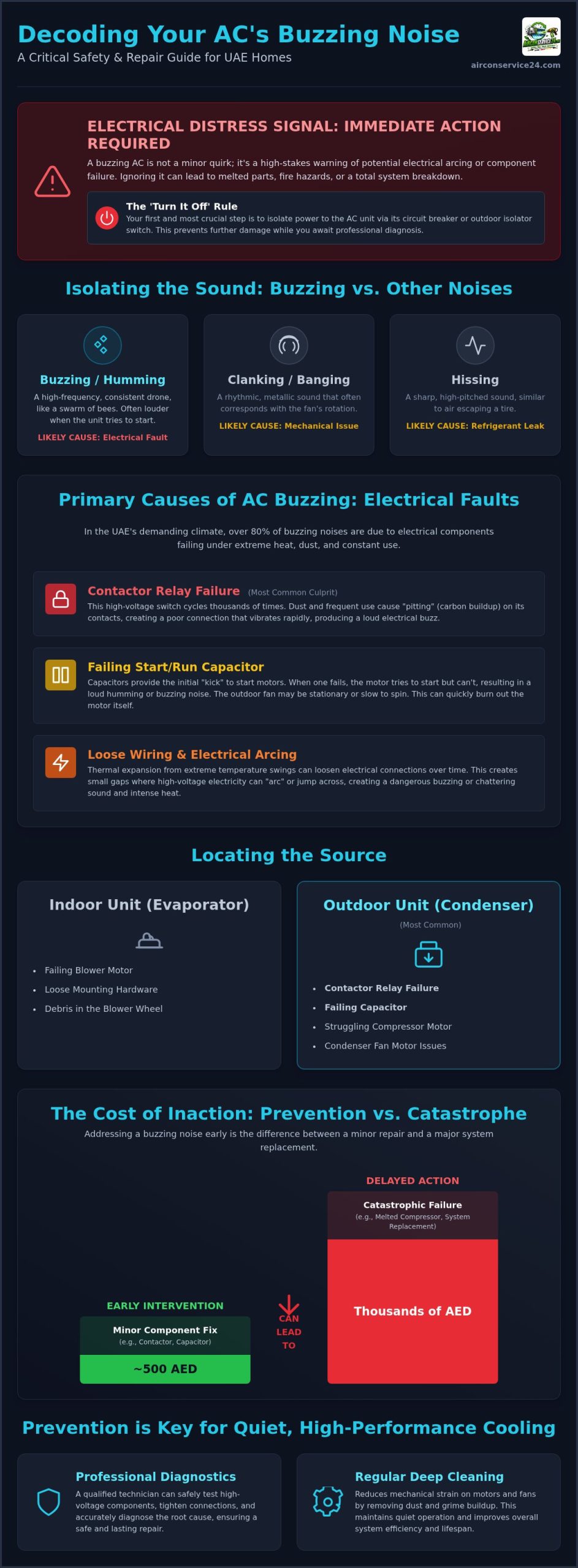
An ac unit making loud buzzing noise is typically the audible signature of electrical arcing or excessive motor vibration. Arcing is a dangerous discharge between circuits that can melt internal components in seconds. While it’s tempting to ignore a sound if the air is still blowing cold, doing so is a high-stakes gamble with your system’s total lifespan. In the UAE’s intense summer heat, components are already under extreme thermal stress. A small buzzing sound can quickly escalate into a catastrophic failure of the compressor or control board without warning.
The ‘Turn It Off’ Rule: Protecting Your Investment
The moment you hear a persistent buzz, your first priority is to isolate the power. Electrical arcing isn’t just a noise; it creates intense heat that leads to fire hazards or permanently melted circuitry. By shutting down the unit immediately, you often prevent a minor 500-dirham component fix from turning into a total system replacement costing thousands. Locate your outdoor isolator switch or the dedicated circuit breaker in your home’s electrical panel. Flipping this switch is the most effective way to safeguard your Heating, ventilation, and air conditioning (HVAC) system from further damage while you wait for a specialist.
Identifying the Sound: Buzzing vs. Hissing vs. Clanking
Not all noises indicate the same fault. An electrical buzz is usually a high-frequency, consistent drone that sounds like a swarm of bees. This is distinct from the rhythmic, metallic clanking of a loose fan blade or the sharp hissing of a refrigerant leak. A constant hum often points to a struggling motor or a failing capacitor. If you notice an ac unit making loud buzzing noise specifically when it tries to start, you are likely dealing with a seized component or an electrical bottleneck. Electrical arcing is defined as a discharge of electricity that jumps across a gap between two electrodes or circuits. This phenomenon generates enough heat to compromise the integrity of your cooling equipment, making professional diagnostics essential to maintain domestic harmony and safety.
Electrical Faults: The Primary Causes of AC Buzzing Noises
While mechanical issues are common, the vast majority of cases involving an ac unit making loud buzzing noise stem from electrical malfunctions. In the UAE, our systems face unique challenges. Fine sand and dust infiltrate the outdoor cabinetry, coating sensitive components and increasing electrical resistance. When combined with ambient temperatures that often exceed 45 degrees Celsius, these electrical parts reach their breaking point much faster than in milder climates. Ignoring these sounds is risky because electrical faults generate localized heat that can lead to melted insulation or dangerous short circuits.
Contactor Relay Failure: The Most Common Culprit
The contactor relay acts as the gatekeeper for your system’s power. It receives a low-voltage signal from your thermostat and physically closes a set of contacts to send high-voltage electricity to the compressor. Because of the high-stakes cooling demands in the region, these switches cycle hundreds of times a day. This frequent movement, especially in dusty conditions, causes “pitting” or carbon buildup on the metal surfaces. The resulting poor connection causes the relay to vibrate at a high frequency, creating that unmistakable electrical buzz that signals a component under extreme stress.
Capacitor and Wiring Issues
Capacitors are essentially temporary energy storage devices that provide the massive torque needed to start the compressor and fan motors. A failing capacitor is often the reason you hear a loud, persistent hum while the outdoor fan remains stationary. The motor is trying to pull current but lacks the necessary “kick” to rotate. If left in this state, the motor windings will overheat and eventually burn out, turning a simple part replacement into a major mechanical overhaul that could cost thousands of dirhams.
Thermal expansion is another silent enemy of your system’s wiring. The dramatic temperature swings between the intense midday sun and night-time cooling cause copper wires to expand and contract. Over months of operation, this cycle naturally loosens terminal screws and connections. A loose wire creates a small gap where electricity can arc, producing a chattering sound that can travel through your walls. It’s vital to inspect these internal connections regularly to prevent arcing. If your system is showing these signs, scheduling a professional AC repair is the most methodical way to restore peace and safety to your home.
Mechanical Vibration: When the Noise is Physical Wear
While electrical issues are the most frequent culprits, physical wear and tear within the mechanical assembly also manifest as a persistent drone. Unlike the sharp, staccato crackle of electrical arcing, mechanical buzzing often sounds deeper and more resonant. It typically signifies that a moving part has lost its factory precision. In the UAE, the constant battle against airborne sand means your system’s mechanical components are under a literal abrasive assault every minute they operate. This environment accelerates the degradation of moving parts, turning a once-silent unit into a source of domestic disruption.
Fan Motor and Bearing Wear
The condenser fan motor is the workhorse of the outdoor unit. It must spin at high speeds to dissipate heat effectively. Over time, the lubricant inside the motor bearings can dry out or become contaminated by fine desert dust, which increases internal friction significantly. What begins as a light hum eventually transforms into an ac unit making loud buzzing noise as the motor struggles against its own resistance. If the bearings seize completely, the motor will pull excessive current, potentially leading to the electrical failures discussed in the previous section. An unbalanced fan blade, often caused by a buildup of grime or physical damage from debris, creates structural vibrations that resonate through the entire chassis.
Loose Parts and Housing Vibrations
Sometimes the buzz isn’t coming from a failing motor, but from the cabinet itself. This is known as a sympathetic vibration. Air conditioners contain hundreds of individual parts, including coil fins, mounting feet, and access panels. If a single screw loosens due to the natural movement of the compressor, the metal-on-metal contact creates an amplified buzzing sound. A loose panel can turn a quiet system into an ac unit making loud buzzing noise that can be heard from several rooms away. Refrigerant lines can also vibrate against the housing, a phenomenon sometimes exacerbated by “slugging,” which occurs when liquid refrigerant enters the compressor instead of gas.
Regular maintenance and deep cleaning are the most effective ways to prevent these mechanical issues. Professional cleaning removes the abrasive sand that destroys bearings and ensures all housing fasteners are torqued to specification. This proactive approach keeps your system balanced and prevents minor vibrations from escalating into expensive mechanical repairs that could compromise your home’s comfort during peak summer months.
Locating the Buzz: Indoor Evaporator vs. Outdoor Condenser
Pinpointing the exact source of the sound is the first step toward a methodical resolution. You must determine if the disturbance originates from the indoor air handler or the outdoor condenser unit. Each component houses different mechanical and electrical assemblies that produce distinct auditory signatures. Identifying the location helps our technicians arrive with the correct diagnostic tools, ensuring a faster return to domestic harmony. Whether your system is a split unit or a centralized package, the location of the sound dictates the level of urgency required to protect your equipment.
Outdoor Unit Noises: High-Voltage Components
The outdoor unit is the heart of the heat exchange process and contains the most power-intensive parts. If your outdoor ac unit making loud buzzing noise is vibrating the balcony or roof slab, the compressor might be experiencing a “locked rotor.” This happens when the internal mechanics seize, but the electrical motor continues to draw current, creating a deep, resonant groan. You can distinguish this from a fan motor buzz by observing the blades. If the blades are spinning but the buzz persists, the compressor is likely failing. Always maintain a safe distance when inspecting the exterior; never attempt to open the high-voltage service panel yourself, as the capacitors hold a lethal charge even after the power is cut.
Indoor Unit Noises: Blower and Control Board
Indoors, the buzzing is usually higher in pitch and often related to air distribution. The blower motor is the primary moving part here. In the UAE, fine dust can bypass filters and coat the blower wheel, causing an imbalance that sounds like a constant vibration. Another common cause is a failing transformer on the control board. These components convert high-voltage electricity into the low-voltage needed for your thermostat. When they begin to fail, they emit a steady, high-frequency hum. For homeowners looking to prevent these indoor disruptions, we recommend exploring these reliable cooling solutions for comprehensive preventive care.
The timing of the noise also provides vital clues. Intermittent buzzing that occurs only during start-up points toward a struggling capacitor or a sticking relay. If the sound is constant, it suggests a continuous electrical flow issue or a transformer that’s nearing its end of life. Regardless of the frequency, a persistent buzz is a signal that your system is working harder than it should. If your cooling performance is dropping while the noise increases, it’s time to book a professional AC Repair to diagnose the fault before it leads to a total shutdown.
Professional Diagnostics and Prevention: Restoring Quiet Performance
Resolving an ac unit making loud buzzing noise requires more than a cursory glance; it demands a structured diagnostic process. Precision is paramount. Our technicians don’t just guess which part is failing. They follow a disciplined workflow to isolate the root cause, whether it’s a microscopic electrical arc or a mounting foot that has vibrated loose over time. By utilizing advanced multimeters and thermal imaging, we can see exactly where heat is building up before a component actually melts. This methodical approach ensures that your domestic harmony is restored with minimal disruption and maximum transparency.
What to Expect During a Professional Repair Visit
When a specialist arrives, the diagnostic begins with a comprehensive visual inspection of all high-voltage contact points. We look for the “pitting” mentioned in earlier sections, checking every capacitor for signs of bulging or leakage. Technicians then test the motor amperage. If a motor is pulling current above its factory specifications, it’s a clear indicator of internal friction or a failing winding. We also verify the integrity of all housing hardware. Tightening every screw to the correct torque specification eliminates the sympathetic vibrations that often amplify a small mechanical hum into a disruptive roar. This level of thoroughness prevents the “quick fix” that leads to another breakdown two weeks later.
Long-Term Prevention: Deep Cleaning and Maintenance
The UAE environment is unforgiving to mechanical systems. Airborne sand acts as an abrasive, grinding down bearings and coating electrical terminals with a layer of resistive grime. Implementing a AC deep cleaning regimen is the most effective way to protect your sensitive electrical parts from this environmental assault. Clean coils allow for better heat exchange, which reduces the load on your compressor and fan motors. This directly lowers the vibration levels and prevents the heat buildup that causes electrical arcing.
A professional maintenance visit offers secondary benefits that enhance your well-being. While we silence the ac unit making loud buzzing noise, we also perform sanitisation and odour removal. These steps eliminate the bacteria and mould that thrive in damp evaporator coils, ensuring your air is as healthy as it is quiet. Establishing a 2026 preventive maintenance plan transforms you from a reactive homeowner into a proactive guardian of your home’s comfort. Don’t wait for a total system failure to occur. Trust our emergency AC repair experts to silence the buzz and restore high-performance cooling to your home today.
Secure Your Home’s Comfort and System Longevity
An ac unit making loud buzzing noise is a definitive signal that your cooling system is operating under extreme duress. As we have explored, whether the cause is a pitted contactor relay or an unbalanced fan motor struggling against desert dust, ignoring these auditory warnings often leads to catastrophic component failure. Precision is our standard. By isolating the power immediately and opting for professional diagnostics, you protect your domestic harmony and avoid the high costs of total system replacement. Methodical troubleshooting remains the only way to ensure your unit remains a reliable guardian against the UAE heat.
Our expert technicians at AirConService24.com remain available around the clock to provide the precise, high-quality care your home deserves. We specialize in deep cleaning and sanitisation to eliminate the root causes of mechanical strain while ensuring your indoor air remains healthy and fresh. If you need immediate assistance, Contact AirConService24.com for 24/7 Emergency AC Repair. We are committed to restoring your peace of mind through transparency and technical expertise. Silence the buzz today and enjoy the predictable performance of a professionally maintained system.
Frequently Asked Questions
Is it safe to run my AC if it is making a loud buzzing noise?
Running an ac unit making loud buzzing noise is generally unsafe and can lead to permanent component damage. The sound often indicates electrical arcing or a seized motor that is pulling excessive current. Continuing to operate the system increases the risk of an electrical fire or a total compressor meltdown. You should isolate the power at the circuit breaker immediately to protect your home and your investment.
What does an AC contactor sound like when it is failing?
A failing contactor typically produces a rapid chattering or a loud, high-frequency hum. This occurs when the silver coating on the internal points wears down or becomes pitted with carbon deposits. In the UAE’s dusty climate, this buildup is common and prevents the relay from making a clean connection. The vibration you hear is the switch struggling to stay closed under electrical load.
Why does my AC buzz for a few seconds and then stop?
This intermittent sound usually points to a struggle during the start-up cycle. It is often caused by a failing capacitor that cannot provide the necessary torque to kick-start the compressor or fan motor. If the noise stops because the unit has successfully started, the component is likely in the early stages of failure. If the unit fails to start, the buzz is the sound of the motor windings overheating.
Can a dirty AC filter cause the unit to make a buzzing sound?
Yes, a severely clogged filter can lead to a buzzing sound by putting extreme strain on the indoor blower motor. When airflow is restricted, the motor must work harder to pull air through the system, which can lead to overheating and electrical humming. Additionally, the pressure imbalance can cause internal cabinet panels to vibrate, creating a sympathetic buzz that resonates through the unit housing.
How much does it typically cost to fix a buzzing air conditioner in the UAE?
The cost of repair depends entirely on the specific faulty component identified during the diagnostic. Minor repairs involving a contactor relay or a start capacitor are relatively affordable compared to major mechanical failures. Replacing a seized compressor or a main control board represents a much larger investment. We recommend a professional assessment to determine the exact scope of work required for your specific system type.
Why is my indoor AC unit buzzing even when the cooling is off?
If the noise persists while the system is idle, the culprit is likely the low-voltage transformer or the control board. These components remain powered to communicate with your thermostat even when the compressor isn’t running. A constant hum suggests that the transformer’s internal laminations have loosened or that the board is experiencing an electrical leak. This requires professional attention to prevent a total loss of system communication.
Can I fix a buzzing AC unit myself or should I call a professional?
You should always call a professional to handle an ac unit making loud buzzing noise. Air conditioning systems contain high-voltage capacitors that can hold a lethal charge even after the power is disconnected. Identifying the difference between a mechanical vibration and an electrical arc requires specialized diagnostic tools like multimeters and thermal cameras. Professional intervention ensures the repair is handled safely and effectively according to UAE technical standards.