Central AC Not Cooling Upstairs? Expert Causes and Solutions for UAE Homes

Article by
Jon Bonnett
Australian Air Conditioning Specialist with extensive hands-on experience in AC servicing, deep cleaning, maintenance, and troubleshooting. Focused on high-quality workmanship, reliability, and professional service to UAE standards.
Why does your UAE villa feel like a cool sanctuary on the ground floor but a stifling sauna the moment you reach the landing? You’ve likely cranked the thermostat down to 18 degrees, yet the primary bedroom remains unbearable while your living room turns into an ice box. This frustrating imbalance is more than a minor annoyance. It’s a direct threat to your sleep quality and a primary cause of skyrocketing energy bills. If you’re struggling with your central ac not cooling upstairs, you aren’t just fighting the heat; you’re battling an airflow distribution crisis that demands a methodical response.
We understand the urgency of restoring comfort to your home before the 45 degree summer peak arrives. You don’t need to accept hot bedrooms or the circulating dust that often accompanies a struggling system. This guide provides the professional clarity you need to diagnose the root causes of uneven cooling. We’ll explore how pressure imbalances, duct hygiene, and thermostat placement impact your environment. By following these expert steps, you can achieve a balanced temperature across all floors, lower your energy consumption, and ensure your system operates with the precision of a disciplined guardian.
Key Takeaways
- Understand the “Attic Effect” and how UAE solar radiation penetrates roof structures to create a heat trap in your upper-floor ceiling plenum.
- Identify if your central ac not cooling upstairs is caused by physical airflow obstructions or misaligned manual dampers that prevent cold air from reaching higher elevations.
- Learn why professional deep cleaning is often more effective than mechanical repairs for units choked by the fine sand and dust ingress typical of the Emirates.
- Discover immediate cooling improvements by switching your thermostat fan to the “On” position to maintain constant air circulation and pressure balancing.
- Recognize when to transition from basic troubleshooting to advanced professional solutions like multi-zone HVAC systems for permanent temperature harmony.
Why Your Upstairs Rooms Stay Hot While Downstairs Is Cool
Heat naturally migrates upward. In a multi-story home, the second floor becomes a reservoir for rising warmth while the denser, chilled air pools on the ground floor. If your central ac not cooling upstairs, you’re likely experiencing this thermal stratification in its most extreme form. The staircase acts as a highway for thermal energy, allowing heat to climb while cold air escapes through gaps in lower-floor doors or windows. This isn’t just a mechanical quirk; it’s a structural challenge that demands a methodical solution.
The “Attic Effect” further complicates this. In the UAE, the sun beats down on villa roofs with relentless intensity. When temperatures exceed 45 degrees Celsius, the ceiling plenum, which is the space between your roof and the upstairs ceiling, becomes an oven. This radiant heat penetrates the insulation and warms the air inside your ducts before it even reaches the vents. Often, your system is fighting an uphill battle against heat that is literally pouring in from above.
It’s also vital to distinguish between a mechanical failure and a distribution crisis. Your AC equipment might be in perfect health, yet still fail to cool the upper floor if it lacks the static pressure to push air through long, vertical duct runs. It’s the difference between a powerful engine and a clogged fuel line. Without a disciplined guardian ensuring every duct is clear and every damper is set correctly, the cooling effort is wasted on the ground floor while bedrooms remain neglected.
The Impact of the UAE Climate on Second-Floor Cooling
Ambient temperatures frequently crossing the 45 degree mark force your system to operate at 100% capacity for extended periods. In these conditions, even a minor drop in efficiency becomes a major comfort crisis. High humidity levels add to the burden, making upstairs bedrooms feel “heavy” and damp. Proper roof insulation is your first line of defense against this thermal siege, yet many properties lack the thermal barrier required to block the 2026 peak summer intensity.
Identifying the “Stack Effect” in Your Home
The stack effect occurs when warm air escapes through the upper levels of a building, creating a vacuum that pulls hot, humid air in through lower-level leaks. This pressure imbalance is often exacerbated by open stairwells. You can identify this in your home by checking for these signs:
- Tissue Paper Test: Hold a tissue near your upstairs supply vents. If it barely flutters while downstairs vents are blasting, you have a distribution failure.
- Temperature Gaps: A difference of more than 4 degrees between floors indicates your central ac not cooling upstairs is a systemic airflow issue.
- Air Leaks: Feeling a draft near ground-floor doors suggests cool air is escaping, which forces hot air to settle upstairs.
Troubleshooting Airflow Blockages and Ductwork Issues
If your central ac not cooling upstairs, the problem often lies within the delivery system rather than the cooling unit itself. Cold air is naturally heavy; it requires significant static pressure and an unobstructed path to climb to the second floor. Start by performing a physical audit of every supply vent and return grille in your home. It’s common to find that furniture, heavy curtains, or decorative rugs have been placed over vents, inadvertently choking the system’s circulation. Ensure every vent is fully open and clear. While it’s tempting to close vents in unused downstairs rooms, this often backfires by disrupting the system’s balanced pressure, which can lead to frozen evaporator coils.
System performance relies heavily on matching equipment specifications to the specific volume and layout of your villa. An undersized blower motor lacks the mechanical torque required to push air through the long, vertical duct runs found in larger UAE properties. If your system was installed without a precise load calculation, it might simply lack the physical capacity to overcome the resistance of your home’s duct architecture. This is a fundamental engineering hurdle that no amount of thermostat adjustment can solve.
Locating and Adjusting Your HVAC Dampers
Many UAE villas are equipped with manual dampers located on the main duct trunk, usually found near the indoor air handling unit in the ceiling plenum. These metal levers act as traffic controllers for your airflow. To implement a “Summer Setting,” you can partially close the dampers feeding the ground floor, which forces a higher volume of chilled air toward the upstairs branches. However, you must be precise. Never restrict more than 20% of your total downstairs airflow. Over-restricting the system creates excessive backpressure that can cause the blower motor to overheat or fail prematurely.
Signs of Ductwork Failure
Even a perfectly functioning unit cannot cool a room if the air escapes into the ceiling void before it reaches the vent. Leaky ductwork is a silent drain on your comfort and your wallet. Listen closely for high-pitched whistling or “rushing” sounds behind your walls, as these are tell-tale signs of air escaping through breached seals. In many cases, flexible ducts in the attic space may have become crushed or entirely disconnected during other home maintenance tasks. Identifying these gaps requires a disciplined approach. If manual adjustments don’t restore balance, a professional AC maintenance audit can utilize pressure testing to find hidden leaks and restore the domestic harmony your home deserves.
The Impact of Hygiene: Deep Cleaning vs. Mechanical Failure
Many homeowners assume a mechanical breakdown is the primary culprit when they find their central ac not cooling upstairs. However, in the intense UAE environment, environmental hygiene is often the true bottleneck. Fine desert sand and airborne dust infiltrate the system, creating a physical blanket over critical components. This accumulation forces the blower motor to work harder against increased resistance, often leading to a total loss of cooling upstairs where the heat load is highest. Choosing preventive AC maintenance over reactive emergency repairs ensures these hygiene-related failures don’t compromise your comfort during the 2026 peak summer heat.
A musty, damp odor in upstairs bedrooms is a significant warning sign that shouldn’t be ignored. It indicates that your evaporator coils are so congested they can no longer effectively dehumidify the air. Since upstairs units must process the warmest and most humid air in the villa, they’re the first to show symptoms when hygiene standards slip. This “heavy” air feel is a direct result of poor heat exchange efficiency, which forces your utility bills higher as the system struggles to reach its set point.
Biofilm and Mould: The Silent Airflow Killers
Biofilm, frequently referred to as “sludge,” is a gelatinous mixture of dust, moisture, and organic growth that thrives in the dark, damp environment of your AC unit. This substance clogs the delicate fins of the cooling coils, creating a nearly impenetrable barrier. This leads to “dirty sock syndrome,” where the air smells stale and the volume of air reaching your upstairs vents drops significantly. Deep sanitisation is the only way to strip away this biofilm and restore the original factory airflow your home was designed for.
Evaporator Coils and Heat Exchange Efficiency
Evaporator coils are responsible for absorbing heat from your home’s air. When these coils are coated in a layer of UAE sand, their heat exchange efficiency plummets. The system may enter an “ice-up” cycle, where the coils become so cold they freeze over, completely blocking airflow to the second floor. A professional deep cleaning can remove this insulating layer of grime, frequently dropping the actual room temperature by 3 to 5 degrees without needing any mechanical part replacements. This methodical approach to hygiene acts as a disciplined guardian for your home’s climate, ensuring your central ac not cooling upstairs becomes a problem of the past.
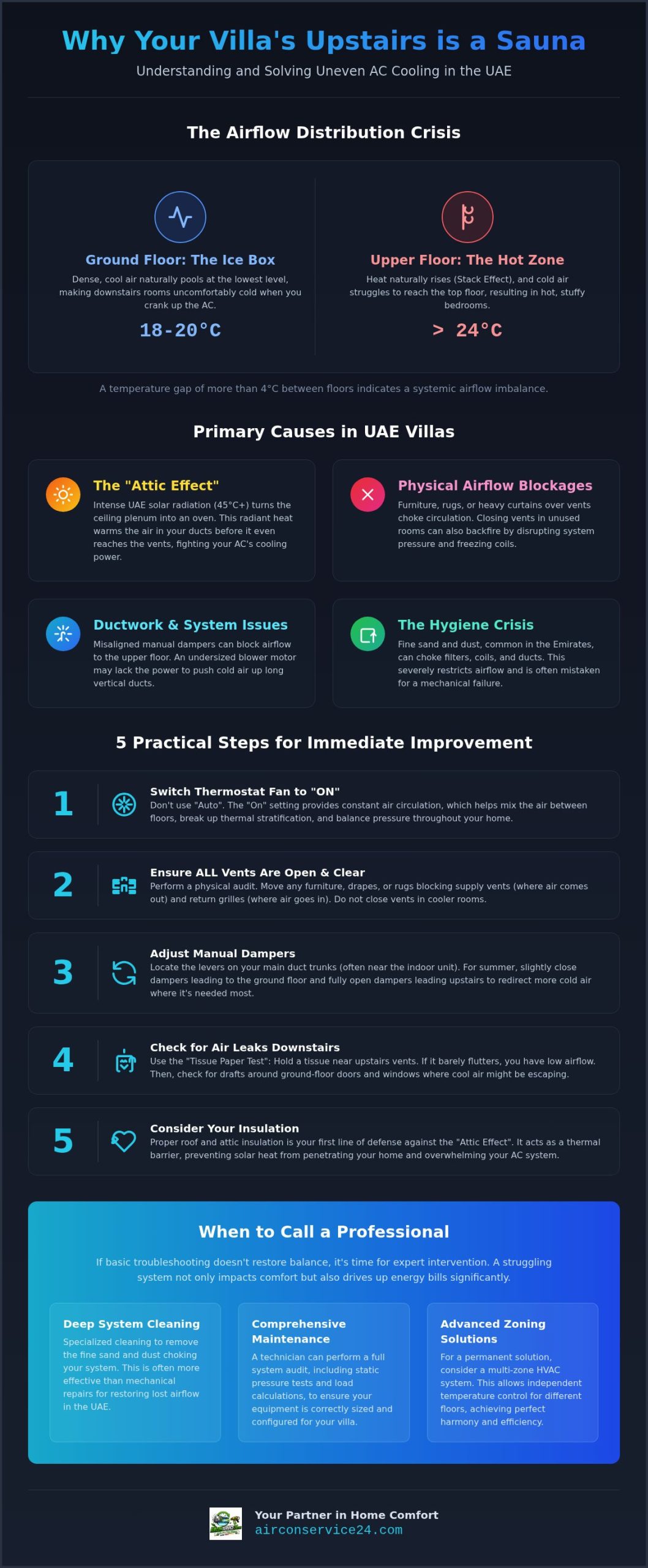
5 Practical Steps to Improve Second-Floor Cooling Efficiency
Restoring balance to your home environment doesn’t always require a complete system overhaul. When your central ac not cooling upstairs, you can often regain control through a series of methodical, proactive adjustments. These steps focus on reducing the thermal load and optimizing the existing airflow to ensure every room meets your standards for comfort. By acting as a disciplined guardian of your home’s climate, you can mitigate the effects of the UAE’s intense solar radiation before it compromises your domestic harmony.
The Thermostat Fan Hack
Most residents keep their AC fan set to “Auto,” which means the blower only runs during a cooling cycle. Switching this to “On” provides constant air circulation, even when the compressor is resting. This continuous movement helps destratify the air, effectively mixing the cold air pooling downstairs with the warmer air trapped upstairs. While this may slightly increase your DEWA bill, the gain in upstairs comfort is often worth the trade-off. However, during periods of extreme humidity, monitor your indoor moisture levels; constant fan operation can sometimes prevent the system from properly draining condensed water, leading to a “clammy” feel.
Managing Solar Heat Gain
The “Bottom-Up” strategy is your most effective defense against the UAE sun. South-facing windows can act like heaters, pouring radiant energy into your upstairs bedrooms. You should utilize black-out thermal curtains or high-quality window films to block this heat before it enters the room. Additionally, inspect the seals on your balcony doors. Even a minor gap allows chilled air to escape and invites 45 degree heat inside, creating a pressure imbalance that leaves your central ac not cooling upstairs effectively. Sealing these leaks is a low-cost, high-impact move for any villa owner.
Maintenance hygiene remains a non-negotiable factor in performance. During the peak summer months, you must clean or replace high-MERV filters every 30 days. The fine UAE dust can choke a new filter in weeks. Restricted airflow is the primary enemy of second-floor cooling. You should also verify that return air grilles aren’t blocked by wardrobes or decorative panels. Your system needs to “inhale” warm air to “exhale” cold air; if the return path is blocked, the circulation loop is broken.
If these practical adjustments don’t lower your upstairs temperature, it’s time for a professional intervention. You can book a comprehensive system audit to identify hidden mechanical bottlenecks and restore your home’s cooling precision.
Professional Solutions: From Zoning to System Maintenance
When localized adjustments and hygiene protocols fail to bridge the temperature gap, the issue likely stems from a mechanical deficiency or an architectural limitation. If your central ac not cooling upstairs despite your best efforts, it’s time to transition from troubleshooting to professional intervention. In the peak of the UAE summer, an overheated second floor isn’t just uncomfortable; it’s a risk to your well-being. Our team provides emergency AC repair to restore cooling precision when DIY methods reach their limits.
Often, the problem is a lack of cooling capacity caused by low refrigerant levels. If your system has a slow leak, it loses the “thermal muscle” required to absorb heat from the upstairs air. The ground floor may stay cool because it’s the first stop in the cooling cycle, but the upstairs is left with lukewarm air. A professional gas refilling service, paired with a comprehensive leak detection test, can restore the system’s original cooling power. This ensures your unit has the technical capacity to handle 45 degree ambient temperatures without straining the compressor.
Upgrading to Smart Zoning Systems
For many multi-story villas, the most effective long-term solution is a multi-zone HVAC system. Traditional single-zone systems rely on one thermostat to make decisions for two different environments. Smart zoning utilizes motorized dampers installed within your ductwork to automatically balance airflow based on real-time demand. If the upstairs sensors detect a rise in temperature, the system redirects chilled air from the ground floor to the bedrooms. While the initial installation requires a professional touch, the ROI is significant. You’ll see lower energy bills because the system only cools the areas that need it, rather than over-cooling the ground floor to satisfy the upstairs thermostat.
The AirConService24.com Response
We approach every cooling imbalance with the mindset of a disciplined guardian. Our technicians perform a methodical 20-point inspection that goes far beyond a simple filter check. We analyze static pressure, measure refrigerant levels, and inspect the integrity of your duct seals to find exactly why your central ac not cooling upstairs. Our response includes advanced sanitisation and odour removal to ensure the air reaching your family is as healthy as it is cool. With 24/7 availability across the UAE, we provide the professional reassurance you need to maintain domestic harmony throughout the hottest months of the year.
Implementing a long-term maintenance plan is the final step in securing your home’s comfort. Regular professional checkups prevent minor pressure imbalances from turning into total system failures. By proactively managing your system’s health, you ensure every floor of your villa remains a sanctuary, regardless of the intensity of the sun outside.
Restore Thermal Harmony to Your Second Floor
You don’t have to tolerate a home divided by temperature extremes. As we’ve explored, the solution to your central ac not cooling upstairs often lies in a blend of environmental management and technical precision. Whether it’s clearing sand-choked coils to improve heat exchange or adjusting manual dampers to redirect airflow, every step you take brings you closer to a more efficient and comfortable living space. Maintaining a disciplined approach to system hygiene is your primary defense against the relentless UAE summer heat.
If your practical adjustments haven’t restored the balance your family needs, it’s time for a professional intervention. Our team provides specialized deep cleaning, sanitisation, and 24/7 emergency response across the UAE to tackle complex multi-story cooling issues. Our expert technicians are equipped to diagnose pressure imbalances and mechanical failures that DIY methods simply can’t reach. Restore balanced cooling to your home-Book your expert AC inspection today. You deserve a home where every room remains a cool sanctuary, even during the peak of August.
Frequently Asked Questions
Is it normal for the upstairs to be hotter than downstairs in the UAE?
It is common for upstairs floors to be 3 to 5 degrees warmer than ground floors in UAE villas due to heat rising and solar radiation hitting the roof. However, a significant temperature gap usually indicates your central ac not cooling upstairs is suffering from a distribution or hygiene issue. While a slight difference is expected, extreme heat suggests your system lacks the static pressure or cleanliness to balance the home.
How do I know if my AC duct is leaking in the ceiling?
You can identify a ceiling duct leak by listening for high-pitched whistling sounds or noticing localized hot spots on your upstairs ceiling. If you see an accumulation of fine desert dust around specific supply vents, it often suggests the duct seal has breached, pulling in unfiltered air from the ceiling plenum. Professional pressure testing is the most accurate way to confirm these hidden gaps and restore airflow efficiency.
Will closing downstairs vents help cool the upstairs faster?
Closing a few downstairs vents can help redirect air upstairs, but you must never close more than 20% of your total vents. Restricting too much airflow creates excessive backpressure that can cause your evaporator coils to freeze or damage the blower motor. A more effective approach is adjusting the manual dampers on the main duct trunk to balance the system without choking the unit’s mechanical components.
How often should I clean my AC filters in a two-story villa?
You should clean or replace your AC filters every 30 days during the peak UAE summer months from May to September. In a two-story villa, the upstairs unit often works harder to combat rising heat, causing filters to clog faster with fine sand and household dust. Regular monthly maintenance prevents airflow restrictions that are a primary cause of your central ac not cooling upstairs effectively.
Can a low refrigerant level cause only the upstairs to stay warm?
Yes, low refrigerant levels often manifest first as a cooling failure on the upper floor. When the system lacks gas, it can’t absorb enough heat to satisfy the entire home’s load, leaving the “end of the line” upstairs vents with lukewarm air. While the ground floor might stay tolerable, the lack of cooling capacity becomes obvious upstairs where the thermal demand is highest due to roof exposure.
What is the best thermostat temperature for a multi-story home?
Setting your thermostat between 22 and 24 degrees Celsius is generally optimal for UAE homes, provided you use the “Fan On” setting. This constant circulation helps mix the air between floors, preventing cold air from pooling downstairs while heat settles upstairs. If you have separate thermostats, try setting the downstairs unit two degrees higher than the upstairs unit to encourage a more balanced and comfortable thermal environment.
Why does my upstairs AC smell musty when it starts cooling?
A musty odor usually indicates the presence of biofilm or organic growth on your upstairs evaporator coils. Because these units handle warmer, more humid air, moisture often accumulates in the drain pan and on the cooling fins, creating a breeding ground for bacteria. Professional deep cleaning and sanitisation are required to remove this sludge, which not only eliminates the smell but also restores restricted airflow for better cooling.
How much does it cost to fix an airflow imbalance professionally?
The investment required to fix a cooling imbalance depends on whether your system needs a deep sanitisation or a more complex mechanical adjustment. While routine checkups are the most cost-effective way to prevent these issues, specific costs vary based on the scale of your villa and the state of your ductwork. We focus on providing a thorough 20-point inspection to identify the exact cause and restore comfort.