Dubai Apartment AC Repair Guide: High-Rise Living

Article by
Jon Bonnett
Australian Air Conditioning Specialist with extensive hands-on experience in AC servicing, deep cleaning, maintenance, and troubleshooting. Focused on high-quality workmanship, reliability, and professional service to UAE standards.
You return to your 30th-floor sanctuary after a long day, only to be met by a wall of stagnant, 45°C heat and a faint, musty odour. In the vertical landscape of the UAE, a cooling failure isn’t just a minor annoyance; it’s an immediate threat to your domestic harmony and well-being. Securing reliable apartment AC repair Dubai residents can trust requires more than just a quick fix. It demands a methodical approach to high-rise infrastructure where complex chillers and confined ductwork create unique environmental challenges.
We understand the anxiety of a rising thermostat and the confusion over whether a repair falls under your responsibility or your landlord’s. This guide provides the professional clarity you need to restore your home’s climate and eliminate health-threatening biofilm. You’ll discover how to troubleshoot common system failures, understand the AED 500 maintenance threshold defined by RERA, and ensure your living space remains a ventilated haven. We’ll examine the technical realities of high-rise cooling and the regulatory frameworks that protect your right to a functional, sanitised home.
Key Takeaways
- Understand how coastal humidity and sand ingress specifically degrade high-rise cooling components and impact efficiency.
- Learn the mechanical differences between Fan Coil Units (FCU) and Split systems to accurately communicate with your technician.
- Identify critical warning signs, such as ceiling leaks and unusual sounds, to prevent catastrophic system failure and water damage.
- Navigate RERA regulations and the “AED 500 rule” to determine whether you or your landlord is responsible for apartment AC repair Dubai costs.
- Discover why professional sanitisation and deep cleaning are essential for removing musty odours and harmful biofilm from confined living spaces.
Common Causes of Apartment AC Failures in Dubai
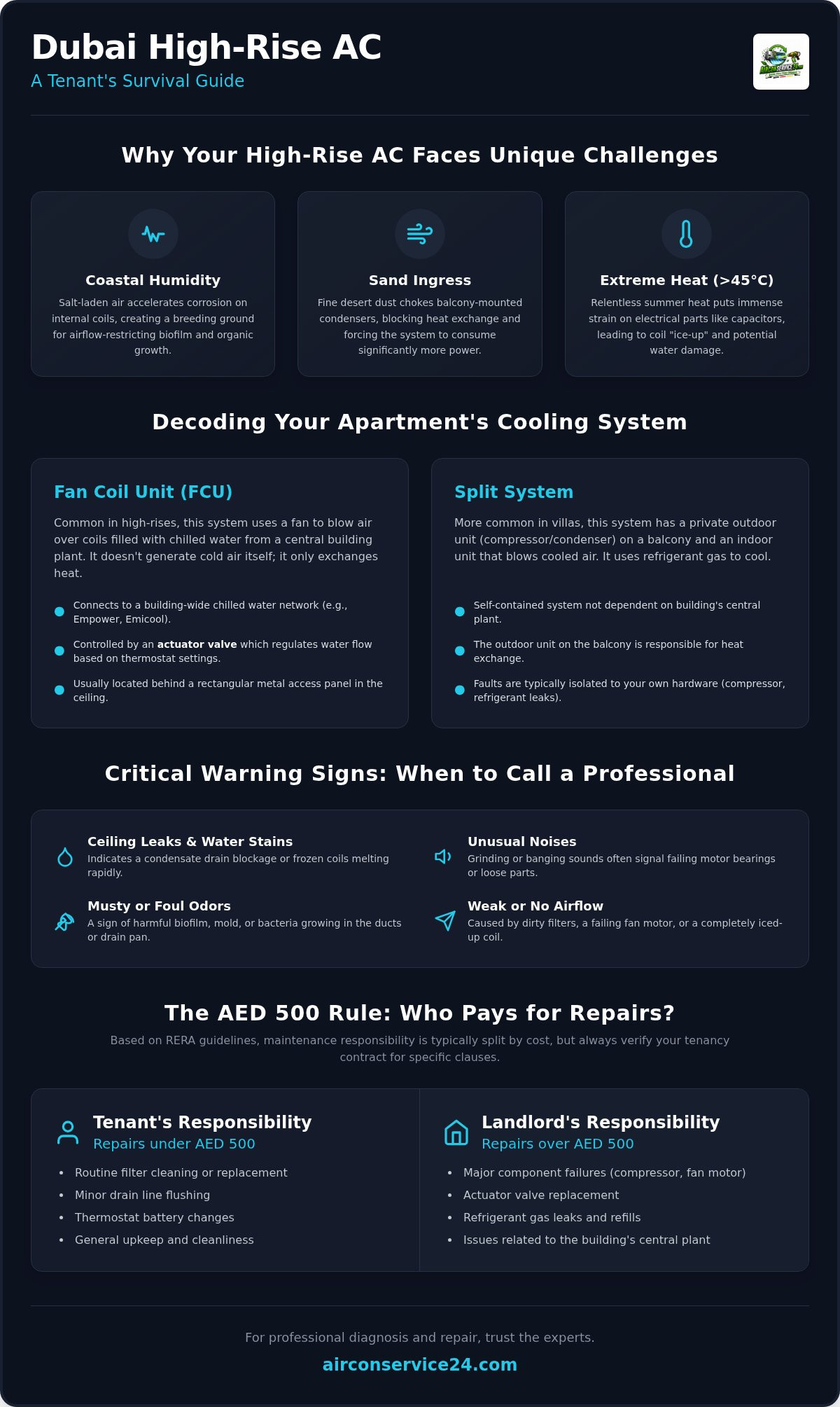
Living in a Dubai high-rise offers stunning views, but it subjects your cooling system to a unique set of environmental stressors. Unlike standalone villas, apartment units operate within a complex, interconnected ecosystem. This means your need for apartment AC repair Dubai services often stems from factors beyond a simple dirty filter. Coastal humidity in districts like Dubai Marina or Jumeirah Beach Residence accelerates the corrosion of internal coils. When salt-laden air meets the moisture on your evaporator, it creates a breeding ground for biofilm and organic growth that restricts airflow.
Sand ingress remains a persistent threat to high-rise living. For units equipped with balcony-mounted condensers, fine desert dust acts as an abrasive blanket. It chokes the heat exchange process and forces the motor to consume significantly more power to achieve the same cooling effect. Many modern towers also utilize integrated smart-home thermostats. While convenient, a software glitch or a communication error between your device and the building’s control board can often be mistaken for a mechanical failure, requiring a precise technical diagnosis rather than a hardware replacement.
The most significant differentiator for apartment dwellers is the “Chilled Water” factor. Most premium towers rely on a central plant to distribute cold water to individual Fan Coil Units (FCUs). If the building’s secondary pumps fluctuate or the chilled water temperature rises due to central plant issues, your unit will blow warm air despite the fan running perfectly. Understanding these basics of Heating, ventilation, and air conditioning (HVAC) is vital for diagnosing whether the fault lies within your private residence or the building’s common infrastructure.
The Impact of Extreme UAE Heat on System Components
During the peak months of July and August, temperatures frequently exceed 45°C. This puts immense strain on electrical components. Capacitors and contactors are prone to failing under the relentless load as they struggle to dissipate heat. If your system is over-pushed while the internal filters are even slightly restricted, it can lead to a total “ice-up” of the coils. This frozen barrier prevents any cooling from reaching your living space and can cause significant water damage once the ice begins to melt rapidly into your ceiling void.
Why Apartment Ventilation Differs from Villas
Apartments are essentially sealed environments that rely on a Fresh Air Handling Unit (FAHU) to maintain positive pressure and air quality. If this building-wide system is poorly maintained, you’ll notice stagnant air and lingering odours that you can’t eliminate through standard cleaning. High-rises also use shared drainage stacks. A blockage three floors below your unit can cause condensate water to back up into your own drain pan. This often results in the dreaded “ceiling leak,” a common emergency that requires immediate intervention to prevent structural damage and mould proliferation.
Decoding Your Apartment’s Cooling System: FCU vs. Split Units
To effectively manage your indoor climate, you must first identify the technology behind your ceiling panels. Most high-rise residences in Dubai Marina, Downtown, and Business Bay don’t use the standard split systems found in villas. Instead, they rely on Fan Coil Units (FCUs) connected to a building-wide chilled water network. Identifying these components is the first step when scheduling apartment AC repair Dubai residents often require during peak summer. While a split system uses a private compressor on your balcony to cool refrigerant, an FCU acts as a heat exchanger. It pulls heat from your room and transfers it to chilled water provided by district cooling giants like Empower or Emicool.
Locating your unit is usually straightforward. Look for a rectangular metal access panel in your hallway or bathroom ceiling. This is the gateway to your system’s vital organs. Inside, you’ll find the cooling coils, the blower fan, and the actuator valve. This valve is the gatekeeper of your comfort; it opens and closes to regulate the flow of chilled water based on your thermostat’s demands. If you’re experiencing inconsistent temperatures, the culprit is often a mechanical failure in this specific component. Understanding the legal framework for these systems, including Dubai’s RERA Law, helps clarify who should manage these complex mechanical repairs.
The Role of the Actuator Valve and Thermostat
The actuator valve is a motorized device that responds to your thermostat’s electrical signals. When it fails, it typically gets stuck in one of two positions. If it’s stuck open, your apartment will feel like a walk-in freezer regardless of the setting. If it’s stuck closed, you’ll receive nothing but lukewarm air. Upgrading to a modern digital thermostat can improve the precision of this communication, ensuring the valve operates only when necessary. This prevents unnecessary wear on the motor and stabilizes your home’s humidity levels.
Understanding Chilled Water Charges and Efficiency
The Fan Coil Unit is the heart of apartment cooling. Its efficiency directly dictates your monthly utility expenses. When dust and biofilm insulate the internal coils, the system must run the fan longer and at higher speeds to reach your desired temperature. This doesn’t just waste electricity; it increases the volume of chilled water passing through your meter. If your bills are spiking without a change in usage, a professional AC maintenance assessment can determine if a deep clean is required to restore thermal conductivity. Keeping these coils pristine ensures you only pay for the cooling you actually feel.
Recognizing Warning Signs: When to Call for Professional Repair
Early detection is the difference between a minor adjustment and a catastrophic system failure. In the high-pressure environment of a Dubai summer, your cooling system rarely fails without warning. Sudden drops in performance or shifts in sensory output are biological and mechanical cries for help. Identifying these red flags early ensures your apartment AC repair Dubai needs are addressed before the indoor temperature reaches dangerous levels. Ignoring a small leak or a faint sound today often leads to an expensive emergency call-out tomorrow.
The infamous “Dubai Smell” is perhaps the most common indicator of a system in distress. If you notice a musty, vinegar-like, or even a rotten egg odour when the fan kicks in, your unit is likely harbouring organic growth. These scents originate from the dark, damp recesses of your Fan Coil Unit where moisture accumulates. Similarly, keep an ear out for unusual acoustics in the ceiling void. Hissing often points to a refrigerant leak or a faulty actuator valve; grinding suggests a failing blower motor; and persistent clicking usually indicates an electrical relay struggling to engage. If your vents feel like they are “gasping” for air, it’s a clear sign of a significant blockage in the intake or a failing motor.
Water dripping from your ceiling panel is an immediate emergency. In a high-rise, this isn’t just a nuisance; it’s a threat to your property and the units below you. Clogged drain lines are the primary culprit, often caused by a buildup of “algae slime” or dust that has turned into a thick paste. When the condensate tray overflows, the water has nowhere to go but through your plasterboard. This moisture doesn’t just damage aesthetics; it weakens the structural integrity of your ceiling and creates a hidden haven for mould.
Biofilm and Mould: The Hidden Dangers
The condensate tray is a perfect breeding ground for bacteria and biofilm. When your AC runs, it strips moisture from the air, which then sits in these trays. In a sealed apartment, these mould spores are continuously recirculated through your living space. This can lead to “Sick Building Syndrome,” causing respiratory issues, headaches, and allergies for residents. Simply cleaning your removable filters isn’t enough to solve this. True sanitisation requires a deep clean of the internal coils and drainage channels to eliminate the biological source of the odour.
Electrical Red Flags in Apartment Units
Electrical issues often manifest as a safety mechanism. If your circuit breaker trips every time the AC starts, the system is drawing too much current, likely due to a short circuit or a seized motor. A burning smell near the control panel or the access hatch is a critical warning of overheating wires. You might also notice intermittent power loss to your thermostat. These are not minor glitches; they are fire hazards that require a professional technician to inspect the wiring and control boards immediately.
Maintenance Responsibilities: Landlords vs. Tenants in Dubai
Determining who pays for your cooling crisis is often as stressful as the heat itself. In the UAE, the division of maintenance duties is primarily governed by Law No. 26 of 2007. Most tenancy agreements in Dubai Marina, Downtown, and Business Bay include a specific cost threshold, commonly referred to as the “500 AED Rule.” Under this standard, any apartment AC repair Dubai costs falling below 500 AED are typically the tenant’s responsibility. This covers minor tasks like filter cleaning, thermostat battery replacements, or basic drain flushing. Conversely, major repairs exceeding this amount, such as compressor failures or PCB board replacements, fall squarely on the landlord’s shoulders.
Tenants are expected to act as the disciplined guardians of their indoor environment. This involves regular filter washing and ensuring that balcony-mounted units are free from dust and debris. If a failure occurs because of gross negligence, such as neglecting filter hygiene for an entire season, the landlord may legally contest the repair costs. Landlords are responsible for ensuring the structural integrity of the HVAC system. This includes the chilled water piping and the fan coil unit’s core components. Coordination with building Facilities Management (FM) is also critical. External repairs often require work permits and security clearance, a process your landlord or their property manager must facilitate to allow technicians access to shared infrastructure.
Documenting AC Issues for Your Landlord
Clarity is the best tool for avoiding disputes. If your system fails, obtain a professional diagnostic report immediately. This document should detail the specific cause of failure, the required parts, and a transparent cost estimate. Use RERA guidelines to justify your request if the repair exceeds the contractual threshold. For an Emergency AC Repair Dubai: Fast, Reliable Cooling Relief 2026, send a formal notice via email or registered messaging. This creates a time-stamped paper trail that proves you’ve notified the landlord of a loss of essential services, which is vital if the case ever reaches the Rent Disputes Settlement Centre.
Annual Maintenance Contracts (AMCs) for Peace of Mind
Reactive maintenance is always more expensive than a proactive strategy. For long-term residents, an Annual Maintenance Contract (AMC) is the most cost-effective solution. A standard contract should include at least two to four scheduled visits per year, covering deep coil cleaning and electrical component checks. This ensures your system operates at peak efficiency, lowering your DEWA or district cooling bills while extending the life of the hardware. If you’re tired of negotiating every small fix, consider a comprehensive AC maintenance plan to ensure year-round comfort without the administrative headache.
Professional Apartment AC Solutions by AirConService24
AirConService24.com operates as a disciplined guardian of your home’s climate, providing a sophisticated response to the unique stresses of high-rise living. Our specialized 24/7 team understands that a cooling failure in 45°C heat is a critical emergency, not a scheduled appointment. We provide the rapid apartment AC repair Dubai residents require to safeguard their health and comfort. Our technicians are equipped with advanced diagnostic tools specifically calibrated for the chilled water systems and Fan Coil Units found in Dubai’s most iconic towers. We remain calm and methodical even in the highest stakes situations, ensuring your cooling is restored with technical precision.
Beyond mechanical restoration, we prioritize environmental hygiene through advanced deep cleaning and sanitisation. Standard services often overlook the biofilm that accumulates in the dark, damp recesses of apartment units. We utilize proprietary odour removal techniques to eliminate the musty scents of organic growth at their source, rather than simply masking them. Every intervention includes a comprehensive, transparent report. This documentation is essential for navigating the RERA guidelines discussed previously, as it provides the technical evidence needed to resolve landlord-tenant maintenance disputes with total clarity and integrity.
Our Precision Repair and Sanitisation Process
Our workflow is methodical and predictable. We begin with a rigorous diagnostic phase to identify electrical or mechanical faults before proceeding to system restoration. We use eco-friendly disinfectants that are specifically formulated to be safe for confined apartment spaces, ensuring no harsh chemical residues remain. AirConService24.com is committed to restoring domestic harmony by ensuring your air is not just cold, but clinically clean and safe for every resident.
Why Dubai Residents Trust PANKOBAU Maintenance
Operating under Dubai trade license 1464852, PANKOBAU Building Maintenance LLC brings elite technical expertise to every call-out. We specialize in complex chilled water and Variable Refrigerant Flow (VRF) systems that demand a higher level of precision than basic window units. Our commitment to speed, hygiene, and technical accuracy has made us a trusted partner for residents in Dubai Marina, Downtown, and beyond. We don’t just fix machines; we optimize your living environment for long-term sustainability and performance. Contact AirConService24.com for Immediate Apartment AC Repair and experience the standard of elite home care.
Secure Your High-Rise Sanctuary and Well-Being
Maintaining a functional home in Dubai’s vertical landscape requires more than just reactive fixes. It demands a proactive understanding of chilled water systems and the specific RERA regulations that govern your tenancy. By recognizing the early warning signs of mechanical strain and addressing musty odours before they impact your health, you ensure your apartment remains a true sanctuary. Don’t let a rising thermostat or confusing maintenance obligations disrupt your domestic harmony. When you need expert apartment AC repair Dubai, professional intervention is the only way to guarantee technical precision and long-term efficiency.
Our certified PANKOBAU technicians are ready to act as the disciplined guardians of your indoor environment. We specialize in specialized odour and mould removal to eliminate the unique biological threats found in high-rise units. With our 24/7 emergency response, you’re never left to face the heat alone. Restore your cooling now with AirConService24’s 24/7 emergency team. Your comfort is an essential component of a quality lifestyle; we’re here to protect it and ensure your home stays perfectly chilled.
Frequently Asked Questions
Who is responsible for AC repair in a Dubai apartment, the landlord or the tenant?
Landlords are typically responsible for major repairs while tenants handle minor maintenance, often defined by a 500 AED threshold in the tenancy contract. This means you pay for filter cleaning, but the owner covers compressor or motor failures. Always refer to your RERA-compliant contract to verify the specific cap for your apartment AC repair Dubai requirements.
Why is my apartment AC leaking water from the ceiling vents?
Ceiling leaks usually indicate a clogged condensate drain line or frozen evaporator coils. When dust and biofilm block the drainage tray, water overflows into your plasterboard ceiling. You should turn the unit off immediately to prevent structural damage and call a technician to flush the line and inspect the secondary drain pan.
How often should I have my apartment AC professionally cleaned in Dubai?
You should have your apartment AC professionally cleaned every three to six months to combat Dubai’s high dust and humidity levels. Quarterly servicing ensures that filters remain clear and drainage lines don’t accumulate the slime that leads to leaks. Regular maintenance also prevents the system from overworking during the extreme summer heat when failure risks are highest.
What should I do if my AC stops cooling in the middle of the night?
Check your circuit breaker and thermostat batteries first if your cooling fails in the middle of the night. If the hardware is unresponsive, you’ll need an emergency 24/7 responder to diagnose technical faults like a seized blower motor or a failed capacitor. Don’t attempt to force the system back on as this can cause permanent electrical damage to the control board.
Why does my AC smell like dirty socks or vinegar?
Musty odours are caused by a buildup of mould, bacteria, and biofilm within the dark, damp environment of the Fan Coil Unit. This “Dirty Sock Syndrome” occurs when moisture isn’t draining correctly, allowing organic matter to thrive on the coils. A professional sanitisation process is required to eliminate these microorganisms and restore healthy indoor air quality.
Can a dirty AC unit increase my DEWA or Empower bills?
A dirty AC unit can increase your DEWA or Empower bills by up to 32% because restricted airflow forces the motor to run longer. When coils are insulated by dust, the heat exchange process becomes inefficient, requiring more energy to reach your desired temperature. Investing in apartment AC repair Dubai services often pays for itself through reduced monthly utility expenses.
Do I need building management approval for AC repairs in my apartment?
You generally don’t need approval for internal repairs, but building management often requires work permits for any activity involving shared infrastructure. This includes accessing the building’s chilled water valves or performing repairs on balcony-mounted condensers. Your technician should provide their trade license and insurance details to the security desk to ensure smooth access to your high-rise unit.
What is the difference between AC servicing and AC deep cleaning?
Basic AC servicing focuses on filter cleaning and a general inspection of electrical components and gas levels. In contrast, deep cleaning involves a thorough chemical wash of the evaporator coils, blower fan, and drainage tray using specialized disinfectants. Deep cleaning is essential for removing persistent odours and improving the overall hygiene of your living environment.