Fixing AC Water Leaks in Walls: UAE Homeowner Guide

Article by
Jon Bonnett
Australian Air Conditioning Specialist with extensive hands-on experience in AC servicing, deep cleaning, maintenance, and troubleshooting. Focused on high-quality workmanship, reliability, and professional service to UAE standards.
That faint damp patch on your hallway wall isn’t just a cosmetic flaw; it is a high-stakes warning that your home’s hygiene and structural integrity are under immediate threat. In the intense 2026 UAE summer humidity, a hidden moisture trail can transform into a colony of mould within hours. You’re likely feeling a mix of anxiety as you search for a way to fix ac water leak in wall issues before the paint bubbles and the masonry rots. It’s a stressful situation that demands a methodical, professional response to protect your property and your family’s health.
This guide provides the technical clarity you need to diagnose the problem before it escalates into a costly remediation project. You’ll discover how to perform immediate triage to stop the flow, identify the root cause with precision, and implement permanent solutions for a dry, safe home. We’ll explore everything from emergency drainage clearing to the role of professional deep cleaning in preventing future failures. By the end of this article, you’ll have a clear, step-by-step roadmap to restore domestic harmony and ensure your cooling system operates with the reliability you deserve.
Key Takeaways
- Distinguish between minor unit drips and deep-seated wall saturation to prevent structural rot and high-stakes remediation costs.
- Understand how the UAE’s intense humidity and fine sand combine to form a restrictive biofilm that compromises your condensate drainage system.
- Master the professional triage process to fix ac water leak in wall hazards using non-invasive technology like thermal imaging to protect your masonry.
- Recognize the limitations of DIY fixes and why professional diagnostic tools are essential for identifying hidden mould colonies before they affect your health.
- Transition to a proactive maintenance model where specialized deep cleaning acts as the ultimate safeguard against future internal leaks and structural damage.
Identifying the Source: Is Your AC Leaking Inside the Wall?
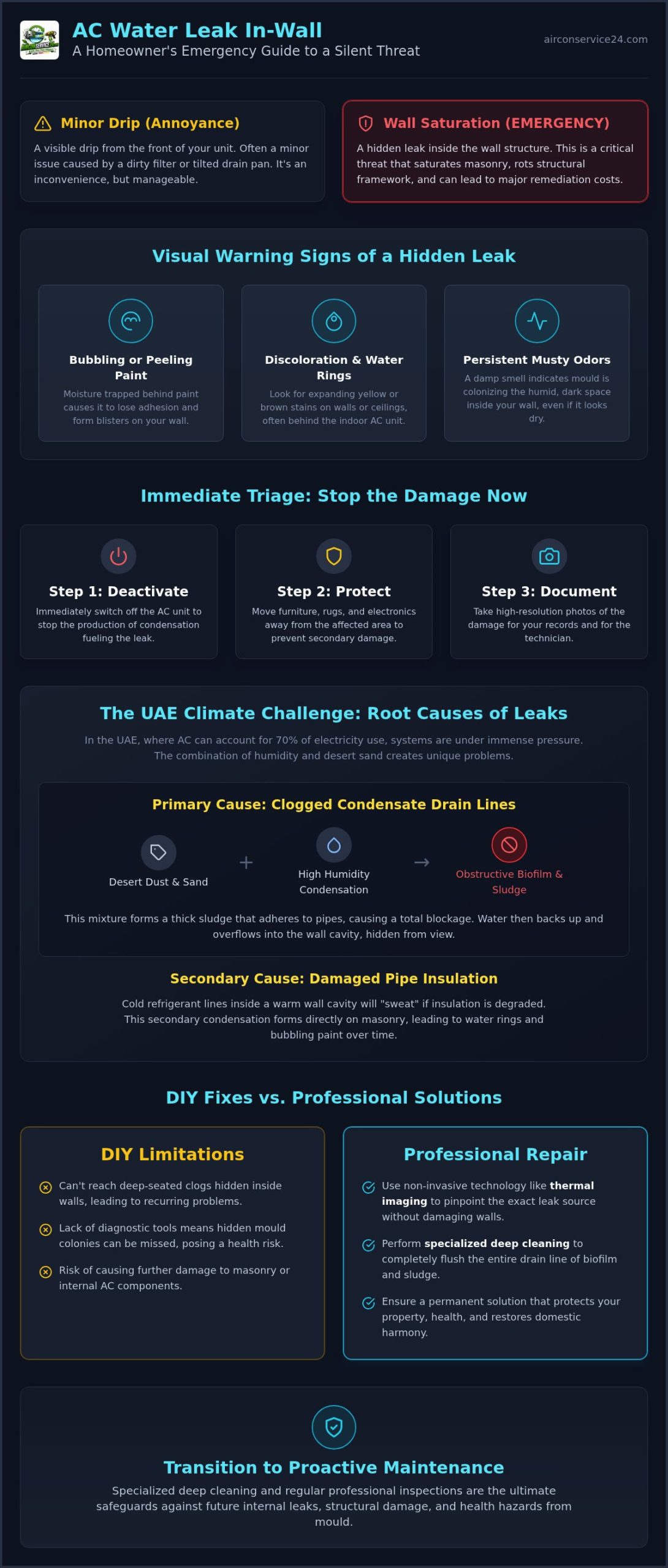
The first sign of trouble isn’t always a puddle on the floor. An in-wall AC leak occurs when the internal drainage or condensation management system fails within the building’s structure. Unlike a visible drip from the front of your unit, this involves water escaping the insulated piping or the primary drain line before it reaches its external exit. It’s a silent, destructive process that saturates the masonry or gypsum from the inside out. Understanding this distinction is the first step toward a permanent resolution.
A surface-level drip is often a minor annoyance, usually caused by a dirty filter or a tilted drain pan. However, deep-seated wall saturation is a critical emergency. When water infiltrates the wall cavity, it compromises the structural integrity of your home. In the UAE’s 2026 climate, where air conditioning accounts for roughly 70% of the country’s electricity usage, these systems are under constant pressure. A leak inside the wall isn’t just a mechanical failure; it’s a direct threat to your domestic harmony and indoor air quality. If you don’t act quickly to fix ac water leak in wall issues, the moisture can lead to irreversible rot in the wall’s internal framework.
Visual Signs of a Hidden Water Leak
Detection requires a vigilant eye and a proactive mindset. Look for these specific indicators near your AC mounting points:
- Bubbling or peeling paint: Moisture trapped behind the paint layer causes it to lose adhesion, creating a blistered appearance.
- Discolouration: Watch for yellow or brown “water rings” that expand outward. These often appear on the ceiling or the wall directly behind the indoor unit.
- Musty odours: A persistent damp smell suggests that mould is already colonising the dark, humid spaces behind your unit, even if the wall looks dry.
Immediate Triage: Stop the Damage Now
When you suspect a leak, you must act with the precision of a disciplined guardian. Follow these steps to contain the situation before professional help arrives:
Step 1: Deactivate the system. Switch off the AC unit immediately. This stops the cooling cycle and prevents the continuous production of condensation that is fueling the leak. This is the most effective way to temporarily fix ac water leak in wall progression.
Step 2: Protect your assets. Clear the area below the leak. Move furniture, rugs, and electronics to prevent secondary water damage from falling plaster or dripping water.
Step 3: Create a record. Document the visible damage with high-resolution photos. This provides your technician with a clear history of the event and is essential for insurance or maintenance records.
Common Causes of AC Water Leaks in the Wall
The 2026 UAE climate presents a unique challenge for residential HVAC systems. High humidity levels mean your unit extracts significant volumes of water from the air every hour. This moisture must travel through a complex network of internal pipes to exit the building safely. If these pathways are compromised, you’ll eventually have to fix ac water leak in wall damage. Most homeowners don’t realize that the primary cause is often a combination of environmental factors and mechanical neglect.
Dust and fine desert sand are unavoidable in this region. When these particles bypass filters and enter the unit, they mix with condensation to form a thick, biological “sludge” or biofilm. This substance is remarkably resilient. It adheres to the inner walls of the pipes, narrowing the passage until a total blockage occurs. It’s a silent process that slowly builds up over months of operation.
Clogged Condensate Drain Lines
When a drain line is obstructed, the “back-up effect” begins. Water fills the internal drain pan and, having no other exit, overflows into the wall structure. This is particularly dangerous because the leak often starts behind the unit where it remains invisible for weeks. Standard cleaning routines often miss these deep-seated clogs in the wall-embedded sections. You need a more thorough approach to ensure the entire line is clear of obstructive biofilm and sand deposits.
Damaged or Inadequate Pipe Insulation
Physics plays a major role in hidden leaks. Refrigerant lines are cold. When they meet warm, humid air inside a wall cavity, they “sweat.” This is known as secondary condensation. If the pipe insulation is degraded or was poorly installed, this moisture forms directly on the masonry. Over time, this leads to yellow water rings and bubbling paint. Shifting units or building settlement can also ruin the necessary gradient of the drain pipe. Without a proper downward slope, gravity cannot pull the water away. This is why a professional AC maintenance check is vital to verify the integrity of hidden components.
DIY Troubleshooting: Can You Fix the Wall Leak Yourself?
Attempting a DIY repair on a hidden leak is a calculated risk. While some obstructions are accessible, others are buried deep within the masonry or gypsum. Transparency is central to our process; we believe you should know when a simple fix is possible and when technical expertise is mandatory. Before you attempt to fix ac water leak in wall complications, ensure you have the right mindset: methodical, calm, and safety-conscious. Neglecting the precision of your AC equipment can lead to more expensive repairs later.
Most homeowners feel a sense of urgency when they see water marks, but rushing into a complex mechanical system without a plan often backfires. Your goal is to triage the situation without causing further damage to the internal components or the wall itself. If these simple checks don’t resolve the issue, it’s a clear signal that the problem is rooted deep within the building’s infrastructure.
Clearing the Primary Drain Port
Start by inspecting the indoor unit’s drain pan. If you see standing water or visible debris like dust clumps, the blockage is likely nearby. One effective DIY method is using a high-powered wet/dry vacuum. Attach the nozzle to the external exit of the condensate line, usually found on a balcony or near the outdoor compressor. Seal the connection with a damp cloth and run the vacuum for 30 seconds. This gentle suction often dislodges minor “sludge” or sand clogs without damaging the system. Do not use compressed air canisters or high-pressure pumps. These can easily burst internal pipe joints hidden inside your walls, turning a minor clog into a major structural flood.
When to Stop and Call a Specialist
Knowing your limits is a hallmark of a disciplined guardian of the home. If the leak persists after you’ve cleared the external line, the problem is likely more complex. Water appearing several feet away from the unit is a significant red flag. This suggests a failure in the pipe insulation or a crack in the line itself, which requires non-invasive diagnostic tools to locate. If you notice an oily residue in the water or a hissing sound, you may be dealing with a refrigerant leak. These situations involve high-pressure gases and chemical components that demand professional handling. Similarly, a cracked internal drain pan cannot be patched; it requires a precise replacement to ensure a watertight seal. If your efforts don’t yield a dry wall within an hour, prioritize the health of your home and seek expert intervention.
The Professional Repair Process: Restoring Domestic Harmony
When DIY efforts fail, a methodical professional intervention is the only way to permanently fix ac water leak in wall issues. We don’t guess; we diagnose. Elite specialists use a disciplined guardian approach, treating your home’s infrastructure with the same precision as a surgical environment. This isn’t just about stopping a drip. It’s about restoring domestic harmony through advanced technology and meticulous workflows. A professional fix is a long-term investment in your home’s health and your family’s well-being.
Advanced Diagnostic Techniques
We utilize thermal imaging cameras to trace water paths behind masonry without destructive demolition. This allows us to see the heat signature of moisture moving through your wall in real time. Moisture meters determine the exact saturation levels, ensuring we know when the structure is truly dry. For hidden pipe damage, borescope inspections allow us to look inside wall cavities through tiny access points. Finally, pressure testing the drain line identifies microscopic cracks or loose fittings that standard visual checks miss entirely.
Often, the root cause is a persistent clog that requires a specialized Deep Cleaning service. This process removes the entire colony of biofilm and sand sludge that standard maintenance leaves behind. It’s an essential step to fix ac water leak in wall recurrences. Once the leak is resolved, the focus shifts to sanitisation. We treat affected areas with anti-fungal solutions to neutralize mould spores before they enter your air supply.
Structural Remediation and Sanitisation
A critical part of the repair is ensuring the unit’s physical alignment. Over time, building settlement can shift the unit, ruining the gravity-fed gradient. Our technicians re-level the system to guarantee water flows exactly where it should. If dampness has left a lingering scent, specialized odour removal services eliminate the biological source of the smell rather than just masking it. This comprehensive approach transforms a mechanical necessity into a high-quality restoration of your living environment.
If you suspect a hidden leak is compromising your home, our elite team is ready to act. You can book an expert AC Repair and sanitisation service today to secure your property and restore your peace of mind.
Preventing Future Leaks: The Proactive Maintenance Plan
Transitioning from a state of crisis to one of total control requires a fundamental shift in strategy. Waiting for a visible damp patch to appear on your masonry is a high-risk gamble with your property’s value and your family’s health. In the UAE, where cooling systems handle extreme thermal loads, disciplined prevention is the only logical path to follow. By the time you need to fix ac water leak in wall damage, the structural remediation has already become a complex, multi-day project that involves more than just mechanical repair. Professional AC maintenance in the UAE isn’t a luxury; it’s a structural necessity for modern living in 2026.
AirConService24.com acts as the elite guardian of your domestic environment. Our approach moves beyond basic surface cleaning to address the technical root causes of drainage failure before they escalate. A proactive strategy ensures you never have to scramble to fix ac water leak in wall emergencies during the peak of the summer heatwaves. We focus on maintaining the integrity of every hidden component, from the internal drain pan to the wall-embedded insulation, ensuring your system remains efficient and your walls stay dry.
The Power of Regular Deep Cleaning
Standard servicing often overlooks the microscopic organic matter that accumulates in the dark, humid recesses of your unit. We advocate for a specialized Deep Cleaning protocol at least twice a year to maintain optimal environmental hygiene. This process removes the biofilm and sand “sludge” before it has the chance to solidify into a pipe-blocking mass. By thoroughly sanitising the evaporator coils, we ensure optimal condensation management, which prevents water from ever backing up into your walls. Maintaining clean filters reduces the overall strain on the drainage system, as it prevents dust from entering the internal moisture pathways and creating new obstructions.
Annual Maintenance Contracts
Securing an Annual Maintenance Contract (AMC) provides the ultimate peace of mind for homeowners. These scheduled inspections are designed to catch microscopic drips and insulation degradation before they manifest as visible wall saturation or bubbling paint. During the extreme 2026 summer heatwaves, your system will be pushed to its absolute limit; having a professional team monitor your drainage gradients and pipe integrity is the best insurance against structural rot. This methodical, recurring oversight transforms your home into a dry, safe, and mould-free sanctuary while extending the overall lifespan of your mechanical equipment. Don’t wait for the next leak to compromise your domestic harmony. Schedule your professional AC inspection today and secure your property with our elite maintenance standards.
Securing Your Home Against Hidden Moisture Damage
We’ve explored the silent progression of internal saturation and the specialized methods required to reverse it. From identifying the first yellow ring to employing advanced non-invasive diagnostics, the goal is always the same: total protection of your home environment. While DIY triage serves as a valuable first step in an emergency, a technical intervention is necessary to fix ac water leak in wall issues at their source, especially when biofilm or degraded insulation is involved. Transitioning from reactive repairs to a disciplined prevention plan is the final step in securing your property’s long-term health.
AirConService24.com serves as your elite guardian in these high-stakes situations. We bring 24/7 Emergency Response, Expert Thermal Imaging Diagnostics, and Comprehensive Mould & Odour Removal to every call, ensuring your domestic harmony is restored with methodical precision. Don’t allow a hidden drip to dictate the safety of your household or the integrity of your walls. Secure Your Home with Professional AC Leak Repair today and experience the confidence that comes with elite technical care. Your dry, safe, and mould-free home is just one professional inspection away.
Frequently Asked Questions
Is an AC water leak in the wall an emergency?
Yes, an in-wall leak is a mechanical emergency that requires immediate intervention. In the 2026 UAE climate, moisture trapped within a wall cavity creates an ideal breeding ground for toxic mould within 24 to 48 hours. Ignoring the issue leads to high-stakes structural remediation costs later. You should deactivate the system and seek professional help to fix ac water leak in wall hazards before the saturation compromises your masonry or electrical wiring.
Can a leaking AC cause structural damage to my home?
Persistent leaks definitely cause structural damage to both gypsum and masonry walls. Water saturation weakens the internal framework, leading to crumbling plaster and compromised paint adhesion. Over time, this moisture can even reach electrical conduits, creating a significant fire hazard. By the time you see bubbling on the surface, the internal damage is often already extensive. Addressing the root cause early is the only way to preserve your property’s long-term value.
How much does it cost to fix an AC leak inside a wall in the UAE?
The cost to resolve an in-wall leak in the UAE varies based on the complexity of the blockage and the extent of the moisture damage. Simple drain line clearing is generally more affordable than repairs involving pipe insulation replacement or structural sanitisation. Factors such as the accessibility of the wall-embedded pipes and the need for thermal imaging diagnostics will influence the final investment. It’s best to request a technical inspection for a precise, transparent quote.
Why does my AC leak water only when it’s humid outside?
High humidity forces your air conditioner to extract significantly more moisture from the indoor air. During peak humidity in the UAE, a partially obstructed drain line might manage a small trickle but will overflow when the condensation volume increases. This is why leaks often manifest during extreme summer heatwaves. Regular deep cleaning ensures your drainage system has the capacity to handle these maximum loads without backing up into your wall structure and causing damage.
Will my insurance cover water damage from a leaking air conditioner?
Insurance coverage for water damage typically depends on whether the leak was sudden or caused by a lack of maintenance. Many UAE home insurance policies cover accidental damage from burst pipes but may exclude claims resulting from gradual seepage or neglected service. You should review your specific policy documents to understand the exclusions. Maintaining a record of professional service and deep cleaning can often support your case during the insurance claims process.
How do I know if the leak has caused mould behind the unit?
Visible indicators like dark spots or fuzzy textures on the wall are clear signs of mould, but hidden growth is often identified by a persistent musty odour. If you experience unexplained respiratory issues or allergies when the AC is running, mould may be colonising the dark spaces behind your unit. Professional technicians use moisture meters and borescopes to confirm the presence of biofilm and fungal growth without needing to break your walls or masonry.
How often should I clean my AC drain line to prevent wall leaks?
You should have your AC drain line professionally inspected every three to six months to ensure it remains clear of sand and biofilm. In the UAE’s dusty environment, a specialized deep cleaning service twice a year is the most effective preventative measure. This proactive schedule prevents the sludge from ever reaching a critical mass that could trigger a backup. Consistent maintenance is far more cost-effective than an emergency repair to fix ac water leak in wall damage.
Can a refrigerant leak look like a water leak in the wall?
A refrigerant leak can indirectly cause what looks like a water leak. When refrigerant levels are low, the evaporator coils and internal lines can freeze or become excessively cold. This causes the pipes to sweat profusely as they meet warm air inside the wall, leading to secondary condensation. If you notice ice on the unit or a hissing sound alongside the damp wall, it’s a strong indicator of a refrigerant-related failure rather than a simple clog.