How to Remove AC Odours: Professional Guide

Article by
Jon Bonnett
Australian Air Conditioning Specialist with extensive hands-on experience in AC servicing, deep cleaning, maintenance, and troubleshooting. Focused on high-quality workmanship, reliability, and professional service to UAE standards.
Spraying air freshener into a musty vent is like putting a small bandage on a deep wound; it masks the symptom while the underlying issue continues to fester. You’ve likely tried every DIY spray and scented candle in the house, yet that persistent, damp odour returns the moment the compressor kicks in. It’s frustrating to feel like your own home isn’t the sanctuary it should be, especially when you’re concerned about the health implications of what your family is breathing. These smells are rarely just a nuisance. They’re often a clear signal that your indoor air quality is compromised and requires immediate, professional attention.
Learning how to get rid of bad smell from ac requires moving beyond surface-level fixes and addressing the microbial colonies thriving in the dark, damp corners of your system. This guide provides a professional roadmap to identifying the root causes of these foul scents and executing the precise steps needed to restore clinical-grade freshness to your air. We’ll explore the science of evaporator coil contamination, the necessity of deep sanitisation, and the proactive maintenance habits that ensure your indoor environment remains a healthy, odour-free zone for the long term.
Key Takeaways
- Identify what specific scents, such as the common “dirty sock” smell, reveal about the biological or mechanical state of your cooling system.
- Understand why biofilm and condensate sludge require advanced sanitisation rather than simple surface cleaning to be permanently eradicated.
- Master a structured 5-step DIY approach for how to get rid of bad smell from ac while prioritising safety and air filter integrity.
- Avoid the “perfume trap” of household aerosols that merely mask underlying bacterial growth and may introduce harmful chemicals into your living space.
- Discover how professional-grade odour removal and regular maintenance contracts provide a 24/7 solution to the unique environmental hygiene challenges of the national climate.
Identifying the Scent: Why Your AC Smells Bad
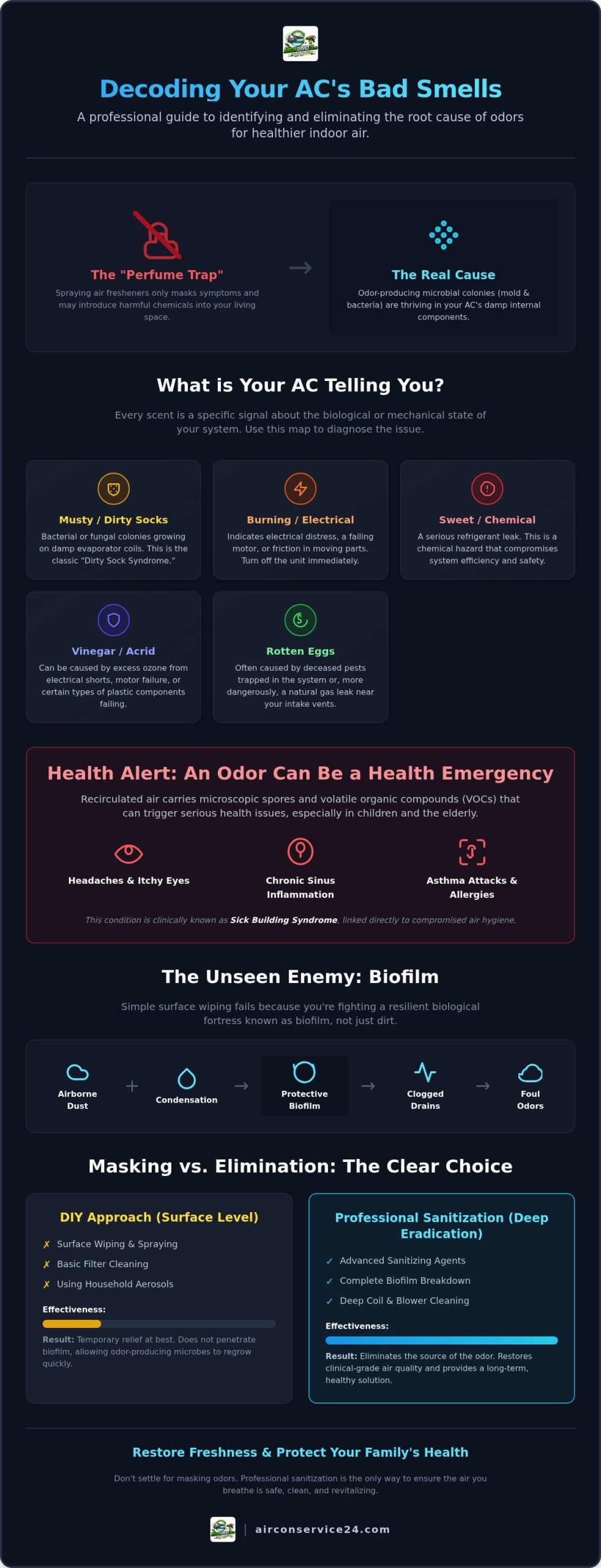
Every scent emitted by your cooling unit is a specific data point. It’s a mechanical or biological signature that tells us exactly what’s failing inside the system. Understanding these signals is the first step in learning how to get rid of bad smell from ac before the issue escalates into a costly repair or a health crisis. When your air conditioner starts to fail, it doesn’t just stop cooling; it begins to communicate through these distinct, often unpleasant, aromas.
The Scent-to-Cause Diagnostic Map
To restore domestic harmony, you must first identify the culprit. Use the following table to map common scents to their likely mechanical or biological root causes.
| Scent Profile | Probable Root Cause |
|---|---|
| Musty / Dirty Socks | Bacterial colonies or mould on evaporator coils |
| Vinegar / Sharp Acrid | Motor failure or excess ozone from electrical shorts |
| Sweet / Ethereal | Refrigerant leak (High-stakes chemical hazard) |
| Burning / Dust | Electrical distress or friction in moving parts |
| Rotten Eggs | Pest intrusion or natural gas leak |
The “sweet” smell of refrigerant is particularly deceptive. It indicates a leak that compromises both system efficiency and environmental safety. While a temporary scent of burning dust is common when a unit hasn’t been used for months, persistent acrid smells suggest electrical components are under extreme distress. Identifying these early requires specialised diagnostic equipment to ensure the source is pinpointed with surgical precision.
When an Odour Becomes a Health Emergency
We often treat bad smells as a minor domestic inconvenience, but they’re frequently precursors to respiratory irritation. In modern Heating, ventilation, and air conditioning (HVAC) systems, recirculated air carries microscopic spores and volatile organic compounds directly into your living space. “Dirty Sock Syndrome” is the specific accumulation of bacterial colonies on the evaporator coils. As moisture condenses during the cooling cycle, it provides the perfect medium for these microbes to multiply and release gases.
Children and the elderly are more susceptible to this poor air quality, which can trigger asthma attacks or chronic sinus inflammation. Sick Building Syndrome is a clinical condition where occupants experience acute health or comfort effects that are directly linked to time spent in a building with compromised air hygiene. If your family is experiencing unexplained headaches or itchy eyes alongside a musty vent, the situation has moved beyond a maintenance task and into a health priority. Immediate sanitisation is the only way to ensure the air you breathe is safe and revitalising.
The Science of Biofilm: Why Simple Cleaning Fails
Most homeowners believe a quick spray of disinfectant or a surface wipe will solve their air quality issues. It won’t. You’re not just fighting dirt; you’re fighting a biological fortress known as biofilm. This complex colony of bacteria and fungi creates a protective, slimy matrix that allows it to thrive in the high-humidity environment of your cooling unit. Understanding the resilience of this biological shield is essential when researching how to get rid of bad smell from ac permanently. Without breaking down this film, the odour-producing microbes remain protected and ready to multiply.
The Anatomy of AC Sludge
Sludge begins as simple airborne dust that bypasses your filters. When this organic matter meets the constant condensation on your evaporator coils, it transforms into a thick, gelatinous substance. This material eventually migrates to the condensate drain pan, where it can block drainage entirely. Stagnant water trapped in these lines begins a fermentation process, producing the pungent, swampy gases that are then circulated through your vents. For those looking to implement a proactive strategy, the AC Maintenance UAE Reference provides a detailed breakdown of the preventive steps required to stop this buildup before it starts.
Why Surface Wiping Isn’t Enough
Surface-level cleaning is a temporary cosmetic fix that ignores the microscopic reality of mould. Spores don’t just sit on the metal surfaces; they embed themselves deep within the porous insulation and the intricate fins of the evaporator coils. Standard household cleaners are designed for hard, non-porous surfaces. They lack the chemical potency and surfactants needed to penetrate professional-grade biological films.
If you don’t use industrial-strength sanitising agents, the bacteria will regenerate within days. This leads to a frustrating cycle of re-contamination. Air passing through dirty ductwork or over contaminated coils picks up new spores and distributes them throughout your living space, rendering your DIY efforts useless. If you’re struggling with persistent, deep-seated odours, a professional sanitisation service is the only methodical way to break this biological cycle and ensure your air remains clinical-grade fresh. Using specialised equipment, technicians can reach the internal components where these biofilms hide, ensuring a total removal of the source rather than just masking the symptom.
5 Step DIY Guide to Freshening Your AC System
Before you begin any maintenance, you must isolate the power supply. Safety is the non-negotiable foundation of any technical intervention. Switch off the unit at the main breaker to ensure no mechanical parts engage while you’re working. Once the system is dormant, you can begin the methodical process of addressing the most common culprits behind indoor air quality issues. If you’re wondering how to get rid of bad smell from ac units without calling a technician immediately, these five steps provide a structured starting point for basic hygiene.
Step 1: Deep Cleaning the Air Filters
Air filters are your primary line of defence against the organic debris that feeds bacterial growth. Remove the filters carefully to avoid shedding dust into the room. If the mesh is intact, wash them using lukewarm water and a mild, pH-neutral detergent. Avoid using high-pressure hoses, as these can easily tear the delicate fibres. If the mesh appears frayed or the “dirty sock” odour remains after a thorough drying, washing is no longer sufficient. In these cases, a full replacement is necessary. You can find high-efficiency options and Professional AC Equipment to ensure your system has the best possible filtration for the national climate.
Step 2: Inspecting the Drain Pan and Line
Locate the primary drain pan, usually situated directly beneath the evaporator coils. Check for any standing water; this is a definitive sign of a blockage. To clear minor obstructions, use a wet/dry vacuum on the external exit of the condensate line to pull out sludge and debris. This low-pressure method is much safer than trying to blow air through the line, which can cause internal connections to burst. However, if the water doesn’t clear after one or two attempts, you must stop. Continuing DIY efforts on a stubborn clog can lead to a backup that floods your interior flooring or damages sensitive electrical components.
The final steps involve maintaining the unit’s environment. Use a damp microfibre cloth to wipe down the external cabinet and louvres, removing the fine dust that eventually migrates inside. Finally, ensure the area surrounding the indoor and outdoor units is free from debris and standing water. While these steps significantly improve air freshness, they’re maintenance tasks, not deep sanitisation. If the odour persists after this 5-step process, it indicates that the biological contamination is embedded deep within the internal components, requiring professional-grade intervention to resolve.
Masking vs. Elimination: Why Professional Sanitisation is Vital
When you’re searching for how to get rid of bad smell from ac, the convenience of a “quick fix” aerosol spray can be incredibly alluring. However, this approach represents a dangerous misunderstanding of environmental hygiene. Sprays and household deodorisers operate on the principle of masking; they use heavy fragrances to overwhelm your olfactory senses while the underlying biological rot continues to thrive. This “Perfume Trap” creates a false sense of security that can lead to prolonged exposure to harmful microbial spores. True domestic harmony isn’t achieved by adding scents, but by removing the source of the decay.
The Dangers of Deodorising Sprays
Household air fresheners are not designed for the complex internal architecture of a cooling system. When you spray these substances into your vents, the oily residue often coats the cooling coils. Instead of cleaning, this sticky film actually attracts more dust and organic matter, accelerating the growth of the very biofilms you’re trying to eliminate. There’s also a significant risk of respiratory distress. Inhaling concentrated chemical fragrances in a confined space can trigger allergic reactions and worsen chronic lung conditions. A disciplined guardian of the home environment knows that pure air doesn’t have a scent. It’s clean, neutral, and revitalising.
Professional Deep Cleaning Protocols
True elimination requires a methodical approach that household products simply cannot provide. Professional sanitisation involves the use of hospital-grade disinfectants that are specifically formulated to penetrate and dissolve biological films without damaging sensitive metal components. Technicians use high-pressure washing and chemical flushing to reach deep into the evaporator fins and condensate lines, ensuring every trace of sludge is physically removed from the system. This process doesn’t just clean; it creates a microscopic protective barrier on the internal surfaces to inhibit future mould growth and bacterial colonisation.
Investing in professional odour removal is a strategic decision for your home’s long-term health and mechanical efficiency. While DIY sprays are cheap, they often lead to more frequent service calls as the system’s efficiency drops due to clogged coils. For urgent situations where the odour is unbearable or indicates a potential mechanical failure, accessing Emergency AC Repair Services ensures a rapid, authoritative response. By choosing elimination over masking, you ensure your indoor air is not just “better smelling,” but clinically safe for every member of your household. If you’re ready to restore domestic harmony, contact our specialists for a deep sanitisation audit today.
Restoring Air Quality with Expert Odour Removal
Transitioning from a reactive “crisis mode” to a proactive state of environmental hygiene is the only way to ensure lasting comfort in your home. When you’re stuck wondering how to get rid of bad smell from ac, you’re usually already dealing with a significant biological or mechanical failure that has breached your domestic sanctuary. AirConService24.com approaches these situations with a methodical, high-stakes urgency. We don’t just “check” your system; we perform a comprehensive sanitisation audit to identify the precise origin of the contamination. Our goal is to move beyond the temporary fixes of DIY maintenance and restore a harmonised environment where the air is as fresh as it is safe.
Our 24/7 Odour Elimination Service
Air quality emergencies don’t adhere to standard business hours. Whether it’s a residential living room or a high-traffic commercial space, a foul odour can disrupt operations and well-being instantly. Our expert technicians maintain a “ready-to-act” posture, arriving equipped with professional-grade disinfectants and specialised tools to neutralise odours at their source. We prioritise transparency and integrity, providing clear expectations regarding the scope of the sanitisation required. This isn’t just about mechanical repair; it’s about an elite response and precision hygiene that protects your family’s health. We treat every call as a mission to restore the safety of your indoor environment.
Preventive Strategies for Year-Round Freshness
The national climate presents unique challenges, specifically high humidity that accelerates the growth of “Dirty Sock Syndrome” bacteria. Scheduling bi-annual deep cleanings is the most effective way to stay ahead of these biological threats. By managing internal humidity and ensuring the condensate system is flawlessly clear, you prevent the formation of the biofilms that lead to persistent stenches. This proactive stance transforms your cooling system from a potential hazard into a reliable component of a comfortable lifestyle. Consider this final checklist for maintaining a smell-free cooling system:
- Audit your air filters monthly and replace them if they show signs of grey discolouration or persistent odours.
- Keep the area around your external condenser unit clear of debris and standing water to prevent dust ingress.
- Ensure your indoor humidity levels remain below 60% to inhibit the growth of mould and microbial colonies.
- Utilise specialised sanitisation equipment to reach deep internal components that standard tools miss.
- Schedule professional sanitisation before the peak summer season to ensure the system is clinically clean.
Restore your domestic harmony today. Don’t wait for a pungent warning sign to signal a crisis when you can secure 24/7 peace of mind through methodical maintenance. Learning how to get rid of bad smell from ac is the first step, but professional elimination is the final solution. Our commitment to excellence ensures that your air isn’t just cooled, but purified to the highest modern standards.
Secure Your Indoor Air Quality Today
Unpleasant scents from your cooling system are more than just a domestic nuisance; they are biological warnings that your indoor environment is compromised. We’ve explored the diagnostic signs of system failure and the resilient nature of biofilms that thrive in our national climate. While basic maintenance is a vital habit, understanding how to get rid of bad smell from ac permanently requires moving beyond surface-level wiping and into the realm of professional deep sanitisation. Masking these smells with aerosols only delays the inevitable and may worsen your air quality.
AirConService24.com provides a 24/7 expert response to air quality crises, offering professional deep sanitisation and national UAE coverage to ensure your home remains a sanctuary. Our elite technicians are ready to act with the precision and transparency you deserve. Don’t settle for compromised air or ineffective DIY fixes when a clinical-grade solution is just a click away. Contact AirConService24 for Professional Odour Removal and take the final step toward restoring true domestic harmony. Your family’s health and comfort are our highest priority; we’re here to ensure you breathe easy every day.
Frequently Asked Questions
Is it safe to breathe air from a musty-smelling AC?
Breathing air from a musty-smelling unit isn’t safe for long-term health. These odours typically signal the presence of active mould spores or bacterial colonies within the evaporator coils. Exposure can lead to immediate respiratory irritation, persistent headaches, or allergic reactions. For children or those with chronic conditions, these biological contaminants represent a significant risk. Prioritising professional sanitisation is the only way to ensure your indoor air remains clinically clean and safe for your family.
Can I use vinegar to get rid of AC smells?
You can use vinegar as a mild, eco-friendly surface cleaner, but it’s rarely effective against deep-seated biological films. While its acidity can kill some surface bacteria, it lacks the industrial surfactants needed to dissolve thick sludge in the condensate lines. Over-reliance on vinegar often leads to a cycle where the smell returns within days. For a permanent solution on how to get rid of bad smell from ac, professional-grade disinfectants are required.
How long does professional AC odour removal take?
A standard professional odour removal and deep sanitisation session typically takes between one and three hours per unit. This duration allows technicians to thoroughly dismantle the external casing, flush the evaporator coils, and clear the condensate drainage system. The exact time depends on the severity of the biological buildup. If you’re researching how to get rid of bad smell from ac quickly, our methodical approach ensures every microbial colony is neutralised without rushing the essential sanitisation stages.
Why does my AC smell like something is burning?
A burning scent is a high-stakes warning sign of electrical distress or mechanical friction. It often indicates that the blower motor is overheating, a capacitor is failing, or wiring insulation is beginning to melt. If you notice this smell, you should shut down the system at the breaker immediately to prevent a potential fire hazard. Our technicians treat these cases as emergency repairs to ensure your home’s safety and mechanical integrity through precise diagnostics.
Will a dirty filter cause my air conditioner to stink?
Yes, a dirty filter is often the primary source of initial odours. Filters trap organic debris like skin cells, pet dander, and dust; when combined with the unit’s natural moisture, these materials begin to decay. This rot creates a stagnant smell that the system then recirculates throughout your rooms. Replacing or cleaning your filters every 30 days is a vital maintenance habit that prevents these contaminants from migrating deeper into the internal coils where they cause damage.
How often should I have my AC professionally sanitised?
You should schedule professional sanitisation at least twice a year in our specific regional climate. The high humidity and extreme temperatures accelerate the growth of biological films and “Dirty Sock Syndrome” bacteria. Regular bi-annual deep cleanings act as a preventive shield, ensuring that minor moisture issues don’t escalate into a full-blown air quality crisis. This proactive schedule maintains both your system’s efficiency and your home’s domestic harmony year-round through clinical-grade hygiene standards.
What happens if I ignore the bad smell in my AC?
Ignoring these odours allows biological contaminants to spread throughout your home’s ductwork and porous surfaces. Over time, the buildup of sludge can lead to condensate leaks that damage your ceiling or flooring. Mechanically, clogged coils force the compressor to work harder, which increases your energy bills and shortens the system’s lifespan. What starts as a minor nuisance eventually becomes an expensive emergency repair and a persistent health hazard for every member of your household.
Can a dead animal in the ductwork cause the smell?
A dead animal in the ductwork causes a distinct, pungent scent of decay that is often mistaken for a gas leak or rotten eggs. Small pests can enter the system through gaps in the external unit or unsealed vents. This situation requires immediate professional intervention to remove the source and execute a deep sanitisation of the affected area. Our team follows strict hygiene protocols to neutralise the biological hazards associated with pest intrusion and decay.