Office AC Repair Services: The Facility Manager’s Guide to Restoring Commercial Cooling

Article by
Jon Bonnett
Australian Air Conditioning Specialist with extensive hands-on experience in AC servicing, deep cleaning, maintenance, and troubleshooting. Focused on high-quality workmanship, reliability, and professional service to UAE standards.
When commercial cooling fails, you aren’t just losing comfortable airflow; you’re risking immediate thermal shutdowns across mission-critical server racks and watching workplace productivity collapse. In high-demand professional environments, securing specialized office ac repair services is an urgent operational priority, not a casual maintenance ticket. You already know that generic residential handymen lack commercial diagnostic rigor, often delivering sluggish response times and superficial band-aids. Those temporary fixes leave your mechanical systems vulnerable to recurring breakdowns that drain capital and frustrate occupants across the entire building.
Restoring stable indoor climate control demands technical precision, verified diagnostics, and long-term mechanical reliability. This guide equips facility managers with the actionable knowledge needed to resolve cooling emergencies swiftly, identify exact system faults, and eliminate costly operational downtime. We’ll examine systematic troubleshooting steps for split and packaged units, highlight current refrigerant compliance standards, and explore why pairing mechanical repairs with commercial sanitisation safeguards environmental hygiene. Here is your strategic playbook for maintaining total control over your office climate.
Key Takeaways
- Identify critical early warning signs, from localized temperature stratification to severe thermal throttling risks inside IT server environments.
- Discover why enterprise systems require specialized office ac repair services equipped for commercial ducted, VRF, and packaged rooftop systems.
- Implement an immediate facility emergency protocol that halts secondary compressor damage and establishes a structured contractor escalation chain.
- Transition from reactive troubleshooting to long-term reliability by combining scheduled maintenance with restorative deep cleaning and biological sanitisation.
Critical Indicators That Your Workplace Needs Immediate Office AC Repair Services
A failing residential air conditioner causes domestic inconvenience; a failing commercial system imperils operational revenue. Unlike residential units, enterprise cooling systems run continuously under shifting occupancy loads and intense equipment heat. Ignoring subtle performance drops accelerates mechanical wear and invites sudden thermal shutdowns. Recognizing early warning signs allows facility managers to deploy specialized office ac repair services before minor component friction escalates into total workplace disruption.
Temperature Inconsistencies and IT Equipment Overheating
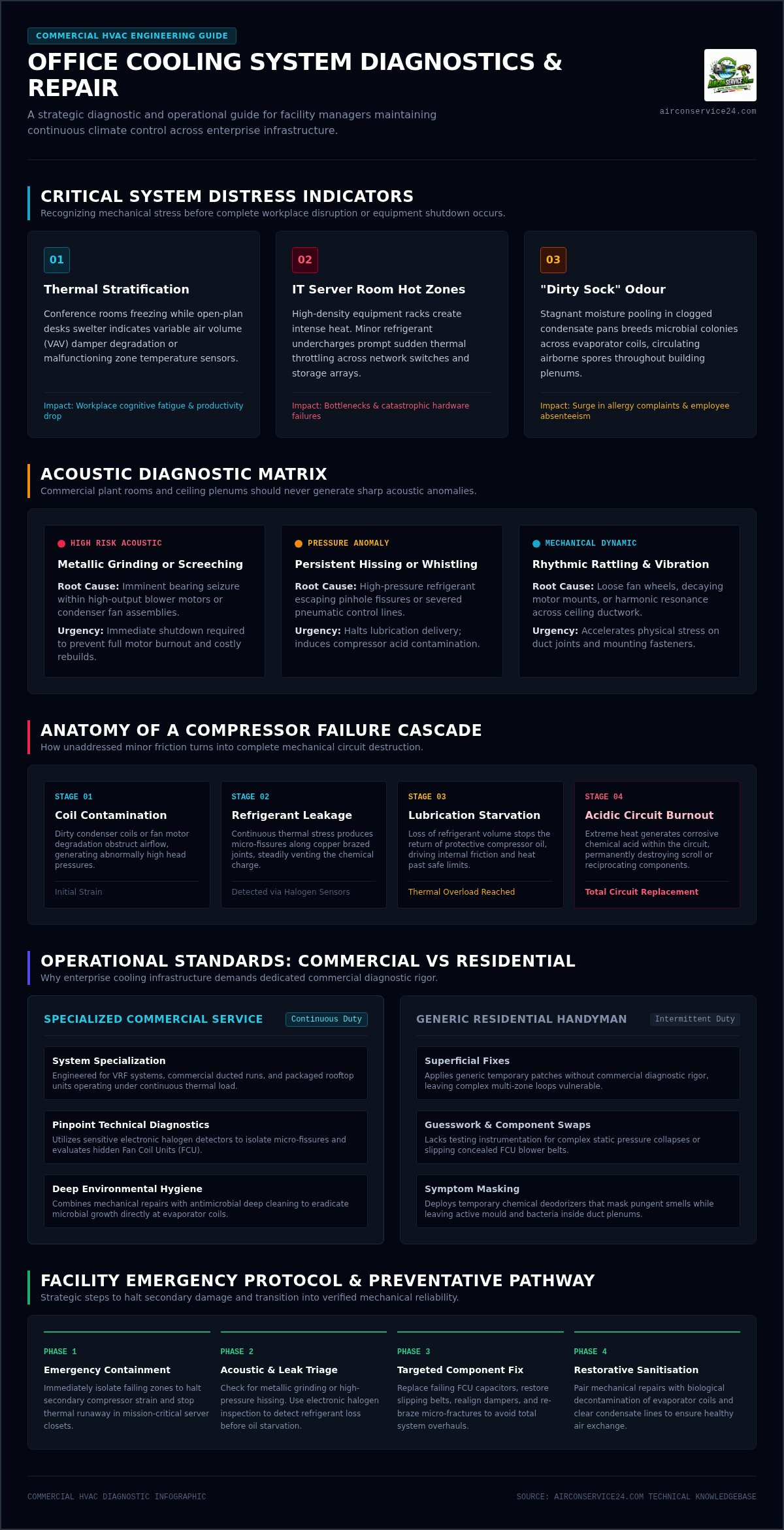
When conference rooms freeze while open-plan desks swelter, your variable air volume (VAV) dampers or zone sensors are likely failing. Even more critical are the localized hot zones inside network closets and server rooms. High-density server racks generate concentrated heat loads. A minor refrigerant undercharge quickly triggers thermal throttling in switches and storage arrays, inducing data processing bottlenecks or catastrophic hardware failures. Early cooling loss also degrades human performance, inducing cognitive fatigue and lowering team output well before ambient alarms sound.
Auditory Warnings and Plated Mechanical Wear
Commercial plant rooms and ceiling plenums should never generate sharp acoustic anomalies. Unusual sounds directly indicate physical stress across heavy-duty components:
- Metallic grinding or screeching: Signals imminent bearing seizure within high-output blower motors or condenser fan assemblies.
- Persistent hissing or whistling: Points toward high-pressure refrigerant leaks or severed pneumatic control lines.
- Rhythmic rattling and vibration: Suggests loose fan wheels, motor mount decay, or harmonic resonance shaking commercial ceiling ductwork.
Addressing these noises immediately prevents motor burnouts that require extensive mechanical rebuilds.
Workplace Odours and Air Quality Degradation
Modern commercial infrastructure relies on integrated heating, ventilation, and air conditioning (HVAC) engineering to cycle fresh air and extract volatile compounds. When indoor air feels stale or carries a pungent “dirty sock” smell, your cooling infrastructure is compromised. Stagnant moisture pooling in clogged condensate pans breeds microbial growth across the evaporator coils. As spores circulate, employee allergy complaints surge, absenteeism rises, and indoor air quality plummets. Professional office ac repair services pair precision mechanical restoration with deep antimicrobial decontamination, eliminating biological contaminants at the source rather than masking them with temporary deodorizers.
Core Mechanical Failures in Modern Commercial Office Cooling Systems
Commercial HVAC architecture operates under punishing duty cycles. Unlike domestic equipment that cycles off when occupants leave, workplace systems balance continuous internal heat gains from computing hardware, high-density personnel, and large building envelopes. This relentless runtime accelerates wear across electro-mechanical sub-assemblies. Guesswork in this environment is costly. Precision engineering diagnostics must isolate the precise point of failure, ensuring facility managers replace only defective components rather than approving unnecessary overhauls.
Compressor Burnout and Refrigerant Circuit Leaks
Compressors represent the mechanical heart of any commercial system. When scroll or reciprocating assemblies fail, cooling halts entirely. High head pressures caused by dirty condenser coils or fan motor degradation force compressors into severe thermal overload. Simultaneously, micro-fissures along copper brazed joints slowly vent refrigerant. Technicians using sensitive electronic halogen detectors pinpoint these pinhole leaks before loss of charge Starves the compressor of lubrication, generating corrosive acid that destroys the entire circuit.
Fan Coil Unit Malfunctions and Condensate Blockages
Concealed fan coil units (FCUs) distributed throughout floor plans regulate individual office comfort. When an FCU blower motor capacitor blows or its belt slips, static pressure collapses instantly. More destructive, however, are drainage failures:
- Biofilm accumulation: Humid return air feeds bacterial slime that clogs shallow drain pans.
- P-trap siphoning: Improper pressure differentials draw drainage water back into the plenum.
- Float-switch failures: Defective overflow safety switches fail to shut down the unit, dumping condensate directly onto ceiling tiles and workstations below.
Systematic clearing of drain lines and electrical testing of limit switches stops moisture damage before it reaches office assets.
Thermostat Malfunctions and Sensor Drift
Enterprise cooling requires pinpoint digital control. Over time, thermistor sensors drift out of factory calibration due to airborne particulates or electrical fluctuations. A sensor reading 21°C when the ambient space is actually 25°C prevents modulated motorized valves from opening. In chilled water systems, stuck two-way or three-way actuator valves physically starve coils of cooling capacity despite central chillers running at total output. Skilled diagnostic verification isolates whether the issue stems from digital communication faults or seized valve linkages.
Restoring these critical sub-assemblies demands systematic engineering protocols rather than temporary adjustments. When managing multi-zone commercial spaces, relying on expert office ac repair services ensures rapid diagnostic verification that protects your mechanical assets and prevents expensive collateral downtime.
Evaluating Office AC Repair Services: Commercial Standards vs Residential Fixes
Hiring a domestic repair contractor to resolve corporate climate failures invites disaster. Enterprise buildings utilize complex variable refrigerant flow (VRF) networks, multi-zone ducted plants, and integrated air-handling units. Residential technicians typically carry basic manifold gauges and off-the-shelf patch sealants suited for modest split systems. When business continuity, tenant comfort, and equipment longevity are on the line, facility managers must demand enterprise-grade rigor from their contractors.
Diagnostic Equipment and Specialized Tooling
Commercial diagnostics demand heavy instrumentation. Technicians must deploy dual-stage industrial vacuum pumps capable of achieving sub-500 micron levels on high-tonnage loops, alongside digital manifolds and thermal imaging cameras that trace coil restrictions behind drop ceilings. Safely recovering hundreds of pounds of refrigerant requires dedicated commercial recovery stations and compliant handling protocols. Field teams equipped with advanced professional AC equipment isolate system anomalies accurately without risking secondary electrical or thermodynamic damage.
Service Level Agreements and Business Continuity
A true commercial provider operates around corporate realities, offering formalized service level agreements (SLAs) rather than vague arrival estimates. When vetting prospective partners, prioritize these operational baseline requirements:
- Defined arrival windows: Guaranteed response metrics for critical cooling failures to protect ongoing operations during heat spikes.
- Phased execution: Capabilities to schedule loud brazing, deep vacuuming, and mechanical overhauls outside standard business hours.
- Comprehensive audit trails: Transparent diagnostic logs and failure analyses to satisfy facility governance and insurance standards.
These formal safeguards keep your workplace operational while preventing unexpected disruptions to billable hours.
Hygiene Integration and Airflow Sanitisation Standards
Elite office ac repair services never stop at replacing capacitors or recharging refrigerant circuits. True climate restoration treats mechanical health and indoor environmental hygiene as inseparable. Bio-sludge accumulating on internal cooling fins restricts airflow, drives up static pressure, and aerosolizes spores throughout shared executive spaces. Leading commercial providers utilize hospital-grade, non-corrosive disinfectants across heat-exchange matrices and blower wheels. Once decontaminated, technicians verify static pressure drops and airflow delivery rates with calibrated digital anemometers, ensuring restored efficiency, zero lingering odours, and healthy indoor air quality across every floor.
Emergency Protocol: What Facility Managers Must Do During Sudden Cooling Failures
When enterprise cooling cuts out unexpectedly, panic is your worst enemy. Facility managers must execute a disciplined emergency response to protect digital infrastructure, preserve tenant safety, and prevent minor mechanical failures from compounding into total system write-offs. Waiting passively for external assistance guarantees thermal escalation. Taking deliberate containment steps immediately stabilizes your building environment while technical responders mobilize.
Immediate System Isolation and Thermal Containment
Containment begins at the mechanical disconnect switch. Continuing to run an overheating unit turns an isolated electrical fault into terminal motor destruction:
- Step 1: Isolate the failing unit. Shut down power at the local isolator switch immediately. Forcing a struggling compressor to cycle on internal overload protection scorches electrical windings and generates systemic acid contamination.
- Step 2: Deploy auxiliary spot cooling. Roll portable conditioning units directly into high-density server rooms, networking closets, and PBX rooms. Close server rack doors and baffle ambient air return vents to concentrate cold airflow across intake louvers.
- Step 3: Eliminate secondary thermal loads. Shut off non-essential peripheral hardware, switch off decorative task lighting, and draw solar blinds across perimeter glass to drop internal heat gains.
Contractor Dispatch and Workplace Communication
Clear logistics accelerate physical resolution. Step 4 requires dispatching specialized office ac repair services immediately. Provide technicians with the central plant error codes, equipment model serial numbers, and observed physical symptoms before they arrive on-site. Follow this in Step 5 with transparent internal messaging. Inform floor managers about estimated restoration windows, temporary zone consolidations, and ventilation adjustments. Step 6 demands clearing physical access routes. Unlock plant room doors, secure roof hatch permissions, and relocate staging furniture so contractors can access ceiling plenums without losing valuable minutes navigating administrative checkpoints.
Post-Repair Commissioning and Temperature Balancing
Once mechanical repairs are finalized, commissioning ensures the failure is truly resolved. Step 7 mandates verifying operating current draws, compressor superheat, and subcooling metrics against nameplate engineering limits. Step 8 requires charting supply and return air delta across every affected floor plate with digital probes. Stable heat rejection and balanced static pressures confirm complete restoration. To benchmark post-repair performance against established operational baselines, consult comprehensive preventive cooling maintenance standards before signing off on service completion logs.
Long-Term Reliability: Transitioning From Reactive Repairs to Preventative Care
Operating in perpetual reaction mode is an expensive trap. While emergency interventions extinguish acute cooling crises, running commercial infrastructure until components seize destroys lifecycle efficiency and inflates operating budgets. Transitioning toward structured preventative maintenance transforms professional office ac repair services from a panicked reaction into a predictable, capital-preserving strategy. Disciplined upkeep stops minor friction from cascading into multi-zone failures.
Comprehensive Deep Cleaning and Coil Restoration
Atmospheric dust and airborne grease form an insulating barrier over condenser coils, trapping heat and forcing compressors to draw excessive amperage. Specialized deep cleaning strips away baked-on grime, instantly restoring optimal heat rejection. Indoors, technical teams sanitise evaporator surfaces with non-corrosive, antimicrobial biocides. This biological decontamination neutralizes fungal colonies and eliminates foul odours at the source. Technicians then vacuum and flush condensate pans and drainage networks, eliminating gelatinous slime before it causes destructive commercial ceiling overflows.
Scheduled Electrical and Mechanical Diagnostics
Component breakdown rarely happens without prior warning. Regular testing detects wear early:
- Electrical terminations: Technicians inspect high-voltage contactors, breakers, and wiring blocks, swapping out pitted contact points before they cause severe phase dropouts.
- Mechanical assemblies: Applying dynamic balancing, bearing lubrication, and precise belt adjustments relieves physical strain on high-output fan blowers.
- Operating logs: Logging run hours and compression ratios helps managers schedule sub-assembly rebuilds well before high-demand seasons arrive.
Partnering With Specialized Commercial Specialists
Managing extensive floorplates requires reliable, standardized technical care across your entire property portfolio. Working with dedicated cooling specialists gives facility managers access to national operational coverage, ensuring consistent service protocols across multiple facilities. Certified technicians focus on root-cause mechanical diagnostics rather than surface-level fixes, keeping your critical systems within factory specifications. Don’t wait for your cooling infrastructure to trigger another workplace emergency; ensure consistent environmental hygiene and uninterrupted productivity by booking professional commercial AC repair today.
Protect Your Workplace Climate and Operational Continuity
Maintaining stable climate control is fundamental to preserving workplace productivity, protecting sensitive network hardware, and eliminating runaway operating expenses. Relying on generic residential fixes invites recurring downtime and leaves complex multi-zone architectures vulnerable to compound failures. As a facility manager, mastering early symptom identification and executing disciplined emergency protocols ensures minor mechanical wear never escalates into catastrophic business disruptions.
Securing dedicated office ac repair services bridges the gap between acute troubleshooting and sustainable operational efficiency. Backed by rapid diagnostic response, precision component testing, and specialized deep cleaning and biological sanitisation protocols, nationwide infrastructure exists to restore your commercial cooling to factory specifications. Take control of your facility’s indoor air quality and mechanical health today. Restore your workplace cooling fast with specialized commercial AC repair and ensure your business operates in total comfort year-round.
Frequently Asked Questions
How quickly can commercial technicians respond to an emergency office AC failure?
Response times depend on established service level agreements, though specialized commercial providers prioritize critical cooling emergencies with rapid dispatch protocols. Dedicated teams arrive with diagnostic instruments to evaluate mission-critical spaces like server rooms first. Facility managers should confirm contractual response windows during vendor onboarding to ensure immediate triage during peak heat waves rather than waiting on open-ended residential callout lists.
What are the primary causes of commercial air conditioning breakdowns during hot weather?
Severe outdoor temperatures dramatically increase head pressure across condensing units, causing electrical and thermal overloads. Dust accumulation on exterior coils restricts heat rejection, forcing compressors to draw excessive current until internal limit switches trip. Coupled with heavy indoor occupancy and continuous IT equipment heat loads, deferred maintenance rapidly triggers blown capacitors, seized blower motors, and refrigerant circuit leaks across commercial systems.
Can office AC repairs be performed outside of standard corporate working hours?
Yes, professional office ac repair services routinely offer flexible scheduling, including evening or weekend mechanical overhauls. Commercial facilities cannot tolerate noisy vacuum pumps, brazing fumes, or interrupted floor cooling during standard business operations. Vetting commercial contractors who execute major sub-assembly rebuilds and deep coil treatments outside normal office hours prevents operational disruption while preserving daytime tenant productivity.
How does dirty ductwork or clogged coils impact employee productivity and indoor air quality?
Heavy biological accumulation and clogged evaporator coils restrict fresh air intake while circulating mould spores, volatile compounds, and musty odours across office zones. Poor ventilation elevates indoor carbon dioxide levels, inducing cognitive fatigue, headaches, and increased sick days among office personnel. Restoring system airflow through deep biological sanitisation eliminates microbial contaminants, stabilizing room temperatures and maintaining healthy air quality throughout shared corporate workspaces.
What is the difference between residential air conditioner repair and commercial servicing?
Commercial systems involve high-tonnage package units, complex variable refrigerant flow architectures, and multi-zone ventilation dampers rather than standalone residential split systems. Specialized office ac repair services utilize heavy industrial vacuum stations, digital BMS sensor calibrations, and formal audit logging. Residential technicians rarely possess the specialized tooling, three-phase electrical diagnostic experience, or safety protocols required to navigate high-demand commercial mechanical rooms.
Why is water dripping from our office ceiling air conditioning unit?
Ceiling leaks typically indicate a clogged condensate drain pan or blocked drainage line caused by gelatinous microbial sludge. When stagnant water cannot exit the P-trap, condensation backs up until the pan overflows through acoustic ceiling tiles. Leaks also happen when defective float switches fail to disconnect the unit or when uninsulated refrigerant lines sweat heavily inside warm ceiling plenums.
Is it more cost-effective to repair an aging commercial AC unit or replace it?
Repairing is generally cost-effective if the mechanical failure is isolated to serviceable components like contactors, fan motors, or thermistors and the unit remains reasonably efficient. If a system exceeds ten to fifteen years of continuous operation, suffers catastrophic compressor burnout, or requires phased-down refrigerants, replacement is often more economical. Facility managers should balance cumulative repair expenses against the energy savings of a modern installation.