AC Blower Motor Repair: Expert Solutions for Restoring Airflow in the UAE

Article by
Jon Bonnett
Australian Air Conditioning Specialist with extensive hands-on experience in AC servicing, deep cleaning, maintenance, and troubleshooting. Focused on high-quality workmanship, reliability, and professional service to UAE standards.
A silent air vent in the middle of a UAE summer is more than a technical failure; it’s a domestic emergency that demands immediate, professional intervention. You’ve likely felt that spike of anxiety when the thermostat drops but the air remains stagnant. Perhaps you’ve noticed a strained, metallic scent wafting through your living room. We recognize that when airflow stops, your sense of domestic harmony disappears. Seeking an ac blower motor repair shouldn’t be a journey into the unknown or a source of financial stress.
Mastering the warning signs of a failing motor allows you to act before a total system shutdown occurs. You’ll learn to distinguish between a simple component fix and a full motor replacement, ensuring you make the most cost-effective decision for your home. We’ll examine the critical intersection of mechanical performance and environmental hygiene. This guide provides a clear roadmap to restore vital airflow and maintain a healthy, reliable cooling system for years to come.
Key Takeaways
- Understand the blower motor’s essential role as the engine of your cooling system and why its failure leaves your home’s air stagnant and unconditioned.
- Identify the critical symptoms of failure, from unusual rattling to weak airflow, so you can act with urgency before a mechanical crisis occurs.
- Master the cost-benefit analysis of an ac blower motor repair versus a full replacement to ensure you’re making the most transparent and effective choice for your budget.
- Discover the professional maintenance and troubleshooting steps that guarantee your system operates with the precision and hygiene required for the UAE climate.
Understanding the AC Blower Motor: The Heart of Your Cooling System
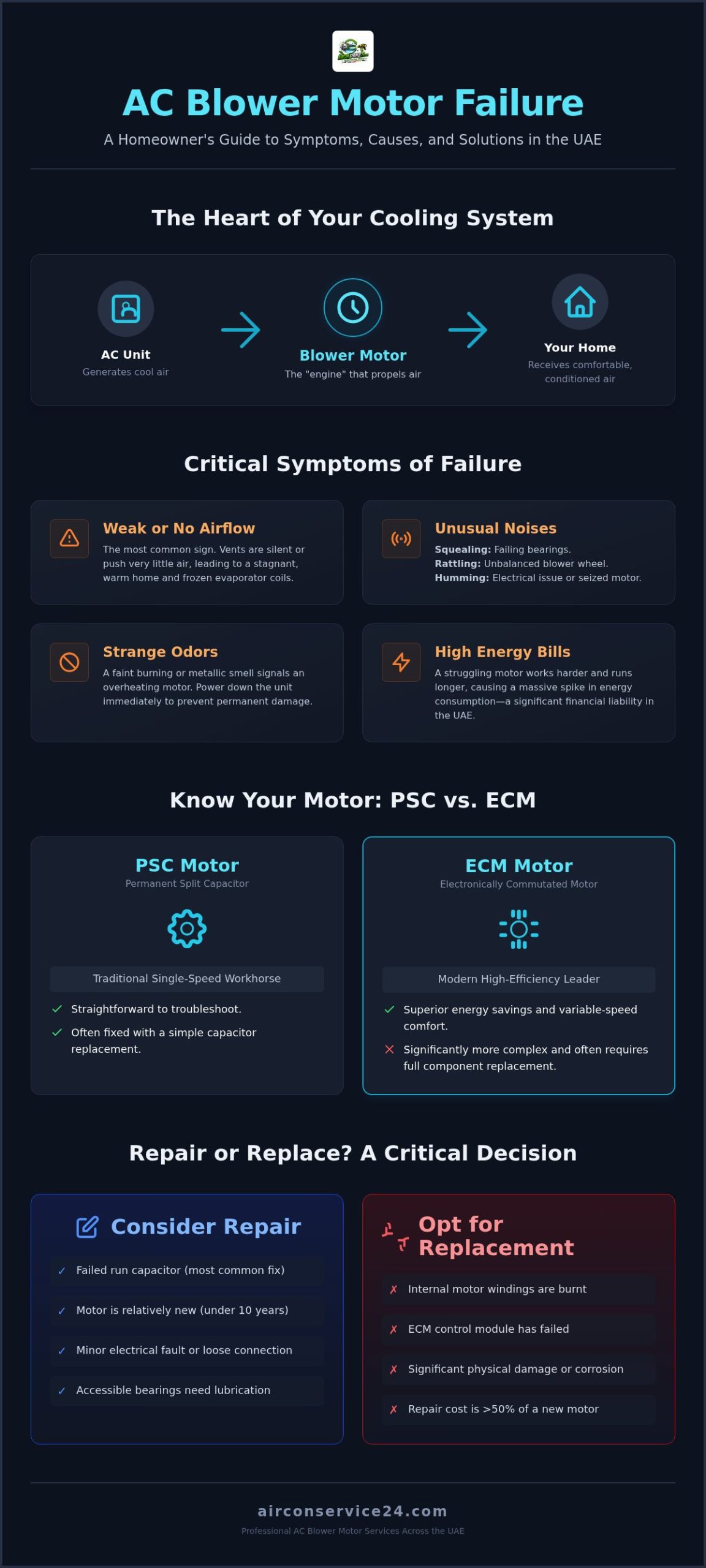
The blower motor acts as the mechanical heart of your HVAC system, serving as the primary mover of indoor climate control. It’s the engine that propels conditioned air through your ductwork and into your living space. Without this critical component, the air your system has worked so hard to chill remains trapped within the evaporator unit. This leads to ice formation on the coils and a rapid rise in indoor temperatures. Understanding the necessity of ac blower motor repair starts with recognizing its dual role in temperature regulation and moisture removal. The motor is typically housed within the Air Handling Unit (AHU), where it must operate with absolute precision to maintain domestic harmony and environmental hygiene.
The Mechanics of Airflow
Airflow is the foundation of energy efficiency in any cooling system. The blower wheel works in direct tandem with the motor to generate the necessary static pressure to move air through long duct runs. It’s vital to distinguish this indoor component from the outdoor condenser fan. While the outdoor fan’s job is to dissipate heat from the refrigerant into the environment, the indoor blower motor is responsible for your immediate comfort. If the indoor airflow is compromised, the entire system must run longer and work harder. This leads to an inevitable spike in energy consumption and premature mechanical strain. Professional maintenance of this equipment ensures that every watt of electricity translates into tangible cooling for your home.
PSC vs. ECM Motors: Which One Is in Your Unit?
Identifying your motor type is the first step in a successful ac blower motor repair strategy. Traditional units typically utilize Permanent Split Capacitor (PSC) motors. These are single-speed workhorses that are relatively straightforward to troubleshoot. Often, a simple capacitor replacement restores them to full functionality. In contrast, modern high-efficiency systems use Electronically Commutated Motors (ECM). These variable-speed leaders provide superior comfort and energy savings but are significantly more complex. Because many ECM units in the UAE market are sealed, a failure in the internal control module often necessitates a full component replacement rather than a modular repair. Understanding these nuances allows for a methodical approach that eliminates anxiety through clear technical expectations.
Common Symptoms and Causes of Blower Motor Failure
Detecting a mechanical struggle before it becomes a total cooling collapse is essential for maintaining domestic harmony. If your vents are silent but the thermostat is calling for cooling, you’re likely facing a critical bottleneck. Weak or inconsistent airflow is the most frequent precursor to an ac blower motor repair. When a motor loses its ability to reach rated RPMs, cooled air pools inside the unit, causing the evaporator coils to freeze. This inefficiency forces the compressor to run indefinitely, leading to a massive spike in energy costs. In the UAE, where cooling accounts for over 70% of building energy consumption according to the Gulf Organization for Research and Development (2024), a struggling motor is a significant financial liability.
Listen for auditory warnings that signal internal distress. A high-pitched squeal typically indicates failing bearings, while a rhythmic rattling suggests an unbalanced blower wheel. A persistent humming sound, often accompanied by a faint burning odor, points to electrical windings overheating or a seized motor. If you detect a metallic scent, it’s vital to power down the unit immediately to prevent permanent damage. Learning how to test a blower motor can help determine if the issue is a simple electrical fault or a terminal mechanical failure.
Environmental Stressors in the UAE
The local climate poses unique challenges to HVAC longevity that standard maintenance often overlooks. Fine desert dust acts as a persistent abrasive, infiltrating motor housings and creating friction that degrades internal components. This dust can also accumulate on the blower wheel, causing an imbalance that vibrates the entire indoor equipment assembly. High humidity further complicates matters by inducing corrosion on sensitive control boards and electrical connectors, which can mimic the signs of total motor failure.
The Role of the Capacitor
A failed run capacitor is the most frequent cause for an ac blower motor repair. This component delivers the electrical torque needed to initiate and sustain rotation. If your unit hums but the fan remains stationary, the capacitor has likely reached its end of life. Never attempt a DIY replacement; these components store lethal electrical charges even when the power is disconnected. You should rely on a specialist in AC maintenance who can safely discharge the system and restore your airflow with precision.
AC Blower Motor Repair vs. Replacement: A Critical Comparison
Deciding between an ac blower motor repair and a total component replacement is a pivotal moment for any property owner. This choice requires a methodical cost-benefit analysis to ensure long-term system reliability and financial integrity. We utilize the 50% Rule as a standard of transparency: if the projected cost of fixing the motor exceeds half the price of a brand-new unit, replacement is the more disciplined choice. This approach eliminates the anxiety of recurring failures and ensures your investment is focused on performance rather than temporary patches.
System age is a non-negotiable factor in this decision framework. While a well-maintained motor can last over a decade, units approaching the 10-year mark often suffer from cumulative wear that a single repair cannot resolve. In these cases, investing in a modern replacement often yields higher returns through improved energy efficiency and reduced strain on the rest of your cooling system. Identifying terminal issues early, such as burnt internal windings or failed control modules, prevents wasted expenditure on components that are fundamentally beyond restoration.
When a Simple Fix Is Sufficient
Many airflow crises are resolved through targeted, low-cost interventions that extend the life of your existing motor. Replacing a failed run capacitor is the most common repair, often restoring full functionality in a single visit. Other repairable issues include securing loose mounting brackets that cause vibration or repairing frayed wiring connectors damaged by heat. Rebalancing the blower wheel is another critical service; by removing accumulated dust and debris, we eliminate the mechanical stress that leads to bearing failure. These precise adjustments restore domestic harmony without the need for a full system overhaul.
The Case for Total Motor Replacement
Modern HVAC units often utilize sealed motors, particularly high-efficiency ECM models, which are designed for performance rather than modular repair. If the internal control board or the copper windings have suffered a catastrophic short, a full replacement is the only viable path to restoring airflow. Upgrading to a newer motor model can provide significant efficiency gains, allowing your system to move more air with less electrical consumption. When selecting a new motor, we prioritize absolute compatibility with your existing HVAC equipment to ensure seamless integration and long-term reliability. This proactive strategy safeguards your home environment against future cooling emergencies during the peak of the UAE summer.
Professional Troubleshooting and Maintenance Protocols
A disciplined approach to ac blower motor repair begins with a rigorous diagnostic protocol. Guessing at component failures leads to unnecessary costs and prolonged downtime, a luxury no one has during a UAE summer. Technicians must follow a structured workflow to eliminate variables and pinpoint the exact source of failure. This methodical sequence prevents the “parts cannon” approach, where components are replaced at random until the system starts. Instead, we focus on precision and customer clarity.
- Step 1: Power Isolation and Safety Discharge. The first priority is the total isolation of the electrical supply. Technicians must safely discharge the run capacitor to prevent accidental shocks, as these components retain high-voltage energy even after the system is off.
- Step 2: Electrical Validation. Using calibrated multimeters, we perform voltage and continuity testing. This identifies if the fault lies in the motor windings, the control board, or the external wiring harness.
- Step 3: Physical Inspection. We examine the blower assembly for physical obstructions or the presence of biofilm. This biological growth creates significant drag, forcing the motor to consume more power and generate excess heat.
These protocols ensure that every action taken is backed by technical data. By identifying the root cause, we provide a reliable solution that restores your home’s comfort without the anxiety of recurring issues.
The Hygiene-Motor Connection
Mechanical performance and environmental hygiene are inseparable. Fine dust and organic buildup on the blower wheel increase rotational resistance, which is a primary cause of motor overheating. Deep cleaning the entire assembly reduces this physical load, allowing the motor to operate within its designed thermal limits. Eliminating these contaminants also removes the source of unpleasant odours that often accompany motor strain. For a detailed breakdown of preventive care, refer to our guide on AC Maintenance UAE to understand how hygiene safeguards your mechanical investments.
Restoring Indoor Air Quality
The blower motor is the primary vehicle for air circulation in your home. If the motor and its housing are neglected, the system effectively distributes dust, allergens, and mould spores through your living spaces. Professional sanitisation serves as the essential final validation of an ac blower motor repair. We ensure the air moving through your vents is not just cool, but medically clean and fresh. This holistic approach protects the well-being of your family while ensuring the long-term reliability of the hardware. Experience the difference of a truly optimized climate by scheduling our professional AC repair and sanitisation services today.
Reliable AC Blower Services Across the UAE
AirConService24.com provides a rapid response for all blower-related emergencies across every emirate. When airflow fails in the middle of a high-heat cycle, our technicians arrive as disciplined guardians of your home’s climate. We recognize that a mechanical breakdown is a disruption to your domestic harmony and a potential risk to your family’s well-being. We don’t just offer a quick fix; we provide a comprehensive technical solution. Our approach integrates ac blower motor repair with deep cleaning and advanced sanitisation. This dual focus ensures that your system doesn’t just move air, but circulates a healthy, purified indoor environment. We prioritize transparency and integrity, eliminating customer anxiety through clear expectations and methodical execution.
Our service is deeply rooted in practical reliability and a “ready-to-act” energy. Whether you’re dealing with a seized motor in a residential villa or a failing AHU in a commercial space, we bring elite technical expertise to every site. We understand the high stakes of a cooling crisis in the UAE. That’s why our 24/7 availability is backed by a sophisticated, quality-focused demeanor. We treat your cooling system as an essential component of a comfortable lifestyle, ensuring every repair meets modern standards of excellence and sustainability.
What to Expect from Our Expert Technicians
Our experts utilize a methodical diagnostic approach powered by modern, precision equipment. You won’t receive vague guesses or “parts cannon” recommendations; you’ll get clear communication and data-driven repair strategies. We believe in the role of the “conscientious innovator,” valuing advanced methods that protect your system’s longevity. Our technicians follow a strict protocol that includes:
- Detailed voltage and mechanical load testing to verify motor health.
- Transparent reporting on the cost-benefit of repair versus replacement.
- A commitment to environmental hygiene, ensuring no dust or biofilm remains in the blower housing.
- Final system validation to confirm peak airflow and energy efficiency.
Securing Your System for the Future
Regular maintenance is the only reliable way to prevent sudden blower failure during the peak summer months. Our proactive protocols ensure your system operates at peak efficiency year-round, significantly reducing the risk of motor burnout and high energy bills. We focus on long-term system reliability rather than temporary patches. If you’ve noticed a drop in airflow or an unusual hum from your vents, act with urgency to protect your indoor climate. Contact us today for Emergency AC Repair and restore your comfort with a service that values precision, speed, and your home’s harmony above all else.
Secure Your Home’s Airflow and Comfort
Restoring your indoor climate requires more than a simple mechanical fix; it demands a comprehensive understanding of how your system interacts with the unique UAE environment. By recognizing the early warning signs of failure and applying a disciplined cost-benefit analysis, you protect both your home’s harmony and your financial interests. It’s vital to remember that a professional ac blower motor repair is most effective when paired with deep cleaning to ensure long-term reliability and medical-grade air hygiene. Our technicians act as elite guardians of your domestic well-being, standing ready to intervene with precision and speed. We provide 24/7 emergency AC repair across the UAE, ensuring that expert deep cleaning and sanitisation are included in every restoration project. Trust in our disciplined, professional technicians who prioritize results and customer clarity above all else. You don’t have to navigate a cooling crisis alone. We’re here to provide the sophisticated, high-quality support your home deserves. Your comfort is our priority.
Restore Your Airflow Today – Contact AirConService24.com
Frequently Asked Questions
Why is my AC blower humming but the fan is not spinning?
A humming sound without rotation typically indicates a failed start capacitor or a seized motor bearing. The capacitor provides the initial electrical torque required to spin the motor. If it fails, the motor attempts to start but lacks the power to overcome inertia. It’s critical to shut the system down immediately to avoid burning the motor windings. A professional ac blower motor repair often begins with testing this component to determine if a simple replacement will suffice.
Can I run my AC if the blower motor is making a grinding noise?
You shouldn’t run your system if you hear a grinding noise from the blower. This sound usually signals that the motor bearings have failed or the blower wheel has become loose and is striking the housing. Continuing to operate the unit can lead to catastrophic mechanical failure or an electrical short. Immediate isolation of the power supply is the most disciplined action to prevent expensive damage to the entire AHU assembly and ensure your home’s safety.
How much does it cost to replace an AC blower motor in the UAE?
The cost of replacing a blower motor in the UAE varies based on the unit’s specifications and technology. Modern Electronically Commutated Motors (ECM) are generally more expensive than traditional Permanent Split Capacitor (PSC) models due to their variable speed capabilities. Other factors include the difficulty of access within your specific property and the need for accompanying services like deep cleaning. We recommend a professional diagnostic visit to receive a transparent recommendation tailored to your system’s requirements and age.
How long should a standard AC blower motor last?
While a blower motor is designed to last between 10 and 15 years, the extreme UAE climate often shortens this window. High ambient temperatures require systems to operate 24/7 during peak summer months, leading to accelerated wear. Fine desert dust also increases internal friction if maintenance is neglected. Regular cleaning and sanitisation are essential to ensure your motor reaches its maximum lifespan by reducing the physical and thermal stress placed on the internal components during operation.
Will a dirty air filter really cause my blower motor to fail?
A dirty air filter is a primary cause of motor failure because it restricts the volume of air the system can pull. This restriction creates high static pressure, forcing the motor to work significantly harder to move the same amount of air. This increased workload leads to overheating and eventual burnout of the electrical windings. Maintaining clean filters is a simple but vital step in avoiding the need for an ac blower motor repair and high energy bills.
What is the difference between a blower motor and a condenser fan?
The blower motor is located in the indoor air handling unit and is responsible for circulating conditioned air through your home’s ductwork. In contrast, the condenser fan is located in the outdoor unit. Its sole purpose is to pull air across the condenser coils to dissipate heat from the refrigerant into the environment. While both are essential for cooling, they operate in different environments and face distinct mechanical stressors, particularly regarding dust and moisture exposure.
Can an AC blower motor be lubricated to stop squealing?
Most modern blower motors utilized in the UAE market are manufactured as sealed units with permanently lubricated bearings. This means they can’t be manually oiled to stop a squealing noise. If the motor is squealing, it usually indicates that the internal lubricant has dried out or the bearings have physically degraded. In these instances, a professional evaluation is necessary to decide if the unit requires a full replacement to restore silent operation and domestic harmony.
How do I know if my capacitor is bad or the motor is dead?
Distinguishing between a bad capacitor and a dead motor requires technical precision. A failed capacitor often results in a distinct humming sound as the motor tries to start without success. If the motor is completely silent and unresponsive despite receiving power, the internal windings have likely failed. Technicians use multimeters to check for electrical continuity and capacitance. This methodical testing ensures we identify the correct fault before recommending any mechanical intervention or total motor replacement.
AC Pipe Insulation Repair: Restoring Cooling Efficiency in the UAE Heat
Article by
Jon Bonnett
Australian Air Conditioning Specialist with extensive hands-on experience in AC servicing, deep cleaning, maintenance, and troubleshooting. Focused on high-quality workmanship, reliability, and professional service to UAE standards.
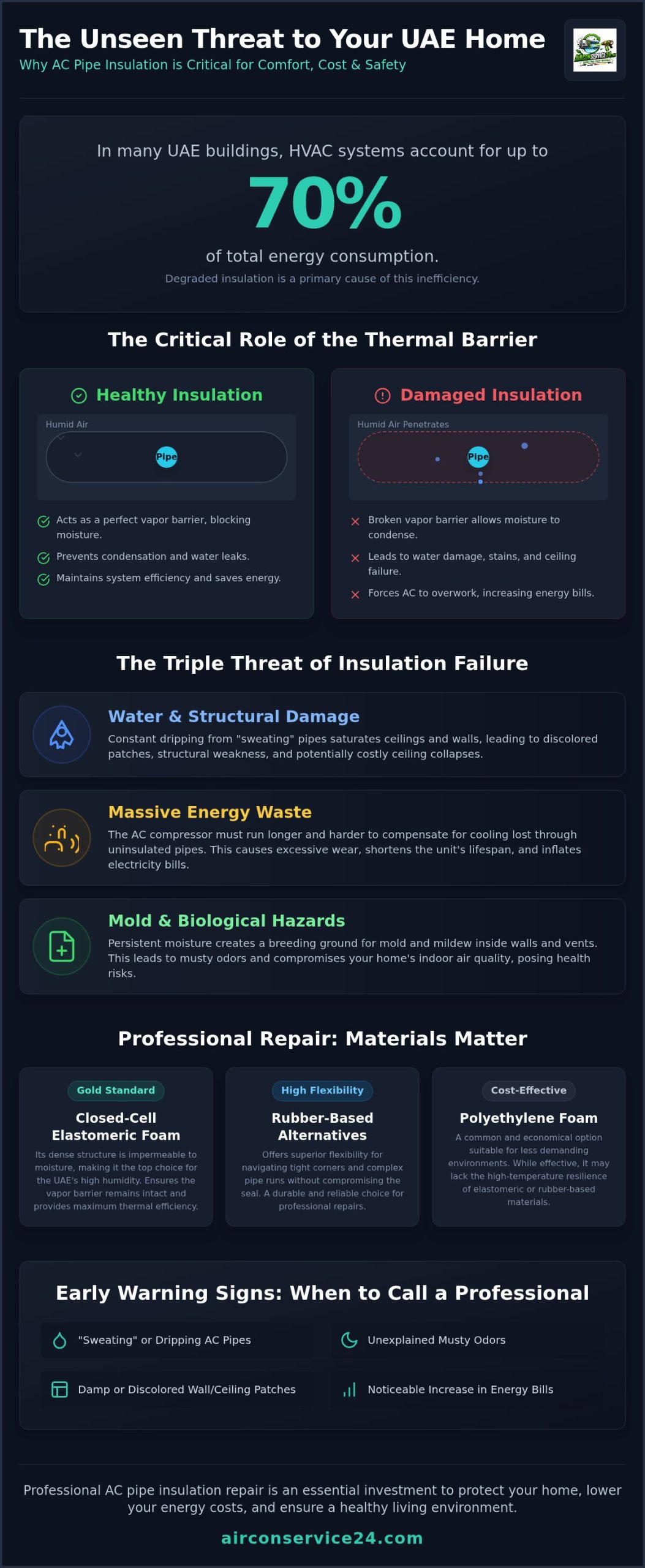
Did you know that HVAC systems account for up to 70% of energy consumption in many UAE buildings? It’s a staggering reality that underscores the immense pressure on your cooling infrastructure during the peak summer months. You’ve likely felt the frustration of discovering a damp patch on a ceiling or smelling that unmistakable musty odor of mold growth in your vents. These issues often stem from a single, overlooked failure: degraded thermal barriers. Professional ac pipe insulation repair is not merely a cosmetic fix; it’s a technical necessity to restore your system’s integrity. We understand the urgency of protecting your home from water damage and rising utility costs. This article explores how specialized repair techniques prevent condensation leaks, eliminate biological hazards, and significantly lower your energy consumption. You’ll discover why a robust vapor barrier is your first line of defense against the UAE’s extreme humidity and how modern standards, like the Al Sa’fat 2.0 Silver rating, are shaping the future of domestic efficiency.
Key Takeaways
- Understand how insulation serves as a critical vapor barrier that prevents humid air from causing condensation and structural damage.
- Recognize the financial impact of thermal loss, which can drastically increase electricity consumption in the extreme UAE climate.
- Determine if your system requires a targeted ac pipe insulation repair or a complete overhaul based on the extent of moisture intrusion.
- Identify early warning signs like sweating pipes and discolored wall patches before they lead to costly ceiling failures.
- Learn why combining insulation restoration with professional sanitisation is essential for maintaining a mold-free and healthy home environment.
AC Pipe Insulation: Why is it Critical in the UAE?
In the extreme climate of the UAE, AC pipe insulation is far more than a simple foam sleeve. It is a precision-engineered thermal cladding designed to wrap around your system’s refrigerant lines. This barrier serves two vital purposes: it prevents heat from entering the cold refrigerant and stops moisture from condensing on the pipe’s surface. Without this protection, your air conditioner works twice as hard to achieve the same cooling effect, leading to a rapid decline in system performance and an inevitable spike in utility costs.
The core of this technology lies in the “Vapor Barrier” concept. Because refrigerant pipes carry fluids at temperatures significantly lower than the surrounding air, they naturally attract moisture. In a high-humidity environment, this leads to immediate condensation. A high-quality insulation layer acts as a shield, keeping humid air away from the cold copper. When this shield fails, ac pipe insulation repair becomes a high-stakes priority to prevent the system from essentially “raining” inside your walls or ceiling voids.
The Role of Refrigerant Lines in Your Cooling Cycle
Your cooling system relies on a continuous loop where cold liquid refrigerant travels from the outdoor condenser unit to the indoor evaporator coil. The physics of “sweating” are relentless in the UAE. When these cold lines are exposed to heavy, moisture-laden air, water droplets form instantly. This moisture doesn’t just sit there; it migrates, saturating surrounding materials and creating a breeding ground for biological growth. Thermal bridging occurs when heat bypasses insulation through highly conductive materials, such as exposed copper pipes, directly compromising the system’s cooling capacity. This phenomenon forces the compressor to run longer cycles, shortening its lifespan and driving up energy bills.
Types of Insulation Materials Used in Professional Repairs
Selecting the right material is the first step in a successful ac pipe insulation repair. Professional Pipe Insulation standards in the region prioritize materials that can survive the intense UV exposure and ambient heat that define the local climate. We utilize several specific types of insulation to ensure longevity:
- Closed-cell elastomeric foam: This is the gold standard for UAE conditions. Its dense structure prevents moisture from passing through the material, ensuring the vapor barrier remains intact even if the outer surface is scuffed.
- Polyethylene foam: A cost-effective alternative often used in less demanding environments, though it lacks the high-temperature resilience of rubber-based products.
- Rubber-based alternatives: These offer superior flexibility and are excellent for navigating tight bends in the refrigerant path.
Our technicians are trained to identify the specific failure points in your existing cladding. We don’t just patch the surface. We ensure the new material is perfectly sealed at every joint. Our team utilizes specialized AC equipment and materials to ensure every repair meets these rigorous environmental demands, restoring your system to its peak operational efficiency.
The High Cost of Damaged Insulation: Condensation, Energy Loss, and Mold
Damaged insulation is a silent drain on your resources. When the thermal barrier fails, the cold refrigerant lines absorb heat from the ambient air before they ever reach your indoor unit, forcing the entire system to work harder. This is a high-stakes failure. Implementing a proper energy saving measure through a professional ac pipe insulation repair is the only way to stop this thermal bleed and restore your system’s efficiency.
Water damage is the most immediate physical consequence of insulation failure. A single breach in the foam leads to “sweating,” where droplets accumulate and eventually saturate gypsum ceilings. What starts as a small, discolored spot can quickly escalate into a structural failure. We’ve seen entire ceiling sections collapse because a minor drip was ignored for too long. These repairs are far more expensive than the simple maintenance required to keep your pipes shielded.
Your AC compressor carries the heaviest burden when insulation is compromised. Poor thermal protection forces the system to run longer cycles to compensate for the lost cooling capacity. This constant overworking increases mechanical wear, shortens the unit’s lifespan, and ensures your electricity bills remain unnecessarily high. You’re effectively paying to cool the voids in your walls rather than your living space.
Vapor Drive and the Humidity Factor
The UAE’s high humidity creates a relentless “vapor drive.” This physical force pushes moisture from the humid outdoor air into the cold, low-pressure environment inside the insulation. If the outer skin is punctured or cracked, the material absorbs water like a sponge. This creates an invisible threat: the refrigerant pipes begin to corrode underneath the wet foam. This external corrosion can lead to pinhole leaks that compromise your entire cooling circuit, necessitating a complex and costly intervention.
Health Risks of Mold-Infested Insulation
Damp insulation is the ideal environment for mold spores to flourish. Once colonies establish themselves in the dark, moist spaces behind your walls, they release spores that can be drawn into your air supply via the fan coil unit. If you notice a persistent musty smell, it’s often a sign of insulation failure. Professional AC sanitisation is vital in these cases to eliminate the biological hazard. A prompt ac pipe insulation repair ensures your home remains a healthy sanctuary rather than a source of respiratory irritation. You can book a professional inspection to identify these hidden failures before they become a threat to your family’s well-being.
AC Pipe Insulation Repair vs. Full Replacement: A Comparison
Deciding whether to patch a specific area or overhaul the entire refrigerant line requires a methodical assessment. We don’t believe in unnecessary replacements. Our technicians focus on three critical factors: the age of the material, the depth of moisture penetration, and the structural integrity of the foam. A disciplined approach ensures you don’t overspend on a full replacement when a targeted ac pipe insulation repair is perfectly viable.
A targeted repair is sufficient when the damage is localized. Small tears from a recent maintenance visit, minor joint separations, or surface-level UV damage are prime candidates for a surgical approach. However, replacement is mandatory if the insulation has become water-logged. Once the material acts like a wet sponge, it loses all thermal resistance and becomes a mold hazard. Crumbling or “dusting” foam also indicates that the material has reached the end of its chemical lifespan and can no longer protect the copper lines.
Beware the false economy of DIY patches. Using duct tape to close gaps is a temporary illusion of a fix. Duct tape is not a professional vapor seal. It lacks the thermal properties and adhesive strength to withstand the relentless vapor drive typical of the UAE climate. Professional materials are designed to expand and contract with the pipes, maintaining an airtight seal that household tapes simply cannot provide.
The Professional Repair Process
Our workflow is designed for precision and predictability. We follow a strict three-step protocol to restore your system’s integrity:
- Step 1: We strip back the damaged cladding until we find dry, healthy material to ensure the repair bond is secure.
- Step 2: Our technicians clean and treat the copper pipe for any surface oxidation, ensuring the metal is pristine before re-insulating.
- Step 3: We apply new closed-cell insulation using specialized AC equipment and materials, including vapor-seal adhesives that create a seamless, airtight barrier.
Cost-Benefit Analysis for Homeowners
Professional ac pipe insulation repair pays for itself through improved efficiency. By eliminating thermal loss, you see immediate reductions in your monthly utility consumption. While a repair is a cost-effective short-term solution, a full replacement is often the smarter investment for systems older than eight years. A professional repair can extend the life of existing insulation by several years, whereas a full replacement resets the clock for a decade of optimal performance.
Identifying the Signs: When to Call for Professional AC Repair
Don’t wait for a ceiling to collapse. Early detection is your best defense against structural water damage. One of the most common signs that you need ac pipe insulation repair is visible “sweating” or water dripping from your AC unit or ceiling access panels. When the vapor barrier is compromised, the temperature differential between the cold refrigerant and the humid ambient air causes moisture to accumulate rapidly, leading to the visible dripping you see at access points.
Inspect your walls for subtle changes in texture or color. Discolored patches or peeling paint on walls near the refrigerant line path are clear indicators of a hidden leak. This isn’t just a cosmetic issue; it’s a sign that moisture is migrating through your building’s structure. If the drywall feels damp to the touch, the insulation behind it has likely failed completely, allowing condensation to saturate the surrounding materials.
Ice buildup on the copper pipes is a critical warning sign that should never be ignored. Whether frost appears on the indoor evaporator coil or the outdoor unit’s valves, it indicates that the pipes are completely exposed to humid air or that the system’s thermal balance is lost. This imbalance can lead to catastrophic compressor failure if left unaddressed. Identifying these signs early allows for a targeted ac pipe insulation repair before the damage spreads to more expensive mechanical components.
Physically check the lines where they are accessible. Healthy insulation should feel firm and resilient. If you encounter a crumbling or “spongy” texture when touching the black foam, the material has reached its saturation point. At this stage, the insulation is no longer a barrier; it is a liability that holds water directly against your copper pipes, which can accelerate surface oxidation and eventually lead to refrigerant leaks.
The Outdoor Unit Inspection
The UAE sun acts as a relentless stress test for mechanical components. Inspect the pipes connecting to your outdoor condenser unit. If the insulation appears brittle, cracked, or is turning a chalky white color, UV degradation has destroyed its cellular structure. You might also notice bird or pest damage; small animals often peck at the foam to create nesting material. Leaving these lines exposed significantly increases the risk of emergency AC failure during peak summer heat when the system is under maximum load.
The Indoor Performance Check
Performance drops are often the first sign of hidden insulation gaps. If the air coming out of your vents feels less cold than usual, your system is likely losing its cooling capacity through unshielded pipes. Pay attention to odors. Unexplained musty smells during the first ten minutes of operation suggest that mold is breeding in damp insulation sections. Our technicians use advanced thermal imaging to detect these cold spots and gaps without tearing into your walls, ensuring a non-invasive and precise assessment. If you notice any of these red flags, book a professional AC repair to protect your home’s air quality and cooling efficiency.
Expert Solutions with AirConService24: Restoring Your Home’s Harmony
At AirConService24, we operate as the disciplined guardians of your indoor environment. We understand that a cooling failure in the UAE heat is not just a mechanical glitch; it’s a disruption to your family’s well-being and domestic harmony. Our approach to ac pipe insulation repair begins with a methodical, multi-point inspection. We don’t believe in superficial fixes. Instead, our specialists investigate the full extent of moisture migration and thermal bridging to ensure the root cause of every leak is permanently addressed.
Transparency is the cornerstone of our professional service. Before any work begins, our technicians provide a comprehensive report detailing the exact state of your thermal barriers. We show you the damage and explain the specific technical solution required, eliminating the anxiety of hidden costs. We utilize industrial-grade adhesives and advanced UV-resistant coatings specifically engineered for the high-salinity and extreme heat conditions of the UAE. This ensures that your ac pipe insulation repair outlasts standard aftermarket patches and provides a robust vapor seal for years to come.
A truly effective restoration must be part of a holistic health strategy. Because damp insulation often harbors biological contaminants, we integrate our repairs with professional deep cleaning and sanitisation. This dual approach removes the physical threat of water damage while simultaneously purging your system of mold spores and allergens. We don’t just restore mechanical efficiency; we restore the purity of your home’s air supply.
Why AirConService24 is the Professional Choice
Our team remains ready to act when you need us most. We offer 24/7 availability for urgent leaks and insulation crises, ensuring that a failing vapor barrier doesn’t lead to a collapsed ceiling or structural damage in the middle of the night. Every technician is rigorously trained in the latest HVAC environmental hygiene standards, moving beyond basic maintenance to provide a premium, health-focused service. Our commitment is to your comfort, providing reliable cooling that you can trust through the most punishing summer months.
Schedule Your Insulation Audit Today
Proactive care is the most effective way to manage your home’s cooling infrastructure. Don’t wait for the first drip to appear on your ceiling or for your electricity bills to spiral out of control. A comprehensive AC check-up from our experts includes a detailed audit of your pipe and duct integrity. Identifying a thinning barrier now can save thousands in structural repairs and unnecessary energy consumption later. Secure your cooling efficiency and protect your home’s air quality. Contact AirConService24 today to schedule your professional insulation audit and ensure your system is prepared for the heat.
Protect Your Home with Superior Thermal Integrity
Maintaining your system’s thermal barrier is a fundamental step in safeguarding your property from the UAE’s relentless humidity. Compromised insulation is more than a minor mechanical flaw; it’s a direct path to structural water damage, biological growth, and inflated utility expenses. A timely ac pipe insulation repair restores your system’s efficiency and ensures your living space remains a healthy, mold-free sanctuary for your family.
AirConService24 stands ready to act as your home’s disciplined guardian. We utilize UV-resistant materials specifically designed for maximum desert durability, ensuring your vapor barrier remains intact against the harshest elements. Our comprehensive service includes expert deep cleaning and sanitisation to provide a total health solution. With our 24/7 emergency response available across the UAE, you can rely on us to resolve cooling crises with precision and speed.
Book Your Professional AC Insulation Inspection Today and take definitive control of your indoor climate. Investing in professional restoration now prevents the high-stakes structural emergencies of tomorrow. You deserve a home that is consistently cool, efficient, and safe.
Frequently Asked Questions
Can I repair AC pipe insulation myself with store-bought foam?
You should avoid DIY attempts for this specific technical task. Professional ac pipe insulation repair requires industrial-grade, closed-cell elastomeric foam and specialized vapor-seal adhesives that aren’t typically available in retail stores. Standard foam tapes often fail to create an airtight barrier, allowing humid air to reach the cold copper. This leads to hidden condensation and internal corrosion that can eventually destroy your refrigerant lines and cause expensive leaks.
How long does AC pipe insulation typically last in the UAE?
In the intense climate of the region, outdoor insulation generally lasts between 3 and 5 years. The relentless UV exposure and extreme ambient temperatures cause standard materials to become brittle and crack. Indoor sections can last up to 10 years if the environment remains dry. However, high humidity levels can accelerate degradation, so we recommend annual audits to identify crumbling or spongy sections before they lead to structural water damage.
Why is my AC pipe dripping water even though it’s covered in foam?
Dripping indicates a failure in the vapor barrier. If the insulation has even a microscopic tear or an unsealed joint, humid air penetrates the material and hits the cold pipe. This causes moisture to condense inside the foam, eventually saturating it like a sponge. Once the material is water-logged, it loses all thermal resistance. The resulting “sweating” leads to persistent dripping that can cause your gypsum ceilings to sag or collapse.
Will replacing my AC insulation really lower my electricity bills?
Yes, restoring your thermal barriers is a highly effective way to reduce utility costs. When pipes are poorly shielded, the refrigerant absorbs heat from the surrounding air before reaching the indoor unit. This “thermal loss” forces your compressor to run longer, more frequent cycles to maintain your desired temperature. By completing an ac pipe insulation repair, you ensure the system operates at peak efficiency, which significantly lowers your monthly energy consumption during the summer.
Is the mold inside the AC insulation dangerous to my family’s health?
Mold growth within damp insulation poses a serious risk to your indoor air quality. Spores thrive in the dark, moist environment provided by failed foam and can be drawn into your home’s air supply via the fan coil unit. This often results in persistent musty odors and respiratory irritation. We combine our insulation repairs with professional sanitisation to eliminate these biological hazards, ensuring your home remains a healthy and safe environment for everyone.
What happens if I leave the AC pipes uninsulated for a few weeks?
Leaving pipes exposed for even a short period can lead to immediate and costly consequences. Without protection, the cold lines will produce constant condensation, which will saturate your walls or ceilings and trigger mold growth within days. Mechanically, the system will struggle to provide cold air, putting immense strain on the compressor. This overworking increases the risk of a total system failure during a heatwave, potentially leaving you without cooling when you need it most.
How much does it cost to repair AC pipe insulation in the UAE?
The cost depends on the accessibility of the refrigerant lines and the severity of the moisture intrusion. A targeted repair is a strategic investment that is far less expensive than replacing a water-damaged ceiling or a failed compressor. We prioritize transparency, providing a thorough inspection and a clear report on the damage before any work begins. This ensures you only pay for the specific technical solutions required to restore your system’s integrity and performance.
How can I tell if my insulation is moldy without cutting it open?
You can identify potential mold growth by checking for unexplained musty smells when the AC starts. Physically inspect the foam for dark stains or a spongy, soft texture when pressed. If the material doesn’t bounce back, it’s likely saturated with water, which is a primary indicator of mold colonies. Our specialists use advanced thermal imaging cameras to detect these hidden moisture pockets and insulation gaps accurately, providing a precise diagnosis without damaging your property.
AC Not Responding to Remote Control? Professional Troubleshooting Guide 2026

Article by
Jon Bonnett
Australian Air Conditioning Specialist with extensive hands-on experience in AC servicing, deep cleaning, maintenance, and troubleshooting. Focused on high-quality workmanship, reliability, and professional service to UAE standards.
Imagine it’s a mid-August afternoon with the UAE sun pushing temperatures past 45°C, and your primary source of relief suddenly ignores your every command. You’re clicking the power button with increasing intensity, yet the unit remains stubbornly silent. This specific moment of helplessness is more than just a minor inconvenience; it’s a direct threat to your home’s comfort and your family’s well-being. When you find your ac not responding to remote control, the immediate anxiety regarding expensive PCB repairs or the cost of a full system replacement can be overwhelming.
We understand that you need fast, transparent answers to restore order to your living environment. You’re likely wondering if a simple battery change will suffice or if the internal infrared sensor has finally succumbed to the intense regional humidity. This professional guide eliminates the guesswork by providing a methodical breakdown of the most common failure points. We’ll walk you through a series of diagnostic steps to identify whether the fault lies within the handheld device, the receiver module, or the main control board. By the end of this article, you’ll have a clear roadmap to restore cooling efficiency and avoid unnecessary service fees in 2026.
Key Takeaways
- Perform a rapid smartphone camera test to visualize the infrared signal and immediately determine if the fault lies within the handheld device or the AC unit.
- Identify how accumulated dust and biofilm on the internal receiver panel can lead to your ac not responding to remote control, requiring professional deep cleaning to restore signal clarity.
- Understand the impact of UAE voltage fluctuations and high humidity on internal PCB components to prevent permanent electronic degradation.
- Evaluate the critical technical differences between universal remotes and OEM replacements to ensure full compatibility with modern, high-performance inverter systems.
- Establish a proactive maintenance and sanitisation schedule to protect sensitive electronic sensors and ensure 24/7 system responsiveness throughout the summer.
The cooling stops. The heat rises. You’re left pointing a plastic brick at a silent machine while the UAE sun intensifies outside. When you find your ac not responding to remote control, the first priority is isolating the failure point with clinical precision. You’re likely feeling the immediate pressure of a rising indoor temperature, but before assuming the internal circuit board has failed, we must determine if the signal is actually leaving your hand. This methodical approach prevents unnecessary replacement costs and identifies the root cause within minutes.
The Smartphone Camera IR Test
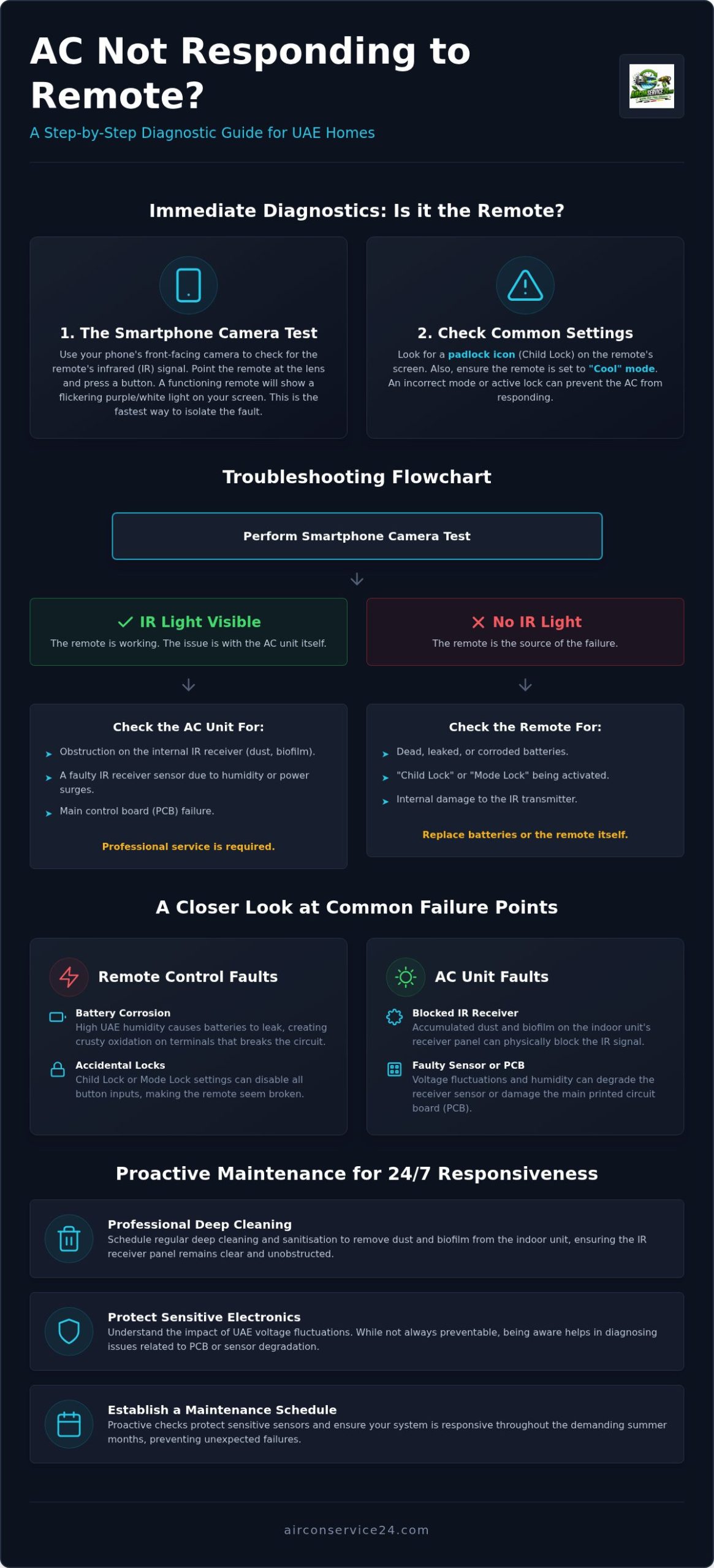
Most modern remotes use infrared light to communicate with the indoor unit. Since this light is invisible to the human eye, you can use a digital sensor to visualize the transmission. Open the camera app on your smartphone; the front-facing camera usually works best in 2026 because it often lacks the heavy IR filters found on primary lenses. Point the remote directly at the lens and press the power button. If the remote is functioning, you’ll see a flickering purple or white light on your phone screen. This simple diagnostic reveals the fundamental physics of how remote controls work by converting light pulses into data. If no light appears on your screen, the remote itself is the source of the failure.
Common Remote Setting Errors
Sometimes the hardware is perfect, but the logic is locked. Look closely at your remote’s LCD screen for a small padlock icon. This indicates the “Child Lock” is active, which prevents any button from triggering a response. You can usually deactivate this by holding the “+” and “-” temperature buttons simultaneously for three seconds. Additionally, verify that the remote is set to “Cool” mode. In some instances, a “Mode Lock” may prevent the unit from responding to cooling commands if it was previously restricted by a facility manager.
If the screen is blank or the digits are fading, inspect the battery compartment immediately. In the UAE’s high humidity, batteries frequently leak or develop white, crusty oxidation on the terminals. This corrosion breaks the electrical circuit and prevents the remote from powering its transmitter. Clean the contacts with a dry cotton swab and insert fresh alkaline batteries. If the unit still ignores your commands, perform a hard reset. Remove the batteries from the remote and unplug the AC unit from its power source for 60 seconds. This clears the temporary memory and often resolves communication glitches. For issues involving the internal AC equipment or the receiver panel, professional technical support is the next logical step.
Technical Failures: When the AC Unit Stops Listening
If your remote passes the camera test described in the previous section, the diagnostic focus must shift to the internal electronics of the indoor unit. When you face an ac not responding to remote control, the failure often stems from the ‘eye’ of the system: the infrared receiver sensor. This small component is responsible for capturing and decoding the binary light pulses used in infrared remote technology. In the UAE’s demanding climate, these sensors are frequently exposed to high humidity and electrical noise, which can cause the delicate semiconductor material to degrade or short-circuit entirely.
To confirm a sensor failure, locate the ‘Emergency Run’ or ‘Manual’ button, usually hidden behind the front panel of your indoor unit. If the system starts and cools normally when this button is pressed, you’ve successfully isolated the fault to the receiver module or the communication path to the main board. This is a critical distinction; it proves the compressor and fan are functional, meaning you’re likely looking at a component repair rather than a total system replacement. If the system remains dead even after a manual override, the issue is significantly deeper.
Faulty IR Receiver Sensors
The receiver sensor is the primary gateway for all user commands. In 2026, many high-efficiency inverter models utilize sophisticated sensors that are sensitive to voltage fluctuations. A sudden surge in the local power grid can easily overwhelm the sensor’s protection circuit, rendering it blind to your remote’s signals. Because these modules are integrated into the internal wiring of the AC equipment, they require professional handling to avoid damaging the surrounding plastic housing or the main logic board. Attempting a DIY repair on these sensitive components often leads to accidental shorts that can escalate repair costs.
PCB and Control Board Degradation
The Printed Circuit Board (PCB) acts as the central nervous system of your air conditioner. In the UAE, heat stress is a primary driver of electronic failure. During peak summer months, internal temperatures within the unit’s casing can lead to thermal fatigue in solder joints. Over time, these joints may crack, creating intermittent connections that make the unit appear ‘frozen’ or unresponsive to any input. If your system ignores both the remote and the manual override button, the PCB has likely suffered a logic failure or a blown capacitor. If you suspect your electronics have been compromised by the heat, a professional diagnostic check can determine if the board can be repaired or if a full replacement is the most cost-effective path forward.
The Hygiene Connection: Dust, Biofilm, and Signal Interference
While most troubleshooting begins with batteries or circuit boards, the root cause of your ac not responding to remote control is frequently a matter of basic hygiene. In the UAE’s unique environment, fine desert dust and airborne particulate matter don’t just settle on your furniture; they infiltrate the microscopic gaps in your air conditioner’s housing. Over time, these particles form a dense, opaque layer over the infrared receiver window. Because infrared signals are essentially pulses of light, any physical obstruction acts as a filter that weakens or completely blocks the command before it reaches the internal sensor.
The relationship between indoor air quality and electronic performance is direct and measurable. When a system operates in a high-dust environment without regular maintenance, the receiver panel becomes coated in a sticky biofilm. This residue, a byproduct of high humidity mixing with organic dust, creates a “ghosting” effect where the signal reflects off the grime instead of penetrating the sensor. To ensure your system remains responsive, you can learn about our deep cleaning and sanitisation services which are designed to clear these critical signal pathways and protect sensitive electronics from environmental degradation.
Obstructed Receiver Windows
The display panel on your indoor unit serves as the gateway for every remote command. If you notice a visible film or a dull appearance on the plastic “eye” of the AC, your signal is likely being strangled by surface grime. Professional sanitisation goes beyond a simple wipe-down; it involves removing the accumulated bio-growth that thrives in the cool, damp areas near the receiver. By restoring the clarity of the receiver window, you allow the IR sensor to detect low-strength signals from across the room, effectively eliminating the need to stand directly under the unit to change the temperature.
Environmental Interference
External factors can also drown out your remote’s signal, creating the illusion of a hardware failure. In 2026, the prevalence of high-output LED lighting and the intense UAE sunlight can introduce significant “optical noise” into a room. Infrared light from the sun is powerful enough to saturate the AC’s receiver, making it unable to distinguish the remote’s specific binary code from the background light. If your unit works perfectly at night but fails during the day, consider the following strategies:
- Close heavy curtains or blinds during peak sunlight hours to reduce IR saturation.
- Check if new electronic appliances or smart home hubs are positioned directly opposite the AC receiver.
- Ensure the remote’s transmitter lens is free of fingerprints or oils that scatter the light beam.
Maintaining a sterile, dust-free environment is the most effective way to prevent these communication breakdowns. When signal interference persists despite a clean exterior, it typically indicates that dust has bypassed the outer casing and settled directly on the internal PCB components, necessitating a professional technical intervention.
Professional Resolution: Universal vs. OEM Replacement
When your ac not responding to remote control persists after cleaning and battery checks, the final stage of troubleshooting involves selecting a replacement device. This decision isn’t merely about finding a button that turns the power on; it’s about maintaining the sophisticated logic of your cooling system. In 2026, air conditioning units have evolved into complex climate control systems that require precise communication between the handheld transmitter and the internal PCB. Choosing between a universal remote and an Original Equipment Manufacturer (OEM) model can determine whether your unit operates at peak efficiency or becomes a source of daily frustration. A mismatched device might even cause logic errors within the main board over time.
Universal Remote Limitations
Universal remotes are often marketed as a catch-all solution, but they frequently fall short when paired with high-performance inverter models. While they can typically manage basic temperature adjustments, they often lack support for specialized features such as ‘I-Feel’ sensors, ‘Eco-Navi’ energy-saving modes, or advanced vertical and horizontal swing controls. This ‘partial pairing’ means you might restore basic cooling but lose the very features you paid for when purchasing a premium unit. A universal remote serves as a valid emergency stop-gap, but it’s rarely a permanent solution for maintaining Expert AC maintenance for UAE homeowners. Relying on an incompatible device can lead to erratic system behavior, which complicates future diagnostics.
Sourcing Genuine Replacement Parts
OEM remotes are engineered specifically for the frequency and binary code of your unit’s receiver module. They offer superior durability in the high-use environments of the UAE, where remotes are handled multiple times a day throughout the long summer. To ensure you source the correct part, look for the specific model number usually printed inside the battery compartment or on the rear casing. Professional technicians play a vital role here; they don’t just guess which remote might work. They use diagnostic tools to verify the frequency match before finalizing the replacement, ensuring that the new device communicates perfectly with the internal electronics. This precision is essential when your ac not responding to remote control because of a specific signal mismatch rather than a hardware failure. If you’re struggling to find the exact match for your system, our team provides 24/7 support for expert AC repair and parts sourcing.
Preventive Care: Ensuring 24/7 Responsiveness
Restoring a system after it fails is a necessity, but preventing the failure entirely is the hallmark of sophisticated home management. In intense summer conditions, your air conditioner operates under extreme thermal loads that can accelerate the degradation of sensitive electronics. When you encounter your ac not responding to remote control, it’s often the final symptom of a long-term accumulation of dust or electrical stress. Shifting your strategy from reactive repairs to proactive preventive care ensures that your indoor environment remains a sanctuary of health and comfort throughout 2026.
A disciplined maintenance schedule acts as a protective shield for your system’s “nervous system.” By addressing minor electronic drifts and environmental obstructions before they manifest as total unresponsiveness, you extend the operational lifespan of your equipment. This methodical approach doesn’t just save you from the immediate frustration of a broken remote; it protects the high-value internal components like the main logic board from premature burnout. If you find yourself in a situation where the system has already stopped responding during extreme temperatures, Emergency AC repair for cooling relief is available to restore your home’s climate immediately.
The Maintenance Advantage
Professional maintenance visits in 2026 involve much more than just washing filters. Our technicians perform a comprehensive audit of the communication pathways between your remote and the indoor unit. This includes a precise cleaning of the IR receiver window to ensure 100% signal transparency and a detailed inspection of the wiring harnesses. Loose or oxidized connections are a common cause of intermittent signal loss and can lead to dangerous PCB surges if left unaddressed. By tightening these electrical points and verifying the sensor’s calibration, we eliminate the primary triggers that lead to an unresponsive system.
Ready-to-Act Support
DIY troubleshooting has its limits. While changing batteries is a logical first step, digging into the internal receiver modules or attempting to bypass safety switches can lead to irreversible damage. We position ourselves as the elite guardians of your domestic harmony, offering a “ready-to-act” energy that mirrors the urgency of your situation. Our commitment to transparency means you’ll always receive a clear explanation of whether a component needs a simple cleaning, a technical repair, or a full OEM replacement. We value modern, environmentally responsible methods that prioritize system longevity and indoor air quality above all else.
Don’t let a minor communication glitch escalate into a total cooling failure. Whether you need a deep sanitisation of your AC equipment or a technical diagnostic of your control board, our specialists are available around the clock to provide precision solutions. Contact our experts for immediate AC repair and ensure your home remains perfectly cooled regardless of the external temperatures.
Restoring Precision Control to Your Indoor Climate
Facing an ac not responding to remote control during the peak of a UAE summer requires a methodical response rather than guesswork. We’ve established that while a simple battery change is the first step, the root cause often involves signal-blocking biofilm or heat-induced electronic degradation. By utilizing the smartphone camera test and prioritizing professional sanitisation, you can effectively distinguish between a minor hardware glitch and a more serious logic board failure that requires technical intervention.
Our elite technicians are trained in all major HVAC brands and specialize in the deep cleaning and sanitisation required to protect sensitive IR sensors from environmental interference. We understand the high stakes of a failed cooling system, which is why we provide 24/7 emergency AC response across the nation. Don’t let a communication breakdown compromise your comfort or well-being in 2026. Precision diagnostics and proactive maintenance are the most reliable ways to ensure your system remains responsive to every command.
Restore your cooling now with AirConService24.com expert repairs
Take command of your home environment today and ensure your cooling system remains as responsive and efficient as it was on day one. Your comfort is our priority, and we’re ready to act whenever you need us.
Frequently Asked Questions
Can I use my smartphone as an AC remote if the original is lost?
You can use your smartphone as a replacement if your device features an integrated infrared (IR) blaster or if your air conditioner is a smart model with Wi-Fi connectivity. Most flagship phones in 2026 rely on Wi-Fi apps rather than IR. While convenient, these apps often lack the granular control of an OEM device. If you’re struggling with an ac not responding to remote control, professional repair of the internal receiver is often more reliable than app-based workarounds.
Why does my AC remote screen show numbers but the unit doesn’t beep?
This symptom indicates that the remote’s logic board and LCD are powered, but the infrared signal isn’t reaching the indoor unit. The fault typically lies in a failed IR transmitter LED or a malfunctioning receiver sensor inside the AC. In the UAE’s humid climate, internal corrosion often prevents the unit from “hearing” the remote. Our technicians specialize in diagnosing these silent failures to determine if a component repair or a deep cleaning is required to restore communication.
How do I know if my AC sensor is broken or just dirty?
A dirty sensor often results in intermittent responsiveness or requires you to stand directly under the unit to trigger a response. If the system fails to respond entirely from any angle after you’ve wiped the receiver window, the internal sensor has likely shorted due to voltage fluctuations. We recommend professional sanitisation first; if the biofilm is removed and the unit remains silent, a technical replacement of the internal IR module is the next logical step for restoration.
Is it worth repairing an old AC remote or should I buy a new one?
Repairing a handheld remote is rarely cost-effective compared to sourcing a genuine OEM replacement in 2026. The delicate plastic housings and microscopic solder joints make manual repairs labor-intensive and prone to future failure. However, if the issue is actually within the AC unit’s receiver board, buying a new remote won’t solve the problem. We provide precision diagnostics to ensure you don’t waste money on a new remote when the actual fault lies within the internal electronics.
Will a universal remote work with all AC brands in the UAE?
Universal remotes work with approximately 90% of standard split systems in the UAE, but they often fail to support advanced inverter features. You might lose access to specialized energy-saving modes or precise vertical swing controls. For high-performance systems, we always recommend OEM parts to ensure full compatibility. If your ac not responding to remote control is due to a frequency mismatch, a universal device might only provide a partial, frustrating solution that limits your system’s efficiency.
Does the heat in the UAE affect how long AC remote batteries last?
The extreme UAE heat and high humidity significantly impact battery longevity and safety. High ambient temperatures increase the rate of internal chemical discharge, while humidity promotes terminal corrosion and electrolyte leakage. This leakage can permanently damage the remote’s internal circuitry. We advise residents to use high-quality alkaline batteries and inspect the compartment every three months to prevent acidic damage from compromising your remote’s transmitter during the peak summer months when cooling is most critical.
What should I do if the emergency button on the AC works but the remote doesn’t?
If the manual emergency button triggers the cooling cycle, your compressor and main PCB are likely functional. This narrows the fault down to either the handheld remote or the infrared receiver module. Since the unit can still operate, the high-voltage components are safe, but you’ve lost the ability to modulate temperature or fan speeds. You should contact a specialist to test the receiver’s voltage and signal reception to restore full wireless control and avoid rising indoor temperatures.
Can bright sunlight prevent my AC remote from working?
Intense UAE sunlight contains high levels of infrared radiation that can saturate the AC unit’s receiver. This “optical noise” prevents the sensor from distinguishing the remote’s specific binary code from the background light. If your unit only fails during daylight hours, try closing the curtains or repositioning the unit’s receiver window. If the problem persists even in the shade, it indicates a weakened sensor that requires professional inspection to ensure 24/7 responsiveness throughout the cooling season.
AC Troubleshooting UAE: The Expert Guide to Cooling and Air Quality (2026)
Article by
Jon Bonnett
Australian Air Conditioning Specialist with extensive hands-on experience in AC servicing, deep cleaning, maintenance, and troubleshooting. Focused on high-quality workmanship, reliability, and professional service to UAE standards.
In the 50-degree peak of a UAE summer, your air conditioning system isn’t just a mechanical luxury; it’s the primary guardian of your family’s health and comfort. You’ve likely felt that immediate spike of anxiety when the vents begin blowing lukewarm air or a persistent, musty odor starts to compromise your indoor sanctuary. Navigating the complexities of ac troubleshooting uae requires more than just a quick fix. It demands a methodical approach to handle the extreme operational loads that residents face in 2026. Conflicting online advice often leads to more confusion, leaving homeowners worried about escalating repair costs while the indoor temperature continues to climb.
We’ve designed this expert guide to empower you with professional diagnostic steps that restore cooling immediately and eliminate the biological films causing those unpleasant smells. You’ll master how to identify common failures before they become expensive emergencies, ensuring your system operates with the precision required by the latest UAE Climate Decree standards. By following this structured path, you’ll achieve lower energy bills through peak efficiency and gain total peace of mind regarding your home’s air quality. From checking refrigerant levels to understanding advanced sanitisation needs, we’re providing the clarity you need to maintain a pristine, cool environment all year round.
Key Takeaways
- Understand how the extreme desert heat and abrasive dust force UAE systems to run at maximum capacity, making specialized maintenance a necessity rather than an option.
- Master the fundamental steps of ac troubleshooting uae to accurately identify whether your cooling failure stems from a simple filter clog or a more serious mechanical issue.
- Learn to eliminate persistent musty odors by targeting the biofilm and sludge that accumulate in drain pans, moving beyond temporary fragrance sprays toward deep sanitisation.
- Execute a structured homeowner diagnostic checklist to resolve minor thermostat and airflow issues immediately, potentially avoiding unnecessary service callout fees.
- Recognize how professional multi-point inspections and annual maintenance contracts can reduce energy consumption by 15% while significantly extending your system’s operational lifespan.
The UAE Environmental Load: Why AC Systems Fail
The UAE environment is a high-stress arena for mechanical systems. Between April and October, units often run at 100% capacity without a single hour of rest. This relentless operational load accelerates component wear and makes ac troubleshooting uae a frequent necessity for residents. Understanding the foundational HVAC system principles is the first step toward diagnosing why a unit that worked perfectly yesterday is struggling today. Mechanical fatigue isn’t just a possibility in this region; it’s a certainty for any system that lacks a proactive, disciplined health strategy.
The Impact of Dust and Sand
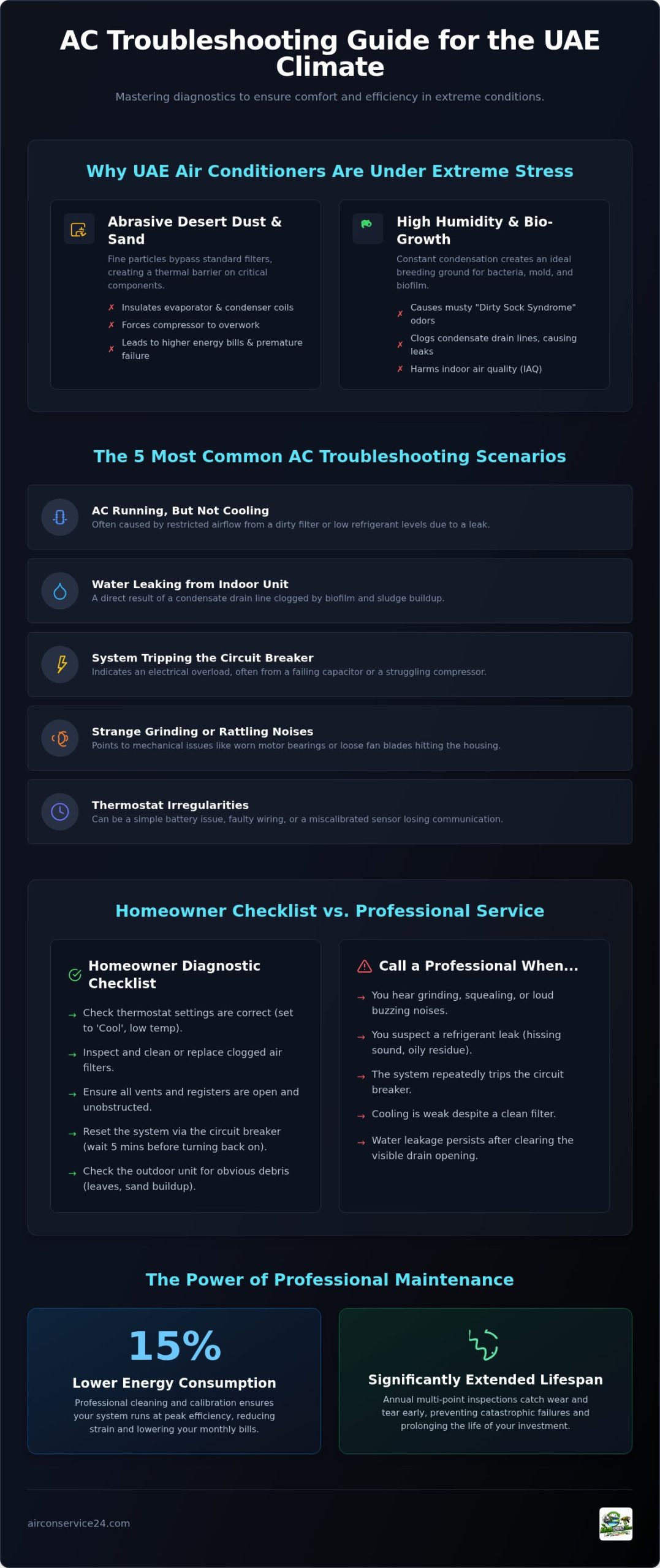
Fine desert dust is more than a nuisance. It’s an abrasive contaminant that settles deep within your system. These microscopic particles frequently bypass standard mesh filters to coat the evaporator coils and the external condenser unit. Once a layer of dust accumulates, it acts as a thermal insulator, preventing the critical heat exchange process that keeps your home cool. This restriction forces the compressor to work significantly harder to reach your thermostat’s target temperature. This extra strain directly leads to higher energy consumption and the premature failure of sensitive specialized AC equipment like fan motors and capacitors. Standard surface cleaning is usually insufficient for these specific environmental loads.
Humidity and Biological Growth
Humidity levels in the UAE fluctuate wildly, creating a constant cycle of heavy condensation within your unit’s dark interior. This damp environment is the ideal breeding ground for biological contaminants that thrive away from sunlight. When moisture traps airborne pollutants and dust, it results in the “dirty sock syndrome” that many homeowners find distressing. Biofilm is a resilient bacterial matrix that attaches to the drain pan and coils, requiring professional sanitisation to remove completely. Beyond the odor, these biological layers can eventually block the condensate drain lines, leading to water damage inside your property. Maintaining air quality is now a mandatory compliance requirement for many buildings under the UAE Climate Decree 2025, highlighting the shift toward health-focused maintenance.
The 5 Most Common AC Troubleshooting Scenarios
Most AC issues in the Emirates manifest as a sudden, unwelcome loss of comfort. Identifying the root cause requires a methodical look at the system’s behavior. Whether it’s a unit that’s running but failing to drop the temperature or a pool of water forming on your floor, the symptoms are clear indicators of internal distress. Effective ac troubleshooting uae starts with recognizing these five common failure modes:
- AC running but not cooling: This signals a conflict between airflow restrictions and refrigerant depletion.
- Water leaking from the indoor unit: A direct result of condensate line obstructions or sludge buildup.
- System tripping the circuit breaker: This indicates electrical overload or a failing capacitor struggling with the heat.
- Strange noises: Grinding or rattling sounds point to worn motor bearings or loose fan blades.
- Thermostat irregularities: These occur when the control system loses its calibration or power source.
Mechanical Failures and Electrical Stress
The capacitor is a small but vital component that provides the electrical surge needed to start the compressor. In the extreme UAE heat, these parts face immense stress. Identifying a failing capacitor early prevents it from damaging the expensive compressor. You should also watch for “short-cycling.” This is where the unit turns on and off too frequently. This behavior destroys system longevity and is a core focus of professional maintenance. Distinguishing between a minor sensor fault and a major mechanical breakdown is essential for maintaining your budget and ensuring your home remains a sanctuary.
Fluid Dynamics: Leaks and Refrigerant
Many residents assume a water leak is simply a plumbing problem. In reality, these leaks are frequently a symptom of poor sanitisation. When biofilm and sludge accumulate in the drain pan, they block the exit route for condensation. This buildup exposes your home to the dangers of mold and moisture. Regarding refrigerant, “topping up” is never a permanent solution. A system is a sealed loop. If gas is low, there’s a leak that requires professional repair. Look for ice buildup on the evaporator coils as a clear diagnostic indicator of low gas levels. If you notice these signs, it’s wise to have a specialist inspect your specialized AC equipment. Contact AirConService24 to restore your cooling and protect your indoor environment.
Beyond Mechanics: Troubleshooting Odours and Biofilm
When you detect an unpleasant scent coming from your vents, it’s a signal that your indoor environment is compromised. Many residents attempt to mask these smells with fragrance sprays, but this only hides a deeper issue. Odour removal is a specialized science that targets the root cause of the problem. In the context of ac troubleshooting uae, persistent smells often indicate a failure in air hygiene rather than a mechanical breakdown. Ignoring these signals can lead to respiratory irritation and a decrease in domestic harmony.
Identifying the Source of the Smell
The type of odour often provides a direct clue to the underlying problem. A “rotten egg” smell typically points to a dead pest within the ductwork or, more rarely, an electrical component that is overheating and melting its insulation. A sharp, vinegar-like scent usually suggests a chemical buildup on the evaporator coils or an issue with ozone production in certain air purifiers. Most commonly, homeowners report a heavy, musty smell that worsens when the unit starts up. It’s vital to understand that musty odours are the active release of microbial VOCs into your breathing air. These volatile organic compounds are the byproducts of active bacterial and fungal growth inside your system.
Biofilm, often described as a thick, jelly-like sludge, is the primary culprit behind these persistent musty smells. It forms in the drain pan where standing water mixes with dust and organic matter. Proper ventilation helps improve indoor air quality, yet it cannot eliminate a biological colony that has established itself within your AC housing. These colonies release spores and contaminants that circulate throughout your home every time the fan turns on, posing hidden health risks to vulnerable family members.
Professional Odour Elimination Strategies
Effective restoration requires a clear distinction between surface cleaning and deep sanitisation. While a standard cleaning might involve wiping down the visible parts of the unit, professional sanitisation uses specialized agents to break down complex biological matrices. This process must be thorough. It isn’t enough to treat the coils alone; the blower fan and the internal housing must be addressed to remove all traces of mould and bacteria. The AirConService24 sanitisation process is designed for high-stakes hygiene, ensuring that the system is not just clean to the eye, but biologically safe. By targeting the source of the biofilm, you restore the fresh, neutral air quality that is essential for a healthy UAE home.
Homeowner Diagnostic Checklist: DIY vs. Professional
Before requesting an emergency responder, a systematic evaluation can often resolve minor performance dips. This structured approach to ac troubleshooting uae helps you identify simple fixes while ensuring you don’t overlook critical warning signs. Safety remains the priority; if a step feels beyond your technical comfort level, stop and seek assistance. Follow these five diagnostic steps to assess your system’s current health:
- Step 1: Verify the thermostat settings and battery power. A blank screen or incorrect mode selection is a frequent cause of “cooling failure.”
- Step 2: Inspect the air filters for visible dust saturation. In the desert climate, a clogged filter can choke airflow in as little as three weeks.
- Step 3: Ensure the outdoor condenser unit is clear of debris. It requires at least 50cm of clearance on all sides to reject heat effectively.
- Step 4: Check your main electrical panel for tripped breakers. A sudden surge during peak summer loads can often flip a switch.
- Step 5: Monitor the system for unusual vibrations or persistent odours. These are early indicators of mechanical fatigue or biological growth.
Safe DIY Interventions
Maintenance is a shared responsibility between the homeowner and the specialist. You can safely clean or replace your own filters every 30 days to maintain peak efficiency. This simple act prevents the evaporator coils from freezing and lowers your monthly energy consumption. Another effective check is the “hand test.” Place your hand above the outdoor unit’s fan; you should feel a steady stream of warm air. If the air is cool while the indoor unit is running, the compressor has likely failed to engage. For digital glitches, resetting your thermostat to factory defaults can often clear software errors that cause temperature fluctuations.
When to Call a Professional Responder
Precision and safety define the boundary for professional intervention. Any task involving high-voltage electrical components or the handling of refrigerant is strictly for certified technicians. Attempting to “top up” gas or bypass a capacitor can lead to expensive compressor damage or personal injury. You should also call for help if you notice persistent water leaks. These suggest an internal blockage or a cracked drain pan that requires dismantling the unit. If musty odours remain after you’ve cleaned the filters, the biofilm has likely migrated deep into the specialized AC equipment. This level of contamination requires professional-grade sanitisation to ensure your home meets the latest air quality standards. If your system fails these diagnostic steps, contact AirConService24 immediately to restore your cooling harmony.
Professional Restoration: The Path to Cooling Harmony
Restoring an air conditioning system to its factory performance requires more than just reactive repairs. It demands a methodical, multi-point inspection that addresses the cumulative stress of the UAE environment. While basic ac troubleshooting uae can resolve immediate symptoms, professional restoration identifies the underlying causes of inefficiency. By utilizing advanced diagnostics, such as pressure gauges and thermal imaging, specialists can locate hidden electrical faults or micro-leaks that standard checks often miss. This level of precision ensures your system doesn’t just run; it performs with the same reliability it had on day one.
Professional deep cleaning is a strategic investment that pays for itself. Industry data indicates that regular HVAC maintenance can reduce energy consumption by up to 15% and extend the system’s lifespan by several years. This efficiency is vital when units are under constant load. A clean, calibrated system draws less power and provides superior air quality, directly contributing to your family’s well-being and domestic harmony. Investing in professional care transforms your AC from a source of anxiety into a reliable guardian of your home environment.
Preventive Maintenance Strategies
We advocate for the “Disciplined Guardian” approach to home climate control. In the UAE, quarterly checks are vital to combat the rapid accumulation of desert dust and biological biofilm. A professional maintenance visit is comprehensive. It must always include a deep cleaning of the evaporator and condenser coils, a thorough flush of the condensate drains, and a precise calibration of all electrical components. For a complete reference on protecting your investment, consult our AC Maintenance UAE pillar. This proactive strategy prevents approximately 80% of the common failures that plague residential systems during the peak of summer.
Emergency Response and Reliability
Climate emergencies don’t follow a schedule. The peace of mind provided by 24/7 availability is essential when your cooling system fails during a heatwave. We prioritize transparency in every diagnostic report, ensuring you have clear expectations regarding the health of your system. There are no hidden costs or vague explanations. Our commitment to modern standards and environmentally responsible methods ensures that your home remains a pristine sanctuary. Don’t wait for a total system failure to address your comfort. Secure your home cooling today with AirConService24 and experience the standard of elite professional care.
Securing Your Indoor Sanctuary
Managing the extreme climate of the Emirates requires a disciplined strategy that looks beyond simple thermostat adjustments. You now understand that maintaining your home’s comfort involves addressing both mechanical stress and the biological contaminants that thrive in high humidity. By implementing a systematic approach to ac troubleshooting uae, you can identify early warning signs like decreased airflow or persistent musty smells before they escalate into costly emergencies. This proactive vigilance is the key to achieving lower energy bills and a significantly longer system lifespan.
Real domestic harmony is only possible when your air is as clean as it is cool. Our specialized odour removal experts and deep sanitisation protocols ensure your living space meets the highest modern hygiene standards while eliminating resilient biofilm colonies. We provide 24/7 emergency repair across the UAE to guarantee you’re never left without protection during a cooling crisis, remaining calm and methodical even in the highest temperatures. Restore your comfort now with professional AC troubleshooting and reclaim the pristine sanctuary your family deserves. Your home’s peak efficiency and health are well within reach.
Frequently Asked Questions
Why is my AC running but not blowing cold air?
This failure usually stems from a combination of restricted airflow and depleted refrigerant levels. When your filters are saturated with desert dust, the evaporator coils can’t absorb heat effectively; this often leads to them freezing solid. Additionally, the extreme outdoor temperatures force the compressor to work at maximum capacity. If there’s a leak in the system, it simply won’t reach the required pressure to drop the temperature efficiently.
How often should I clean my AC filters in the UAE?
You should clean or replace your AC filters every 30 days to maintain optimal performance. In the UAE’s high-dust environment, microscopic particles accumulate rapidly, choking the system’s ability to breathe. Neglecting this simple step leads to “short-cycling” and increased mechanical fatigue. Regular filter maintenance is a vital part of ac troubleshooting uae that prevents approximately 80% of common airflow issues before they require a professional responder.
Why does my AC smell like dirty socks or vinegar?
These odours are indicators of biological growth or chemical imbalances within the unit. The “dirty sock” smell is the active release of microbial VOCs from biofilm colonies established in your drain pan. Conversely, a vinegar scent often suggests a chemical buildup on the coils or an issue with the system’s electronic components. Both scenarios require professional sanitisation to eliminate the root cause and protect your indoor air quality and general well-being.
Can I fix a water leak from my AC unit myself?
While you can check for visible obstructions in the primary drain line, most leaks require professional intervention. Persistent dripping often signals a deep-seated blockage caused by sludge or a cracked condensate pan. Attempting a DIY fix without the correct tools can lead to internal water damage or electrical shorts. A specialist will use high-pressure flushes and sanitisation agents to clear the blockage and prevent future recurrences in your home.
What is the average lifespan of an AC unit in the UAE?
AC units in the Emirates typically last between 10 to 15 years, provided they receive disciplined, quarterly maintenance. The extreme environmental load in this region means systems run two to three times more frequently than in temperate climates. Without proactive care, mechanical fatigue can reduce this lifespan significantly. Regular deep cleaning and timely component replacement are essential to ensure your system survives the relentless summer operational demands year after year.
Is it worth repairing an old AC unit or should I replace it?
If your unit is over 10 years old or uses the phased-out R22 refrigerant, replacement is often the more sustainable choice. Modern inverter systems are significantly more energy-efficient and use environmentally responsible refrigerants like R32. When the cost of a major repair, such as a compressor replacement, exceeds 50% of a new unit’s value, investing in an upgrade provides better long-term reliability and lower monthly electricity bills for the homeowner.
What are the signs that my AC compressor is failing?
A failing compressor often presents through “hard starting,” where the unit struggles or shudders when turning on. You might also notice the circuit breaker tripping frequently or hear loud grinding noises coming from the outdoor unit. If your vents are blowing warm air despite the fan running, the compressor has likely failed to engage. These are high-stakes issues that require immediate attention from a technical expert to prevent a total system collapse.
How does deep cleaning improve my electricity bill?
Deep cleaning restores the system’s ability to exchange heat efficiently by removing insulating layers of dust and biofilm from the coils. When the system is pristine, the compressor reaches the target temperature faster and stays off longer, reducing power consumption by up to 15%. This methodical restoration of factory performance ensures your unit operates with precision, directly translating into significant savings on your monthly utility costs during the peak summer months.
AC Repair Cost in Dubai: 2026 Price Guide and Value Analysis
Article by
Jon Bonnett
Australian Air Conditioning Specialist with extensive hands-on experience in AC servicing, deep cleaning, maintenance, and troubleshooting. Focused on high-quality workmanship, reliability, and professional service to UAE standards.
What if that AED 150 “quick fix” is actually the primary reason your monthly utility bill just spiked by thirty percent? It’s a common frustration for residents who face unpredictable breakdowns in the middle of extreme summer heat, only to be met with vague quotes and recurring technical failures. You deserve a home environment that remains a sanctuary; you shouldn’t have to worry about whether a technician is cutting corners or if your cooling system is silently draining your bank account through energy inefficiency. We understand the high stakes of a cooling crisis and the need for absolute financial transparency.
This comprehensive guide provides a definitive breakdown of current AC repair costs across the country for 2026. You’ll gain professional insights from AirConService24.com into fair market rates for everything from refrigerant refilling to complex compressor replacements. We’ll show you how to navigate service variables and identify the long-term savings found in precision maintenance and advanced sanitisation. Our analysis explores the technical factors that influence pricing, identifies the difference between minor repairs and major overhauls, and explains how to secure a reliable, high-performance cooling solution that stands up to the most extreme regional conditions.
Key Takeaways
- Master the standard tiered pricing structure in the UAE to ensure you never overpay for essential cooling services.
- Evaluate how unit accessibility and system age directly impact your ac repair cost in dubai and overall project estimates.
- Discover why proactive maintenance and deep cleaning are the most effective strategies to prevent catastrophic compressor failures.
- Identify early warning signs such as unusual odors or noises to resolve issues before they escalate into high-stakes emergencies.
- Clarify the distinction between tenant and landlord responsibilities under RERA guidelines to avoid unnecessary out-of-pocket expenses.
Understanding the Market: Average AC Repair Cost in Dubai
When your cooling fails during a peak summer afternoon, the situation transforms from a minor inconvenience into a high-stakes emergency. The extreme regional climate places immense strain on Heating, ventilation, and air conditioning (HVAC) systems, leading to a tiered market for technical services. You’ll encounter a wide range of quotes, but understanding the ac repair cost in dubai requires looking beyond the initial figure. The market typically splits between budget contractors offering quick fixes and professional specialists who provide comprehensive, warrantied solutions. Choosing the cheapest option often results in recurrent failures and higher utility bills due to inefficient unit performance.
The complexity of your system dictates the repair path. Window units are the most straightforward, while split systems and large-scale package units require sophisticated diagnostic tools. For those managing more complex cooling equipment, the repair process involves intricate electrical testing and pressure monitoring to ensure the system’s longevity under pressure. A methodical approach to diagnostics prevents the cycle of “patch-and-fail” that plagues many residential units during the high-ambient months.
Common Service Price Ranges
Market data for 2026 indicates that most reputable providers charge an initial inspection or call-out fee ranging from AED 100 to AED 200. This fee covers the technician’s time and diagnostic equipment; it’s frequently waived if you proceed with the recommended repair. Below are the typical market averages for common interventions across the country:
- Minor Repairs: Thermostat replacements, capacitor swaps, or fuse fixes generally range from AED 200 to AED 400.
- Mid-Range Repairs: Resolving water leaks or replacing fan motors typically costs between AED 350 and AED 600.
- Major Overhauls: Detecting refrigerant leaks and refilling gas can cost AED 250 to AED 500, while compressor replacements range from AED 600 to AED 3,500 depending on the unit’s capacity.
Labor vs. Parts: What Are You Paying For?
Your final estimate isn’t just a random number; it’s a combination of technical expertise and component quality. Modern inverter systems are highly efficient but require technicians who understand complex PCB boards and variable-speed sensors. Paying for professional labor ensures these sensitive electronics aren’t damaged during the repair process. Additionally, the use of genuine spare parts justifies a higher upfront ac repair cost in dubai because they maintain the manufacturer’s efficiency ratings and prevent secondary component stress. A warranty-backed repair provides the ultimate value, offering you professional reassurance that the fix is permanent rather than a temporary patch.
Key Factors That Influence Your AC Repair Estimate
Predicting the final ac repair cost in dubai isn’t always straightforward. While standard pricing exists for common parts, the environment surrounding your unit often dictates the complexity of the job. System age remains a critical factor; as units approach the ten-year mark, sourcing obsolete components becomes difficult and expensive. Older systems also operate with less efficiency, making it vital to follow energy-saving tips to mitigate the financial impact of a struggling unit. If your unit is located in a restrictive ceiling-void or a high-access rooftop, expect labor costs to reflect the additional safety equipment and time required for access.
Timing is another major variable. Standard scheduling during business hours is the most economical path, but cooling failures rarely wait for a convenient moment. Opting for a 24/7 emergency response ensures immediate relief but typically carries a surcharge of AED 100 to AED 200. Additionally, the type of refrigerant your system uses influences the bill. Modern, eco-friendly gases are becoming the industry standard, but their specialized handling requirements can increase the cost of a recharge compared to older, less sustainable alternatives. During peak summer months, a single emergency visit for a major failure can cost between AED 1,500 and AED 3,000, making early intervention essential.
The Complexity of the Malfunction
Diagnosis is often the most technical part of the process. Electrical issues, such as a fried PCB board or a faulty sensor, require advanced troubleshooting tools and precision. These are often more complex to identify than mechanical failures like a seized fan motor. When multiple faults occur simultaneously, such as a leak that has also damaged the compressor, the invoice compounds quickly. Precision diagnostics save you money by preventing the “parts cannon” approach where technicians replace components blindly until the system starts breathing again.
System Capacity and Configuration
The scale of your cooling infrastructure changes the labor dynamics significantly. Repairing a single window unit is a contained task, whereas a multi-split system involves checking multiple indoor units and a synchronized outdoor compressor. Central HVAC systems require a different level of expertise compared to standard residential units. You should review different AC equipment types to understand how your specific configuration might affect service times. For a thorough, transparent evaluation of your system’s health, you can book a professional assessment to avoid hidden surprises. This methodical approach helps you decide whether a repair is a sound investment or if the ‘obsolescence factor’ makes replacement the more logical financial choice.
Repair vs. Maintenance: A Cost-Benefit Comparison
The total ac repair cost in dubai becomes significantly more manageable when you transition from a reactive mindset to a proactive one. Residents who wait for a total system failure often face the “Emergency Premium,” a financial reality where peak summer service calls can escalate to between AED 1,500 and AED 3,000. This spike isn’t just about the surcharge; it reflects the high-stakes pressure on the supply chain and technician availability during the hottest months. By adopting a “disciplined guardian” approach to your home environment, you can bypass these crises entirely. Regular maintenance ensures that your system operates at peak efficiency, preventing the catastrophic AED 2,000+ compressor failures that often result from sustained mechanical strain.
Clean coils are the foundation of cost-effective cooling. When your evaporator and condenser coils are free from debris, the heat exchange process is seamless, allowing the unit to reach your desired temperature without excessive cycling. This directly impacts your monthly utility consumption. An efficient unit doesn’t just feel better; it protects your bank account by keeping DEWA bills within a predictable range. Investing in professional care before the summer heat intensifies is the most methodical way to ensure domestic harmony and financial predictability.
The Hidden Cost of Neglect
Dirt is never just a surface-level issue in the UAE’s dusty climate. Over time, moisture and dust combine to form biofilm and mould within the unit’s dark recesses. This biological growth creates a physical barrier that forces the motor to work harder, leading to premature burnout and expensive part replacements. For a complete preventative strategy, you should consult the AC Maintenance UAE reference guide. Understanding the relationship between system strain and motor health is essential for avoiding the high ac repair cost in dubai associated with major mechanical overhauls.
Long-term Savings Through Deep Cleaning
Professional sanitisation is a sophisticated preventative measure that goes beyond basic dusting. By eliminating corrosive elements and biological contaminants, you protect the integrity of sensitive internal components. Specialized odour removal services also play a vital role in maintaining property value and a healthy interior environment, ensuring that your home remains a sanctuary. Annual Maintenance Contracts (AMCs), which typically range from AED 550 to AED 2,200, offer a clear return on investment. These contracts provide priority service and regular check-ups, effectively insulating you from the volatility of the repair market while extending the total lifespan of your cooling infrastructure.
How to Reduce Your AC Repair Expenses Safely
Reducing your ac repair cost in dubai starts with a commitment to fundamental maintenance. In a climate where sandstorms and high humidity are constant, your unit’s filters are the first line of defense. Implementing a strict cleaning schedule every two to four weeks prevents dust accumulation from choking the airflow. When airflow is restricted, the internal components work twice as hard, leading to the component fatigue discussed in previous sections. You should also optimize your thermostat settings to prevent rapid ‘cycling’. Setting the temperature too low forces the compressor to start and stop frequently, which is a primary cause of motor burnout. Aiming for a consistent 24 degrees Celsius balances comfort with mechanical longevity.
Vigilance is your best tool for financial protection. Identifying early warning signs, such as subtle grinding noises or unusual metallic smells, allows you to intervene before a minor fault becomes a total system failure. Always verify that your chosen provider holds a valid DED trade license and municipal approvals. This verification ensures that the technicians are trained to handle modern refrigerants safely and follow local regulations, protecting you from the liability of sub-standard work. Professionalism and integrity are the cornerstones of a reliable fix, ensuring that your home environment remains a sanctuary during the hottest months of the year.
Proactive Troubleshooting Steps
Before you request a professional responder, perform a few basic checks to rule out simple issues. Ensure the circuit breaker hasn’t tripped and that the thermostat batteries are functional. Your DEWA bill acts as a sophisticated diagnostic tool; a sudden, unexplained increase in consumption often indicates that your unit is struggling with a leak or a failing capacitor. When a technician arrives, insist on a 14-point check report. This methodical documentation provides a clear snapshot of your system’s health, covering everything from amp draws to drainage clarity, ensuring you aren’t paying for guesswork.
Choosing the Right Service Partner
Transparency in quoting is the most reliable indicator of a trustworthy partner. A professional estimate should detail labor and parts separately, giving you a clear understanding of the ac repair cost in dubai before work begins. Be wary of providers who immediately suggest a ‘gas top-up’ without performing a pressure test. Refrigerant doesn’t just evaporate; if the levels are low, there is a leak that must be sealed. Choosing a partner with 24/7 availability is essential during the UAE’s high-ambient months, providing you with professional reassurance when you need it most. For a transparent and methodical approach to your cooling needs, you can schedule professional technical support today.
AirConService24.com operates with the understanding that a cooling failure is more than a technical glitch; it’s a disruption to your health and domestic harmony. As a specialized division under PANKOBAU Building Maintenance LLC, we bring a legacy of technical excellence and integrity to every project. We eliminate the anxiety typically associated with the unpredictable ac repair cost in dubai by providing clear, methodical workflows from the moment you contact our team. Our “disciplined guardian” approach means we don’t just patch a leak; we restore the entire system to its optimal state. We believe in absolute transparency, ensuring that you understand every step of the restoration process before any work begins.
Most providers stop at the mechanical fix, but our philosophy integrates deep cleaning and sanitisation into the core of the repair process. We know that a clean system is a durable system. Removing the biological load from your unit ensures that the repairs we perform are supported by an environment that promotes longevity and efficiency. This holistic view of HVAC health is what differentiates a premium service from a temporary fix. By addressing the root causes of system strain, we provide a reliable, long-term cooling solution that stands up to the most extreme regional conditions.
Beyond Mechanical Fixes
Our focus extends to the air you breathe. By removing contaminants and utilizing specialized sanitisation techniques, we significantly improve indoor air quality (IAQ). This is particularly critical in the UAE, where fine dust and allergens can accumulate rapidly within cooling units. We also provide specialized odour removal to restore the freshness of your home environment. If you’re currently facing a total system shutdown during peak heat, our Emergency AC Repair specialists are available to provide fast, reliable relief, ensuring your home remains a sanctuary.
Ready to Act: Your 24/7 Cooling Partner
We remain ready to act at all times. Our systematic approach to troubleshooting ensures that we identify the precise cause of an issue rather than just treating the symptoms. This precision minimizes the ac repair cost in dubai by preventing unnecessary parts replacements and reducing labor hours through expert diagnostics. We prioritize sustainability and energy efficiency in every restoration, ensuring your unit operates with the lowest possible carbon footprint. Our commitment to 24/7 availability provides you with professional reassurance that a solution is always within reach. Don’t let a cooling failure compromise your comfort; contact us today to ensure your system operates at peak performance year-round.
Securing Your Home’s Cooling Reliability
Navigating the ac repair cost in dubai doesn’t have to be a source of seasonal anxiety. By understanding the tiered pricing of the local market and the critical value of proactive maintenance, you’ve taken the first step toward long-term financial and domestic stability. Remember that a well-maintained system isn’t just about cold air; it’s a commitment to your family’s health and your property’s efficiency. You now have the tools to distinguish between a temporary patch and a permanent, high-quality solution that preserves your unit’s longevity.
As a disciplined guardian of your home environment, AirConService24.com remains ready to act with 24/7 emergency support. We are specialists in deep sanitisation, ensuring your indoor air quality matches the technical excellence of our mechanical repairs. Operating under trade license 1464852, we provide the professional reassurance you need to face the extreme heat with absolute confidence. Don’t wait for a total system failure to address your cooling needs; precision care is the most methodical way to protect your comfort.
Restore Your Comfort: Book Expert AC Repair Now
Your sanctuary deserves the highest standard of care, and a more efficient, reliable home is just a professional assessment away.
Frequently Asked Questions
What is the average call-out fee for AC repair in the UAE?
The average call-out or inspection fee typically ranges between AED 100 and AED 200 across the UAE market. This fee covers the technician’s travel time and the specialized diagnostic tools required to identify the root cause of your cooling issue. Many reputable providers will waive this initial charge if you proceed with the recommended repair work. It’s a standard practice that ensures you receive a methodical assessment before committing to larger mechanical expenses.
Why is my AC repair estimate higher than my neighbor’s?
Several variables influence your individual ac repair cost in dubai, making direct comparisons difficult. Factors such as unit accessibility, the specific capacity of the system, and the brand’s spare part pricing play significant roles. Additionally, your unit’s age and the complexity of the electrical fault will dictate the labor hours required. A precise diagnostic report ensures you pay for the exact technical needs of your specific cooling infrastructure rather than a generic estimate.
How much does an AC gas refill cost in the current market?
Market rates for an AC gas refill generally fall between AED 250 and AED 500 in the current year. This price fluctuates based on the volume of refrigerant required and the specific type of eco-friendly gas your system utilizes. It’s important to remember that refrigerant does not evaporate; a low level indicates a leak. A professional responder should always perform a pressure test to seal the system before performing any top-up to prevent recurring costs.
Is it worth repairing an AC unit that is more than 10 years old?
Deciding to repair a unit over a decade old requires a careful value analysis. While minor fixes like capacitor replacements are viable, major component failures often signal that the system has reached its end-of-life stage. Older units typically consume significantly more energy and struggle to maintain indoor air quality. If the repair quote exceeds 50 percent of the cost of a new, energy-efficient installation, replacement is usually the more methodical financial choice.
What are the hidden costs of hiring an unlicensed AC technician?
Hiring unlicensed technicians carries significant financial and safety risks that far outweigh the initial savings. These individuals often lack the specialized training to handle modern inverter boards or high-pressure refrigerants, leading to secondary component damage. Sub-standard work can also void your manufacturer’s warranty and leave you liable for building code violations. Choosing a licensed specialist ensures that your home environment remains a safe, warrantied sanctuary that complies with all national regulations.
Can deep cleaning really lower my monthly electricity bills?
Professional deep cleaning can substantially reduce your monthly DEWA bills by restoring optimal heat exchange efficiency. When coils are blocked by dust and biofilm, the system must work harder and cycle more frequently to reach your desired temperature. By removing these physical barriers, you lower the mechanical load and energy consumption. This proactive approach to maintenance is one of the most effective ways to manage your overall ac repair cost in dubai over time.
How often should I schedule professional sanitisation to avoid repairs?
We recommend scheduling professional sanitisation at least twice a year to maintain peak indoor air quality and system health. In the UAE’s high-dust environment, biological contaminants like mould and biofilm can accumulate rapidly within the dark, damp recesses of your unit. Regular treatments eliminate these hazards before they cause component corrosion or unpleasant odours. This disciplined schedule acts as a preventative shield, ensuring your domestic harmony remains undisturbed by sudden mechanical cooling failures.
What happens if my AC compressor fails outside of business hours?
If your compressor fails outside of standard business hours, you should contact an elite 24/7 specialist immediately. A cooling failure during the night is a high-stakes emergency that requires a rapid, methodical response to restore comfort. Professionals are equipped to provide urgent diagnostic services and temporary cooling relief if specific parts are not immediately available. You should expect an emergency surcharge for after-hours visits, but this investment ensures your home remains habitable during extreme temperature spikes.
AC Smells Like Burning Plastic: Critical Causes and Emergency Solutions
Article by
Jon Bonnett
Australian Air Conditioning Specialist with extensive hands-on experience in AC servicing, deep cleaning, maintenance, and troubleshooting. Focused on high-quality workmanship, reliability, and professional service to UAE standards.
That sharp, chemical scent wafting through your vents is more than a simple mechanical hiccup; it is a critical warning that your system is on the verge of a dangerous electrical failure. When your ac smells like burning plastic, the safety of your home and the health of your family become the immediate priority. It’s natural to feel a surge of anxiety about potential fire hazards or the looming cost of major repairs during a sweltering afternoon. We understand that your air conditioner is the guardian of your domestic harmony, and a breakdown of this magnitude feels like an invasion of your comfort.
We will help you navigate this crisis with professional clarity and methodical precision. You’ll learn to identify the specific components, from failing blower motors to overheated circuit boards, that trigger these alarming odours. By following our emergency protocols, you can secure your property and set the stage for a rapid restoration of cooling efficiency. We are going to detail the exact causes of these smells and the professional diagnostic steps necessary to return your environment to a state of fresh, filtered, and safe air.
Key Takeaways
- Learn the critical shutdown protocol to protect your property the moment your ac smells like burning plastic.
- Identify how extreme national heat forces electrical components and blower motors to reach their dangerous thermal limits.
- Understand the professional diagnostic process used to pinpoint melting insulation, failing capacitors, or shorted control boards.
- Discover why specialized sanitisation and odour removal are essential for eliminating persistent chemical scents after a repair.
- Explore the rapid 24/7 response plan designed to restore cooling efficiency and domestic harmony with methodical precision.
The moment your ac smells like burning plastic, your home air quality is no longer just a comfort issue. It is a safety emergency. This acrid, sharp scent is the primary indicator of melting wire insulation or an active electrical short-circuit. Unlike the damp, earthy smell of mold or the “dirty sock” odour of bacterial growth, a plastic scent signals that internal components are reaching critical thermal limits. Your anxiety in this moment is entirely justified. This is a legitimate fire hazard that requires immediate, methodical intervention to protect your property and your family.
To mitigate risk, you must follow the Critical Shutdown Protocol without delay:
- Step 1: Switch the system off at the thermostat immediately to stop the cooling cycle.
- Step 2: Navigate to your home’s main electrical panel.
- Step 3: Flip the dedicated HVAC breaker to the “Off” position to cut all power.
This sequence ensures that no residual current can continue to heat the compromised components while you wait for professional assistance. Taking these steps transforms you from a worried bystander into a proactive guardian of your home environment.
The Dangers of Melting Insulation
Residential wiring and internal motor windings are typically coated in PVC or similar synthetic polymers designed to insulate electrical flow. When these materials overheat due to friction or electrical resistance, they release toxic fumes directly into your ventilation stream. In the tightly sealed residential spaces common across the UAE, these chemical gases can quickly reach harmful concentrations. This intense heat is rarely localized. It often travels through the electrical lines, potentially damaging sensitive adjacent equipment and leading to a cascade of expensive system failures.
Why ‘Waiting it Out’ Is a Costly Mistake
Hoping the smell will simply “burn off” is a dangerous and expensive misconception. While a faint dusty smell is common when activating a heating element for the first time in a season, the scent of burning plastic always indicates an active mechanical or electrical breakdown. Ignoring this warning can turn a manageable capacitor or wiring fix into a total compressor failure. An internal short-circuit can also bridge to your building’s main electrical grid, which increases the risk of a structure fire. Prompt action ensures that a single failing part does not compromise the safety and integrity of your entire home.
Identifying the Technical Culprits: What Part Is Burning?
When your ac smells like burning plastic, the source is rarely a single isolated wire. It is typically a high-load component struggling against physical or electrical resistance. Identifying the specific culprit requires a methodical examination of the system’s moving parts and power distribution pathways. While the smell is a symptom, the underlying failure is often a mechanical part reaching its thermal breaking point. Understanding these components helps you communicate effectively with a technician and grasp the severity of the situation.
Failing Blower Motors and Fan Assemblies
The blower motor serves as the heart of your air distribution system. Over years of intense operation, the internal bearings can lose their vital lubrication or become clogged with fine desert silt. This degradation leads to intense friction. As the motor fights to maintain its RPMs against this physical resistance, it generates localized heat that far exceeds its design parameters. This heat quickly reaches the plastic wire coatings and synthetic connectors, causing them to liquefy and off-gas. In critical scenarios, the motor enters a “locked rotor” condition. It continues to draw a massive surge of electrical current while the fan remains stationary. This creates a rapid temperature spike that can melt internal motor windings in a matter of seconds.
Overloaded Circuit Boards and Capacitors
Electrical components act as the brain and nervous system of your HVAC unit. Capacitors, which provide the high-voltage “kick” necessary to start the compressor and fan motors, are filled with electrolytic fluids. When a capacitor fails due to age or heat stress, it may “pop” or bulge, releasing a sharp, ozone-like scent that closely mimics burning plastic. Similarly, circuit board shorts can char the plastic mounting brackets or the board’s protective resin coating. These failures are frequently the result of environmental neglect. A lack of consistent AC maintenance UAE allows dust and moisture to bridge electrical contacts, creating the very shorts that lead to these alarming odours.
Distinguishing between a dangerous failure and a harmless “break-in” period is also vital for homeowners. New units may emit a faint plastic or oily smell for the first few hours of operation as factory-applied protective coatings settle. However, if your system is established, any sharp chemical scent is a signal of mechanical distress. If the smell persists or grows in intensity, you should immediately request a professional diagnostic inspection to ensure no internal components have reached their ignition point.
The Climate Factor: How Extreme Heat Accelerates AC Odours
The relentless national heat creates a high-stakes environment for your cooling system. In a region where external temperatures frequently exceed 45°C, your air conditioner does not just provide comfort; it performs a grueling, continuous duty cycle that pushes every internal component to its absolute thermal limit. When your ac smells like burning plastic, you are often witnessing the cumulative effect of environmental stress. The system must work significantly harder to reject heat from your home into the sweltering outside air. This constant strain accelerates the degradation of sensitive electrical parts and mechanical assemblies.
This environmental pressure makes professional intervention vital. When a system fails under these extreme conditions, the lack of cooling becomes a health risk within hours. This is why securing emergency AC repair is a critical step for any homeowner facing a sudden electrical odour during the peak of summer. A disciplined technician treats your unit as a complex machine operating in a hostile environment, ensuring that repairs account for the unique stresses of the UAE climate.
Thermal Stress on Wiring and Connectors
The extreme fluctuations between the intense midday sun and the slightly cooler night temperatures cause materials to expand and contract repeatedly. Over time, this thermal cycling makes the plastic and PVC insulation on your wiring brittle. Once the insulation loses its flexibility, it can crack or pull away from terminals. These compromised areas are prone to “arcing,” where electricity jumps across gaps. Arcing creates intense, localized heat that can reach thousands of degrees. This heat liquefies the remaining plastic insulation instantly, resulting in that sharp, acrid scent that signals a potential fire hazard. Standard insulation often fails under these prolonged, extreme loads if the system’s electrical connections aren’t perfectly tight and maintained.
Dust Infiltration and Mechanical Friction
Fine sand particles and desert silt are more than just a cleaning nuisance; they are silent catalysts for mechanical failure. These abrasive particles find their way into motor bearings and fan assemblies, where they act like sandpaper against moving parts. This increased mechanical resistance forces the motor to draw more current to maintain its speed. As the current increases, so does the heat generated within the motor windings. Furthermore, clogged filters and sand-dusted coils restrict airflow, which forces the blower motor to work at its maximum capacity for longer periods. This combination of friction and restricted airflow creates a “heat soak” effect that eventually melts the plastic housing and connectors surrounding the motor assembly.
Professional Solutions: Diagnostics, Repair, and Odour Removal
Once you have executed the critical shutdown, the focus shifts to methodical restoration. A professional responder doesn’t merely replace a visible fuse or a charred connector. They conduct a comprehensive system audit to ensure the underlying instability is neutralized. When your ac smells like burning plastic, the repair is only complete when the root cause is identified and the environmental hygiene of your home is restored to its peak state. This dual approach protects your investment and your health simultaneously.
Electrical Diagnostic and Component Replacement
Technicians utilize precision multimeters to trace electrical continuity and detect subtle voltage drops across the system’s architecture. This data-driven approach allows for the identification of high-resistance points that lead to overheating. Simply replacing a damaged wire is insufficient if a failing blower motor is drawing excessive current and causing the load. Arcing is the rapid discharge of electricity across an insulating gap, which generates intense heat sufficient to ignite plastic components. A disciplined guardian of your home cooling will investigate every relay, capacitor, and terminal to prevent a recurrence of the failure.
Deep Cleaning and Sanitisation for Odour Removal
Combustion byproducts from melting PVC and insulation are remarkably persistent. These microscopic char particles and chemical residues often adhere to the damp surfaces of the evaporator coils and the internal lining of the air handler. If left unaddressed, these particles will continue to circulate through your home long after the mechanical repair is finished. Professional deep cleaning is essential to physically remove these contaminants from sensitive equipment. It ensures that the cooling surfaces are pristine and free from the sticky residue that attracts further dust.
Specialized sanitisation treatments are then applied to neutralize the sharp, acrid scent at a molecular level. This process is vital for restoring domestic harmony and ensuring the air your family breathes is free from toxic combustion byproducts. Removing these irritants prevents respiratory discomfort and eliminates the psychological anxiety associated with the lingering smell of fire. By combining technical repair with advanced odour removal, we ensure your environment is both safe and comfortable. If you detect any chemical scents, you can secure a comprehensive restoration through our emergency AC repair and sanitisation services.
Securing Your Home: The AirConService24 Response Plan
AirConService24 serves as the disciplined guardian of your home environment. When your ac smells like burning plastic, you need more than a generic technician; you require an elite specialist who remains calm and methodical under pressure. Our 24/7 emergency response is designed specifically for the high-stakes climate of the UAE, where a cooling failure is a direct threat to your domestic harmony. We operate with a ready-to-act energy that prioritizes your safety and restores your comfort with surgical precision. Our mission is to eliminate customer anxiety through clear expectations and uncompromising technical standards.
Our Rapid Response workflow is built on transparency and efficiency. From the moment you contact us, our team initiates a structured journey toward system recovery. We dispatch a specialist equipped with advanced diagnostic tools to perform a thorough audit of your electrical and mechanical pathways. You will receive a clear, honest explanation of the failure, accompanied by a precise estimate that eliminates financial uncertainty. We don’t just patch the problem. We execute a comprehensive restoration that includes technical repair, deep cleaning, and molecular sanitisation to ensure your air is as healthy as it is cool.
Expert Technicians for High-Stakes Repairs
Handling complex electrical AC failures requires a level of expertise that goes beyond basic mechanical skills. Our technicians are trained to navigate the intricate power distribution pathways and sensitive control systems of modern HVAC units. We understand that a burning odour is a distress signal from your home. By providing 24/7 national coverage, we ensure that no resident has to endure the discomfort and danger of a compromised air conditioner. Our commitment is to restore the domestic harmony of your living space through reliable, high-quality engineering and a sophisticated, quality-focused demeanor.
Preventive Care for Long-Term Safety
The most effective way to manage a crisis is to prevent it from ever occurring. Regular maintenance acts as a proactive shield, identifying frayed wires, worn motor bearings, and failing capacitors before they reach their thermal breaking point. A professionally maintained system runs with greater efficiency and lower mechanical resistance, which significantly reduces the risk of electrical fires. By investing in routine inspections, you secure the longevity of your cooling system and the peace of mind that comes with a safe, sanitized home. Our conscientious innovators use advanced methodology to keep your environment pristine. Don’t wait for a warning scent to compromise your safety. Schedule an emergency inspection or deep cleaning today to ensure your air remains cool, fresh, and perfectly safe.
Restoring Safety and Freshness to Your Home
Your home’s safety depends on how you react to critical warning signs. When your ac smells like burning plastic, you must act with speed and methodical precision to protect your property. We’ve established that immediate power disconnection at the breaker is the only safe response. Professional diagnostics are then required to identify failing motors, shorted capacitors, or compromised circuit boards before they ignite. Beyond the technical repair, deep cleaning and sanitisation are essential steps to clear your ventilation system of toxic combustion byproducts.
Our team serves as the disciplined guardian of your domestic harmony; we ensure your environment remains a sanctuary of health and comfort. We provide 24/7 emergency response availability and expert odour removal specialists to handle high-stakes failures across the nation. Our professional deep cleaning and sanitisation expertise guarantees that your air is not just cool, but safe and pristine. Don’t let a minor electrical fault escalate into a total system loss. Don’t risk an electrical fire; contact AirConService24 for immediate AC diagnostic and repair. Your comfort and well-being are our highest priorities, and we’re ready to restore your home’s cooling efficiency today.
Frequently Asked Questions
Is it safe to run my AC if it smells like burning plastic?
No, it’s never safe to operate your system when an ac smells like burning plastic. This acrid scent indicates that electrical insulation or synthetic components are actively melting due to extreme heat or a short circuit. Continuing to run the unit significantly increases the risk of a residential fire and can lead to permanent mechanical failure. You should immediately cut the power at the thermostat and the main circuit breaker for total safety.
Can a dirty AC filter cause a burning smell?
Yes, a severely clogged filter can indirectly trigger a burning smell by restricting airflow. When air cannot circulate freely, the blower motor must work significantly harder to maintain cooling levels; this leads to intense mechanical strain and overheating. This excess heat can eventually melt the synthetic coatings on internal wiring. While the filter doesn’t burn, the resistance it creates is a primary catalyst for electrical failures and the resulting acrid plastic odour.
How much does it cost to fix an AC burning smell in the UAE?
Repair costs in the UAE depend on the specific part that has reached its thermal limit. A basic capacitor replacement is typically more economical than replacing a primary blower motor or a complex control board. Every situation is unique; a professional diagnostic is necessary to establish a precise project scope. Our technicians provide transparent expectations and clear communication regarding all repairs to ensure your system returns to peak performance without hidden financial surprises or unnecessary delays.
Why does my new AC smell like plastic when I first turn it on?
A faint plastic scent from a brand new unit is often caused by the initial heating of factory-applied protective coatings. This process, known as off-gassing, is normal during the first few hours of operation as the system reaches its working temperature. However, if the smell is intense, persistent, or accompanied by smoke, it signals a potential installation error or manufacturing defect. In these cases, you should request an immediate professional inspection to ensure your environment is safe.
What should I do if I see smoke coming from my AC vents?
You must treat smoke coming from your vents as an active fire emergency. Immediately shut down the HVAC system at the main electrical panel to stop the flow of current. If you observe flames or if the smoke continues, evacuate your home and contact emergency services. Once the area is secured, a specialist must perform a forensic diagnostic to identify and replace the failed components before the system is ever restarted for use.
How long does it take for a professional to fix an electrical AC odour?
Most common electrical repairs, including the replacement of capacitors or blower motors, are completed within one to three hours. This timeframe allows the technician to perform a methodical diagnostic and verify that the root cause of the overheating is resolved. If your system requires additional deep cleaning or sanitisation to remove persistent chemical odours, the process may take longer. We prioritize speed and precision to restore your cooling as quickly as possible.
Can a burning plastic smell indicate a refrigerant leak?
No, a burning plastic smell is rarely an indicator of a refrigerant leak. Refrigerant leaks typically produce a faint, sweet, or ether-like scent; they can also be completely odourless. The sharp, acrid smell of burning plastic is almost exclusively related to electrical components or mechanical friction. If you detect this specific scent, your focus should remain on the electrical integrity of the motor and wiring rather than the refrigerant levels of the system.
Will professional sanitisation remove the smell of burnt plastic from my house?
Yes, professional sanitisation is designed to neutralize the microscopic char particles and chemical residues that linger after an electrical failure. These combustion byproducts often stick to the evaporator coils and internal ductwork; they cause the acrid scent to persist even after the mechanical repair. Advanced sanitisation treatments break down these odours at a molecular level. This process restores your indoor air quality and ensures that your home returns to a state of domestic harmony and health.
Why Is My AC Leaking Water Inside? Causes, Risks, and Expert Solutions
Article by
Jon Bonnett
Australian Air Conditioning Specialist with extensive hands-on experience in AC servicing, deep cleaning, maintenance, and troubleshooting. Focused on high-quality workmanship, reliability, and professional service to UAE standards.
That steady drip pooling on your floor isn’t just a minor plumbing nuisance; it’s a critical warning that your home’s structural integrity and your family’s respiratory health are under immediate threat. You’ve likely spent the last hour wondering why is my ac leaking water inside while worrying about ruined floorboards or the looming cost of a major breakdown. It’s completely natural to feel anxious when your primary defense against the heat starts failing, especially when moisture begins to compromise your living space. We understand that you need more than a temporary fix; you need the peace of mind that comes from a permanent, hygienic solution.
This guide will help you decode the exact mechanical and environmental triggers behind this moisture, providing you with the professional steps needed to stop the damage and restore a dry, healthy environment. We’ll explore everything from clogged condensate lines to the high-stakes implications of the 2026 EPA refrigerant regulations that are currently reshaping the industry. By the end of this article, you’ll know exactly how to identify the source of the leak, assess the urgency of the repair, and ensure your indoor air quality remains uncompromised through precise maintenance and sanitisation.
Key Takeaways
- Understand the fundamental condensation process to identify why is my ac leaking water inside and differentiate between normal moisture extraction and a critical system failure.
- Recognise that standing water isn’t just a structural threat; it’s a breeding ground for biofilm and mould that compromises your home’s hygiene and air quality.
- Learn the critical first steps to take during a leak, including safe power-down procedures and air filter inspections, to prevent expensive mechanical damage.
- Discover how professional deep cleaning and sanitisation go beyond a simple fix to restore your system’s efficiency and eliminate persistent odours.
- Establish a proactive maintenance routine to safeguard your domestic harmony and avoid the high-stakes urgency of emergency system downtime.
Why Is Your AC Leaking Water Inside? Understanding the Condensation Process
Your air conditioner is effectively a high-performance dehumidifier. Every hour it operates, it extracts liters of moisture from your indoor environment. This process remains silent and invisible until the drainage path fails. When homeowners ask why is my ac leaking water inside, they’re usually witnessing a breakdown in the system’s ability to manage its own liquid byproduct. It is a transition from controlled cooling to an uncontrolled domestic hazard.
The Role of the Evaporator Coil
The evaporator coil serves as the primary site for heat exchange. As warm, humid air is pulled across these cold metal fins, the refrigerant inside absorbs the thermal energy. This sudden temperature drop forces the moisture in the air to reach its dew point. It transitions instantly from a gas to a liquid. A clean coil allows these droplets to sheet off and collect safely. However, if the coil is blanketed in dust or debris, the water can’t flow correctly. It gets trapped, freezes, or drips erratically onto the floor below. Maintaining a pristine coil is not just about efficiency; it is the first line of defense against indoor flooding.
The Path of Condensate Drainage
Once moisture leaves the coil, it enters a gravity-fed drainage network. It falls into a primary drip pan and travels through a PVC condensate line to an external exit. The precision of this system depends on two factors:
- Pitch and Gravity: The drain line must maintain a specific downward slope to ensure water never stagnates. A slight shift in the unit’s position can disrupt this flow.
- Unobstructed Flow: Even a minor buildup of dust can create a dam in high-volume systems.
In high-humidity environments across the UAE, a residential unit can generate massive amounts of water daily. This heavy volume is why a small clog causes a rapid overflow. Modern AC equipment often features safety float switches to mitigate this risk, but older systems rely entirely on an open path. If that path is compromised, the water has nowhere to go but into your home. When you see a puddle, the system is telling you that its internal plumbing has reached a breaking point. Solving why is my ac leaking water inside requires looking past the puddle and examining this entire mechanical journey.
The Top 5 Mechanical Failures Causing Indoor Water Pools
While the condensation process is a standard part of cooling, a mechanical failure turns this routine moisture into a domestic crisis. When you find yourself investigating why is my ac leaking water inside, the answer usually lies within one of five specific technical breakdowns. These failures range from simple hygiene issues to complex refrigerant imbalances that require immediate professional intervention. Identifying the root cause is essential to prevent permanent damage to your home’s infrastructure.
- Clogged condensate drain lines: The most frequent cause of indoor flooding.
- Damaged or corroded drain pans: Direct seepage through metal or plastic.
- Frozen evaporator coils: An overwhelming surge of water during the thaw cycle.
- Malfunctioning condensate pumps: Failure in units that cannot rely on gravity alone.
- Improper installation: Unlevelled units that disrupt the intended flow of water.
Clogs and Blockages in the Drain Line
Dust, hair, and environmental debris are the primary components of a waterproof plug. In the high-demand climate of the UAE, moisture combines with these particles to form a thick, gelatinous sludge known as biofilm. This organic growth thrives in the dark, damp environment of your PVC piping. Once a blockage forms, the water backs up instantly. Because many modern systems lack a safety shut-off, the unit continues to produce water, leading to a total overflow. This isn’t just a plumbing issue; it’s a sign that your system requires a professional AC repair to clear the line and sanitise the internal components.
Frozen Coils and the Thaw Cycle
A frozen coil is often a symptom of restricted airflow or a refrigerant leak. When the coil temperature drops below freezing, the moisture on the fins turns to ice rather than draining away. You might hear a distinct hissing or crackling sound as the ice expands. The real danger occurs during the thaw cycle. When the unit finally shuts down, the massive volume of ice melts rapidly, completely overwhelming the drain pan’s capacity. Unlike a slow drip, this creates an immediate indoor pool. Addressing this requires more than just melting the ice; it involves checking for the underlying refrigerant issues that are becoming more critical under the 2026 EPA regulations.
Drain Pan Integrity and Corrosion
Primary and secondary drain pans are designed to catch every drop of moisture. However, older metal pans are susceptible to rust, while modern plastic versions can develop hairline cracks under extreme heat over time. In ceiling-mounted units, even a microscopic leak in the pan leads to visible ceiling stains and potential structural collapse. If your pan is overflowing despite a clear drain line, the integrity of the pan itself is likely compromised. Ensuring your AC equipment is level and the pan is sound is a non-negotiable step in maintaining a dry, healthy home.
Beyond the Puddle: Hidden Health Risks of AC Water Leaks
The visual impact of water on your floor is alarming, but the biological activity happening inside your unit is far more hazardous. When you investigate why is my ac leaking water inside, you must look beyond the mechanical failure and consider the impact on your home’s environmental hygiene. Standing water within an AC system acts as a catalyst for rapid microbial growth, turning your cooling unit into a source of contamination rather than comfort. This moisture doesn’t just damage your property; it actively degrades the air your family breathes every minute the system is running.
Biofilm: The Silent Drain Blocker
Biofilm is a complex colony of bacteria and fungi that creates a protective, slimy matrix. It thrives in the dark, damp channels of your condensate system. This organic sludge doesn’t just block the pipe; it provides a persistent reservoir for pathogens that prevents the system from ever truly drying out. Because this matrix is resistant to standard detergents, it requires professional deep cleaning to physically break down the biological bonds. Without this intervention, the sludge continues to produce the volatile organic compounds that cause that distinct, sour smell in your home. It’s a cycle of contamination that only precision sanitisation can break.
Indoor Air Quality and Mould Proliferation
A leak creates a localized zone of 100% humidity inside the unit. This is the perfect environment for mould and mildew spores to germinate. Once established, these spores are picked up by the blower fan and distributed through your living spaces. This process presents several risks to your domestic harmony:
- Respiratory Irritation: Airborne spores can trigger allergies and asthma, especially in children and the elderly.
- Secondary Contamination: Moisture from the leak can seep into drywall and carpets, allowing mould to spread far beyond the AC unit.
- Persistent Odours: The musty scent associated with water damage is a direct result of active fungal growth.
Simply mopping the floor doesn’t eliminate the spores colonizing your unit’s internal components. True remediation requires specialized sanitisation to ensure the air you breathe is as clean as the surfaces you see. When you’re trying to figure out why is my ac leaking water inside, remember that the water you see is only half the problem. The invisible spores and bacteria represent the real threat to your family’s well-being. A methodical approach to odour removal and hygiene is the only way to restore your home to a safe, healthy state.
Methodical Troubleshooting: What to Check Before Calling a Specialist
When water begins to breach your home’s interior, your priority must shift from comfort to containment. Shut it down immediately. The first and most critical step is to power down the unit entirely at the thermostat. Continuing to run a leaking system risks saturating sensitive electrical components and worsening structural damage to your ceilings or floors. Once the system is inactive, you can begin a methodical assessment to determine why is my ac leaking water inside and whether the fix is a simple maintenance task or a high-stakes mechanical failure.
The Air Filter Check
A severely restricted air filter is the most common non-mechanical cause of water leaks. When airflow is blocked by accumulated debris, the evaporator coil cannot absorb enough heat from the room. This leads to a significant pressure drop, causing the coil temperature to plummet and freeze. As the unit cycles off, that ice melts rapidly and overwhelms the drainage system. Inspecting your AC filters should be your first diagnostic action. If the filter is caked in grey dust, replace it. Establishing a strict 30 to 60 day replacement schedule prevents the thermal imbalances that lead to these emergency situations.
When DIY Troubleshooting Ends
There is a narrow window where homeowner intervention is safe and effective. If the filter is clean and the unit continues to leak, you’ve reached the limit of amateur troubleshooting. Attempting to clear a drain line with harsh household chemicals like bleach is a dangerous mistake; these substances can corrode internal metal components and react with organic biofilm to create toxic fumes. If you notice water dripping near the electrical panel or hear a distinct buzzing sound, stop immediately. Water and high-voltage circuitry are a lethal combination that requires an expert’s precision.
Check your thermostat settings to ensure the system hasn’t been set to an impossibly low temperature, which can also trigger coil freezing. If the settings are correct and the filters are fresh, the issue likely involves an internal crack or a refrigerant leak regulated by the 2026 EPA standards. At this stage, the most responsible action for your home’s safety is to request professional AC repair. A certified specialist can perform a comprehensive diagnostic, ensuring that the root cause is eliminated without risking your system’s long-term viability or your personal safety.
Professional remediation moves beyond a temporary mop-up to address the systemic failures that triggered the crisis. When our specialists evaluate why is my ac leaking water inside, we look for more than just a mechanical blockage. We view every leak as a breach of your home’s environmental hygiene. Our methodical recovery process is designed to eliminate the immediate flood while sterilizing the internal environment to prevent the recurrence of biological growth. It is a transition from emergency response to long-term stability.
Deep Cleaning and Sanitisation Protocols
A standard wipe-down is insufficient for a contaminated drainage system. We employ high-pressure flushing and precision vacuuming to clear the entire condensate path, ensuring that even the most stubborn biofilm is physically removed from the unit’s interior. This process is paired with hospital-grade disinfectants and specialized treatments for odour removal. By targeting the microscopic spores and bacteria established during the leak, we restore your indoor air quality to modern standards of excellence. This level of thoroughness is what separates a basic mechanical repair from a complete environmental remediation.
Long-Term Prevention Strategies
Preventing the next emergency requires a shift from reactive repairs to disciplined, proactive care. The most effective safeguard against recurring water damage is annual AC maintenance. This allows technicians to identify corroded pans or minor clogs before they manifest as indoor pools. During these visits, we also recommend the implementation of advanced safety hardware:
- Safety Float Switches: These devices act as a fail-safe, automatically cutting power to the unit if water levels in the drain pan rise too high.
- Drain Line Treatments: Professional-grade tablets that prevent the formation of organic sludge between service intervals.
- Precision Calibration: Ensuring the unit remains perfectly level to maintain the gravity-fed flow of condensate.
AirConService24.com operates as a 24/7 responder, committed to restoring domestic harmony in homes across the UAE. We understand that a functioning air conditioner is a necessity, not a luxury. Our technicians don’t just fix the immediate drip; they recalibrate your entire system for optimal performance and hygiene. By combining advanced methodology with a ready-to-act energy, we ensure your living space remains a sanctuary of cool, clean air. If you are still questioning why is my ac leaking water inside, it is time to transition from uncertainty to a professional solution that secures your home’s structural and respiratory health.
Restore Your Home’s Environmental Sanctuary
A puddle on your floor is a clear signal that your system’s internal balance has been compromised. Whether the cause is a simple filter blockage or a complex mechanical failure, understanding why is my ac leaking water inside is the first step toward reclaiming your domestic harmony. Leaving standing water unaddressed invites rapid biofilm growth and mould proliferation, turning a manageable repair into a significant health hazard for your family. You deserve a cooling system that operates with surgical precision and medical-grade hygiene.
Our expert technicians are available 24/7 to provide the specialized deep cleaning and sanitisation required to eliminate these risks permanently. As trusted UAE-wide cooling specialists, we don’t just stop the leak; we restore the air quality and structural integrity of your living space. Don’t let a technical failure disrupt your well-being. Request Urgent AC Repair and Sanitisation today to ensure your home remains a dry, healthy, and sophisticated environment. Your comfort and safety are our highest priorities.
Frequently Asked Questions
Can I still run my AC if it is leaking water inside?
You should stop operating your unit immediately if you notice water pooling indoors. Continuing to run a leaking system risks saturating sensitive internal electrical components, which can lead to short circuits or permanent motor failure. Beyond the mechanical risks, the moisture can quickly damage your drywall and flooring. Powering down the system at the thermostat is the most effective way to prevent a minor leak from escalating into a costly emergency restoration project.
Is a leaking air conditioner considered an emergency?
A leaking unit is a high-stakes emergency that requires a rapid response from a specialist. In the high-humidity environment of the UAE, standing water becomes a breeding ground for biofilm and mould within just a few hours. This compromises both your home’s structural integrity and your family’s respiratory health. Because a leak often indicates a complete failure of the drainage or cooling cycle, immediate professional intervention is necessary to restore domestic harmony and prevent system downtime.
How do I unblock my AC condensate drain line at home?
You can attempt to clear a minor blockage by using a wet/dry vacuum on the external condensate exit point to suction out debris. However, you must avoid using harsh household chemicals like bleach, as these substances can corrode metal components and react with organic sludge to create toxic fumes. If the suction doesn’t clear the line, the blockage is likely a dense biological matrix that requires professional high-pressure flushing and specialized sanitisation to remove safely.
Why is my AC leaking water even when it is turned off?
This phenomenon usually occurs because of a frozen evaporator coil that begins to melt once the system stops. When the unit is running, moisture turns to ice on the coil fins due to airflow or refrigerant issues. Once you turn the power off, the ice thaws rapidly, producing a volume of water that completely overwhelms the primary drain pan. This is a primary reason why is my ac leaking water inside even after you have finished cooling.
Will a dirty AC filter really cause a water leak?
A clogged air filter is the most frequent non-mechanical cause of indoor flooding. When airflow is restricted, the evaporator coil cannot absorb sufficient heat, causing its temperature to drop below freezing. The resulting ice buildup eventually melts and bypasses the drainage system entirely. Replacing your filters every 30 to 60 days is a critical preventive measure. If you’re wondering why is my ac leaking water inside, checking for a dirty filter should always be your first diagnostic action.
How can I tell if my AC leak is caused by low refrigerant?
Low refrigerant levels cause the pressure in the evaporator coil to drop, leading to ice formation and subsequent leaking during the thaw cycle. You can identify this by looking for ice on the copper lines or listening for a distinct hissing sound. Under the 2026 EPA regulations, handling these leaks requires certified technicians to ensure compliance with new environmental standards. If your unit is blowing warm air while leaking, a refrigerant imbalance is the likely culprit.
What is the musty smell coming from my leaking AC unit?
The sour or musty odour is a direct byproduct of active microbial growth within the standing water. Biofilm, which is a gelatinous colony of bacteria and fungi, thrives in the damp environment of a failed drainage system. This biological activity releases volatile organic compounds into your air supply. Eliminating this smell requires more than a mechanical fix; it necessitates specialized odour removal and professional sanitisation to physically remove the organic contaminants and restore a healthy environment.
Does professional AC cleaning prevent future water leaks?
Comprehensive professional cleaning is the most effective way to ensure long-term system stability. Unlike surface dusting, a deep clean involves high-pressure flushing of the condensate lines and the application of professional-grade disinfectants to the evaporator coils. This prevents the formation of the organic sludge that causes most clogs. Regular maintenance visits allow technicians to calibrate the system’s pitch and verify the integrity of the drain pans, stopping high-stakes crises before they begin.
AC Unit Making Loud Buzzing Noise? Causes, Risks, and 2026 Repair Guide
Article by
Jon Bonnett
Australian Air Conditioning Specialist with extensive hands-on experience in AC servicing, deep cleaning, maintenance, and troubleshooting. Focused on high-quality workmanship, reliability, and professional service to UAE standards.
A buzzing air conditioner is rarely just a minor mechanical quirk; it’s often a high-stakes electrical distress signal that demands your immediate attention. If you’re currently dealing with an ac unit making loud buzzing noise, the sound you hear could be the precursor to a melted compressor or a dangerous electrical arc. In the intense UAE climate, where systems run at peak capacity, ignoring this warning can transform a simple component fix into a total system failure costing thousands of AED.
We understand the anxiety that comes with sudden equipment sounds, especially when your home’s comfort and safety are on the line. You’re likely wondering if you should shut the power off immediately or if the system is still safe to run. This 2026 repair guide reveals exactly why your unit is buzzing and provides the precise steps you must take to prevent expensive damage. We will walk you through identifying faulty contactors, diagnosing failing motors, and navigating the latest regional maintenance standards to get your cooling back on track quickly and safely.
Key Takeaways
- Identify why an ac unit making loud buzzing noise is often an electrical emergency and learn when to immediately isolate power to prevent catastrophic component failure.
- Understand the critical role of contactor relays and capacitors in your system’s start-up cycle and how their degradation creates specific auditory warning signs.
- Distinguish between mechanical vibrations caused by loose hardware and internal motor friction within the condenser fan or blower assembly.
- Learn how to isolate the source of the sound between your indoor and outdoor units to facilitate a faster, more precise professional repair.
- Discover the long-term benefits of deep cleaning and sanitisation in reducing mechanical strain and maintaining quiet, high-performance cooling in the UAE.
An ac unit making loud buzzing noise is typically the audible signature of electrical arcing or excessive motor vibration. Arcing is a dangerous discharge between circuits that can melt internal components in seconds. While it’s tempting to ignore a sound if the air is still blowing cold, doing so is a high-stakes gamble with your system’s total lifespan. In the UAE’s intense summer heat, components are already under extreme thermal stress. A small buzzing sound can quickly escalate into a catastrophic failure of the compressor or control board without warning.
The ‘Turn It Off’ Rule: Protecting Your Investment
The moment you hear a persistent buzz, your first priority is to isolate the power. Electrical arcing isn’t just a noise; it creates intense heat that leads to fire hazards or permanently melted circuitry. By shutting down the unit immediately, you often prevent a minor 500-dirham component fix from turning into a total system replacement costing thousands. Locate your outdoor isolator switch or the dedicated circuit breaker in your home’s electrical panel. Flipping this switch is the most effective way to safeguard your Heating, ventilation, and air conditioning (HVAC) system from further damage while you wait for a specialist.
Identifying the Sound: Buzzing vs. Hissing vs. Clanking
Not all noises indicate the same fault. An electrical buzz is usually a high-frequency, consistent drone that sounds like a swarm of bees. This is distinct from the rhythmic, metallic clanking of a loose fan blade or the sharp hissing of a refrigerant leak. A constant hum often points to a struggling motor or a failing capacitor. If you notice an ac unit making loud buzzing noise specifically when it tries to start, you are likely dealing with a seized component or an electrical bottleneck. Electrical arcing is defined as a discharge of electricity that jumps across a gap between two electrodes or circuits. This phenomenon generates enough heat to compromise the integrity of your cooling equipment, making professional diagnostics essential to maintain domestic harmony and safety.
Electrical Faults: The Primary Causes of AC Buzzing Noises
While mechanical issues are common, the vast majority of cases involving an ac unit making loud buzzing noise stem from electrical malfunctions. In the UAE, our systems face unique challenges. Fine sand and dust infiltrate the outdoor cabinetry, coating sensitive components and increasing electrical resistance. When combined with ambient temperatures that often exceed 45 degrees Celsius, these electrical parts reach their breaking point much faster than in milder climates. Ignoring these sounds is risky because electrical faults generate localized heat that can lead to melted insulation or dangerous short circuits.
Contactor Relay Failure: The Most Common Culprit
The contactor relay acts as the gatekeeper for your system’s power. It receives a low-voltage signal from your thermostat and physically closes a set of contacts to send high-voltage electricity to the compressor. Because of the high-stakes cooling demands in the region, these switches cycle hundreds of times a day. This frequent movement, especially in dusty conditions, causes “pitting” or carbon buildup on the metal surfaces. The resulting poor connection causes the relay to vibrate at a high frequency, creating that unmistakable electrical buzz that signals a component under extreme stress.
Capacitor and Wiring Issues
Capacitors are essentially temporary energy storage devices that provide the massive torque needed to start the compressor and fan motors. A failing capacitor is often the reason you hear a loud, persistent hum while the outdoor fan remains stationary. The motor is trying to pull current but lacks the necessary “kick” to rotate. If left in this state, the motor windings will overheat and eventually burn out, turning a simple part replacement into a major mechanical overhaul that could cost thousands of dirhams.
Thermal expansion is another silent enemy of your system’s wiring. The dramatic temperature swings between the intense midday sun and night-time cooling cause copper wires to expand and contract. Over months of operation, this cycle naturally loosens terminal screws and connections. A loose wire creates a small gap where electricity can arc, producing a chattering sound that can travel through your walls. It’s vital to inspect these internal connections regularly to prevent arcing. If your system is showing these signs, scheduling a professional AC repair is the most methodical way to restore peace and safety to your home.
Mechanical Vibration: When the Noise is Physical Wear
While electrical issues are the most frequent culprits, physical wear and tear within the mechanical assembly also manifest as a persistent drone. Unlike the sharp, staccato crackle of electrical arcing, mechanical buzzing often sounds deeper and more resonant. It typically signifies that a moving part has lost its factory precision. In the UAE, the constant battle against airborne sand means your system’s mechanical components are under a literal abrasive assault every minute they operate. This environment accelerates the degradation of moving parts, turning a once-silent unit into a source of domestic disruption.
Fan Motor and Bearing Wear
The condenser fan motor is the workhorse of the outdoor unit. It must spin at high speeds to dissipate heat effectively. Over time, the lubricant inside the motor bearings can dry out or become contaminated by fine desert dust, which increases internal friction significantly. What begins as a light hum eventually transforms into an ac unit making loud buzzing noise as the motor struggles against its own resistance. If the bearings seize completely, the motor will pull excessive current, potentially leading to the electrical failures discussed in the previous section. An unbalanced fan blade, often caused by a buildup of grime or physical damage from debris, creates structural vibrations that resonate through the entire chassis.
Loose Parts and Housing Vibrations
Sometimes the buzz isn’t coming from a failing motor, but from the cabinet itself. This is known as a sympathetic vibration. Air conditioners contain hundreds of individual parts, including coil fins, mounting feet, and access panels. If a single screw loosens due to the natural movement of the compressor, the metal-on-metal contact creates an amplified buzzing sound. A loose panel can turn a quiet system into an ac unit making loud buzzing noise that can be heard from several rooms away. Refrigerant lines can also vibrate against the housing, a phenomenon sometimes exacerbated by “slugging,” which occurs when liquid refrigerant enters the compressor instead of gas.
Regular maintenance and deep cleaning are the most effective ways to prevent these mechanical issues. Professional cleaning removes the abrasive sand that destroys bearings and ensures all housing fasteners are torqued to specification. This proactive approach keeps your system balanced and prevents minor vibrations from escalating into expensive mechanical repairs that could compromise your home’s comfort during peak summer months.
Locating the Buzz: Indoor Evaporator vs. Outdoor Condenser
Pinpointing the exact source of the sound is the first step toward a methodical resolution. You must determine if the disturbance originates from the indoor air handler or the outdoor condenser unit. Each component houses different mechanical and electrical assemblies that produce distinct auditory signatures. Identifying the location helps our technicians arrive with the correct diagnostic tools, ensuring a faster return to domestic harmony. Whether your system is a split unit or a centralized package, the location of the sound dictates the level of urgency required to protect your equipment.
Outdoor Unit Noises: High-Voltage Components
The outdoor unit is the heart of the heat exchange process and contains the most power-intensive parts. If your outdoor ac unit making loud buzzing noise is vibrating the balcony or roof slab, the compressor might be experiencing a “locked rotor.” This happens when the internal mechanics seize, but the electrical motor continues to draw current, creating a deep, resonant groan. You can distinguish this from a fan motor buzz by observing the blades. If the blades are spinning but the buzz persists, the compressor is likely failing. Always maintain a safe distance when inspecting the exterior; never attempt to open the high-voltage service panel yourself, as the capacitors hold a lethal charge even after the power is cut.
Indoor Unit Noises: Blower and Control Board
Indoors, the buzzing is usually higher in pitch and often related to air distribution. The blower motor is the primary moving part here. In the UAE, fine dust can bypass filters and coat the blower wheel, causing an imbalance that sounds like a constant vibration. Another common cause is a failing transformer on the control board. These components convert high-voltage electricity into the low-voltage needed for your thermostat. When they begin to fail, they emit a steady, high-frequency hum. For homeowners looking to prevent these indoor disruptions, we recommend exploring these reliable cooling solutions for comprehensive preventive care.
The timing of the noise also provides vital clues. Intermittent buzzing that occurs only during start-up points toward a struggling capacitor or a sticking relay. If the sound is constant, it suggests a continuous electrical flow issue or a transformer that’s nearing its end of life. Regardless of the frequency, a persistent buzz is a signal that your system is working harder than it should. If your cooling performance is dropping while the noise increases, it’s time to book a professional AC Repair to diagnose the fault before it leads to a total shutdown.
Resolving an ac unit making loud buzzing noise requires more than a cursory glance; it demands a structured diagnostic process. Precision is paramount. Our technicians don’t just guess which part is failing. They follow a disciplined workflow to isolate the root cause, whether it’s a microscopic electrical arc or a mounting foot that has vibrated loose over time. By utilizing advanced multimeters and thermal imaging, we can see exactly where heat is building up before a component actually melts. This methodical approach ensures that your domestic harmony is restored with minimal disruption and maximum transparency.
What to Expect During a Professional Repair Visit
When a specialist arrives, the diagnostic begins with a comprehensive visual inspection of all high-voltage contact points. We look for the “pitting” mentioned in earlier sections, checking every capacitor for signs of bulging or leakage. Technicians then test the motor amperage. If a motor is pulling current above its factory specifications, it’s a clear indicator of internal friction or a failing winding. We also verify the integrity of all housing hardware. Tightening every screw to the correct torque specification eliminates the sympathetic vibrations that often amplify a small mechanical hum into a disruptive roar. This level of thoroughness prevents the “quick fix” that leads to another breakdown two weeks later.
Long-Term Prevention: Deep Cleaning and Maintenance
The UAE environment is unforgiving to mechanical systems. Airborne sand acts as an abrasive, grinding down bearings and coating electrical terminals with a layer of resistive grime. Implementing a AC deep cleaning regimen is the most effective way to protect your sensitive electrical parts from this environmental assault. Clean coils allow for better heat exchange, which reduces the load on your compressor and fan motors. This directly lowers the vibration levels and prevents the heat buildup that causes electrical arcing.
A professional maintenance visit offers secondary benefits that enhance your well-being. While we silence the ac unit making loud buzzing noise, we also perform sanitisation and odour removal. These steps eliminate the bacteria and mould that thrive in damp evaporator coils, ensuring your air is as healthy as it is quiet. Establishing a 2026 preventive maintenance plan transforms you from a reactive homeowner into a proactive guardian of your home’s comfort. Don’t wait for a total system failure to occur. Trust our emergency AC repair experts to silence the buzz and restore high-performance cooling to your home today.
Secure Your Home’s Comfort and System Longevity
An ac unit making loud buzzing noise is a definitive signal that your cooling system is operating under extreme duress. As we have explored, whether the cause is a pitted contactor relay or an unbalanced fan motor struggling against desert dust, ignoring these auditory warnings often leads to catastrophic component failure. Precision is our standard. By isolating the power immediately and opting for professional diagnostics, you protect your domestic harmony and avoid the high costs of total system replacement. Methodical troubleshooting remains the only way to ensure your unit remains a reliable guardian against the UAE heat.
Our expert technicians at AirConService24.com remain available around the clock to provide the precise, high-quality care your home deserves. We specialize in deep cleaning and sanitisation to eliminate the root causes of mechanical strain while ensuring your indoor air remains healthy and fresh. If you need immediate assistance, Contact AirConService24.com for 24/7 Emergency AC Repair. We are committed to restoring your peace of mind through transparency and technical expertise. Silence the buzz today and enjoy the predictable performance of a professionally maintained system.
Frequently Asked Questions
Is it safe to run my AC if it is making a loud buzzing noise?
Running an ac unit making loud buzzing noise is generally unsafe and can lead to permanent component damage. The sound often indicates electrical arcing or a seized motor that is pulling excessive current. Continuing to operate the system increases the risk of an electrical fire or a total compressor meltdown. You should isolate the power at the circuit breaker immediately to protect your home and your investment.
What does an AC contactor sound like when it is failing?
A failing contactor typically produces a rapid chattering or a loud, high-frequency hum. This occurs when the silver coating on the internal points wears down or becomes pitted with carbon deposits. In the UAE’s dusty climate, this buildup is common and prevents the relay from making a clean connection. The vibration you hear is the switch struggling to stay closed under electrical load.
Why does my AC buzz for a few seconds and then stop?
This intermittent sound usually points to a struggle during the start-up cycle. It is often caused by a failing capacitor that cannot provide the necessary torque to kick-start the compressor or fan motor. If the noise stops because the unit has successfully started, the component is likely in the early stages of failure. If the unit fails to start, the buzz is the sound of the motor windings overheating.
Can a dirty AC filter cause the unit to make a buzzing sound?
Yes, a severely clogged filter can lead to a buzzing sound by putting extreme strain on the indoor blower motor. When airflow is restricted, the motor must work harder to pull air through the system, which can lead to overheating and electrical humming. Additionally, the pressure imbalance can cause internal cabinet panels to vibrate, creating a sympathetic buzz that resonates through the unit housing.
How much does it typically cost to fix a buzzing air conditioner in the UAE?
The cost of repair depends entirely on the specific faulty component identified during the diagnostic. Minor repairs involving a contactor relay or a start capacitor are relatively affordable compared to major mechanical failures. Replacing a seized compressor or a main control board represents a much larger investment. We recommend a professional assessment to determine the exact scope of work required for your specific system type.
Why is my indoor AC unit buzzing even when the cooling is off?
If the noise persists while the system is idle, the culprit is likely the low-voltage transformer or the control board. These components remain powered to communicate with your thermostat even when the compressor isn’t running. A constant hum suggests that the transformer’s internal laminations have loosened or that the board is experiencing an electrical leak. This requires professional attention to prevent a total loss of system communication.
Can I fix a buzzing AC unit myself or should I call a professional?
You should always call a professional to handle an ac unit making loud buzzing noise. Air conditioning systems contain high-voltage capacitors that can hold a lethal charge even after the power is disconnected. Identifying the difference between a mechanical vibration and an electrical arc requires specialized diagnostic tools like multimeters and thermal cameras. Professional intervention ensures the repair is handled safely and effectively according to UAE technical standards.
Central AC Not Cooling Upstairs? Expert Causes and Solutions for UAE Homes
Article by
Jon Bonnett
Australian Air Conditioning Specialist with extensive hands-on experience in AC servicing, deep cleaning, maintenance, and troubleshooting. Focused on high-quality workmanship, reliability, and professional service to UAE standards.
Why does your UAE villa feel like a cool sanctuary on the ground floor but a stifling sauna the moment you reach the landing? You’ve likely cranked the thermostat down to 18 degrees, yet the primary bedroom remains unbearable while your living room turns into an ice box. This frustrating imbalance is more than a minor annoyance. It’s a direct threat to your sleep quality and a primary cause of skyrocketing energy bills. If you’re struggling with your central ac not cooling upstairs, you aren’t just fighting the heat; you’re battling an airflow distribution crisis that demands a methodical response.
We understand the urgency of restoring comfort to your home before the 45 degree summer peak arrives. You don’t need to accept hot bedrooms or the circulating dust that often accompanies a struggling system. This guide provides the professional clarity you need to diagnose the root causes of uneven cooling. We’ll explore how pressure imbalances, duct hygiene, and thermostat placement impact your environment. By following these expert steps, you can achieve a balanced temperature across all floors, lower your energy consumption, and ensure your system operates with the precision of a disciplined guardian.
Key Takeaways
- Understand the “Attic Effect” and how UAE solar radiation penetrates roof structures to create a heat trap in your upper-floor ceiling plenum.
- Identify if your central ac not cooling upstairs is caused by physical airflow obstructions or misaligned manual dampers that prevent cold air from reaching higher elevations.
- Learn why professional deep cleaning is often more effective than mechanical repairs for units choked by the fine sand and dust ingress typical of the Emirates.
- Discover immediate cooling improvements by switching your thermostat fan to the “On” position to maintain constant air circulation and pressure balancing.
- Recognize when to transition from basic troubleshooting to advanced professional solutions like multi-zone HVAC systems for permanent temperature harmony.
Why Your Upstairs Rooms Stay Hot While Downstairs Is Cool
Heat naturally migrates upward. In a multi-story home, the second floor becomes a reservoir for rising warmth while the denser, chilled air pools on the ground floor. If your central ac not cooling upstairs, you’re likely experiencing this thermal stratification in its most extreme form. The staircase acts as a highway for thermal energy, allowing heat to climb while cold air escapes through gaps in lower-floor doors or windows. This isn’t just a mechanical quirk; it’s a structural challenge that demands a methodical solution.
The “Attic Effect” further complicates this. In the UAE, the sun beats down on villa roofs with relentless intensity. When temperatures exceed 45 degrees Celsius, the ceiling plenum, which is the space between your roof and the upstairs ceiling, becomes an oven. This radiant heat penetrates the insulation and warms the air inside your ducts before it even reaches the vents. Often, your system is fighting an uphill battle against heat that is literally pouring in from above.
It’s also vital to distinguish between a mechanical failure and a distribution crisis. Your AC equipment might be in perfect health, yet still fail to cool the upper floor if it lacks the static pressure to push air through long, vertical duct runs. It’s the difference between a powerful engine and a clogged fuel line. Without a disciplined guardian ensuring every duct is clear and every damper is set correctly, the cooling effort is wasted on the ground floor while bedrooms remain neglected.
The Impact of the UAE Climate on Second-Floor Cooling
Ambient temperatures frequently crossing the 45 degree mark force your system to operate at 100% capacity for extended periods. In these conditions, even a minor drop in efficiency becomes a major comfort crisis. High humidity levels add to the burden, making upstairs bedrooms feel “heavy” and damp. Proper roof insulation is your first line of defense against this thermal siege, yet many properties lack the thermal barrier required to block the 2026 peak summer intensity.
Identifying the “Stack Effect” in Your Home
The stack effect occurs when warm air escapes through the upper levels of a building, creating a vacuum that pulls hot, humid air in through lower-level leaks. This pressure imbalance is often exacerbated by open stairwells. You can identify this in your home by checking for these signs:
- Tissue Paper Test: Hold a tissue near your upstairs supply vents. If it barely flutters while downstairs vents are blasting, you have a distribution failure.
- Temperature Gaps: A difference of more than 4 degrees between floors indicates your central ac not cooling upstairs is a systemic airflow issue.
- Air Leaks: Feeling a draft near ground-floor doors suggests cool air is escaping, which forces hot air to settle upstairs.
Troubleshooting Airflow Blockages and Ductwork Issues
If your central ac not cooling upstairs, the problem often lies within the delivery system rather than the cooling unit itself. Cold air is naturally heavy; it requires significant static pressure and an unobstructed path to climb to the second floor. Start by performing a physical audit of every supply vent and return grille in your home. It’s common to find that furniture, heavy curtains, or decorative rugs have been placed over vents, inadvertently choking the system’s circulation. Ensure every vent is fully open and clear. While it’s tempting to close vents in unused downstairs rooms, this often backfires by disrupting the system’s balanced pressure, which can lead to frozen evaporator coils.
System performance relies heavily on matching equipment specifications to the specific volume and layout of your villa. An undersized blower motor lacks the mechanical torque required to push air through the long, vertical duct runs found in larger UAE properties. If your system was installed without a precise load calculation, it might simply lack the physical capacity to overcome the resistance of your home’s duct architecture. This is a fundamental engineering hurdle that no amount of thermostat adjustment can solve.
Locating and Adjusting Your HVAC Dampers
Many UAE villas are equipped with manual dampers located on the main duct trunk, usually found near the indoor air handling unit in the ceiling plenum. These metal levers act as traffic controllers for your airflow. To implement a “Summer Setting,” you can partially close the dampers feeding the ground floor, which forces a higher volume of chilled air toward the upstairs branches. However, you must be precise. Never restrict more than 20% of your total downstairs airflow. Over-restricting the system creates excessive backpressure that can cause the blower motor to overheat or fail prematurely.
Signs of Ductwork Failure
Even a perfectly functioning unit cannot cool a room if the air escapes into the ceiling void before it reaches the vent. Leaky ductwork is a silent drain on your comfort and your wallet. Listen closely for high-pitched whistling or “rushing” sounds behind your walls, as these are tell-tale signs of air escaping through breached seals. In many cases, flexible ducts in the attic space may have become crushed or entirely disconnected during other home maintenance tasks. Identifying these gaps requires a disciplined approach. If manual adjustments don’t restore balance, a professional AC maintenance audit can utilize pressure testing to find hidden leaks and restore the domestic harmony your home deserves.
The Impact of Hygiene: Deep Cleaning vs. Mechanical Failure
Many homeowners assume a mechanical breakdown is the primary culprit when they find their central ac not cooling upstairs. However, in the intense UAE environment, environmental hygiene is often the true bottleneck. Fine desert sand and airborne dust infiltrate the system, creating a physical blanket over critical components. This accumulation forces the blower motor to work harder against increased resistance, often leading to a total loss of cooling upstairs where the heat load is highest. Choosing preventive AC maintenance over reactive emergency repairs ensures these hygiene-related failures don’t compromise your comfort during the 2026 peak summer heat.
A musty, damp odor in upstairs bedrooms is a significant warning sign that shouldn’t be ignored. It indicates that your evaporator coils are so congested they can no longer effectively dehumidify the air. Since upstairs units must process the warmest and most humid air in the villa, they’re the first to show symptoms when hygiene standards slip. This “heavy” air feel is a direct result of poor heat exchange efficiency, which forces your utility bills higher as the system struggles to reach its set point.
Biofilm and Mould: The Silent Airflow Killers
Biofilm, frequently referred to as “sludge,” is a gelatinous mixture of dust, moisture, and organic growth that thrives in the dark, damp environment of your AC unit. This substance clogs the delicate fins of the cooling coils, creating a nearly impenetrable barrier. This leads to “dirty sock syndrome,” where the air smells stale and the volume of air reaching your upstairs vents drops significantly. Deep sanitisation is the only way to strip away this biofilm and restore the original factory airflow your home was designed for.
Evaporator Coils and Heat Exchange Efficiency
Evaporator coils are responsible for absorbing heat from your home’s air. When these coils are coated in a layer of UAE sand, their heat exchange efficiency plummets. The system may enter an “ice-up” cycle, where the coils become so cold they freeze over, completely blocking airflow to the second floor. A professional deep cleaning can remove this insulating layer of grime, frequently dropping the actual room temperature by 3 to 5 degrees without needing any mechanical part replacements. This methodical approach to hygiene acts as a disciplined guardian for your home’s climate, ensuring your central ac not cooling upstairs becomes a problem of the past.
5 Practical Steps to Improve Second-Floor Cooling Efficiency
Restoring balance to your home environment doesn’t always require a complete system overhaul. When your central ac not cooling upstairs, you can often regain control through a series of methodical, proactive adjustments. These steps focus on reducing the thermal load and optimizing the existing airflow to ensure every room meets your standards for comfort. By acting as a disciplined guardian of your home’s climate, you can mitigate the effects of the UAE’s intense solar radiation before it compromises your domestic harmony.
The Thermostat Fan Hack
Most residents keep their AC fan set to “Auto,” which means the blower only runs during a cooling cycle. Switching this to “On” provides constant air circulation, even when the compressor is resting. This continuous movement helps destratify the air, effectively mixing the cold air pooling downstairs with the warmer air trapped upstairs. While this may slightly increase your DEWA bill, the gain in upstairs comfort is often worth the trade-off. However, during periods of extreme humidity, monitor your indoor moisture levels; constant fan operation can sometimes prevent the system from properly draining condensed water, leading to a “clammy” feel.
Managing Solar Heat Gain
The “Bottom-Up” strategy is your most effective defense against the UAE sun. South-facing windows can act like heaters, pouring radiant energy into your upstairs bedrooms. You should utilize black-out thermal curtains or high-quality window films to block this heat before it enters the room. Additionally, inspect the seals on your balcony doors. Even a minor gap allows chilled air to escape and invites 45 degree heat inside, creating a pressure imbalance that leaves your central ac not cooling upstairs effectively. Sealing these leaks is a low-cost, high-impact move for any villa owner.
Maintenance hygiene remains a non-negotiable factor in performance. During the peak summer months, you must clean or replace high-MERV filters every 30 days. The fine UAE dust can choke a new filter in weeks. Restricted airflow is the primary enemy of second-floor cooling. You should also verify that return air grilles aren’t blocked by wardrobes or decorative panels. Your system needs to “inhale” warm air to “exhale” cold air; if the return path is blocked, the circulation loop is broken.
If these practical adjustments don’t lower your upstairs temperature, it’s time for a professional intervention. You can book a comprehensive system audit to identify hidden mechanical bottlenecks and restore your home’s cooling precision.
Professional Solutions: From Zoning to System Maintenance
When localized adjustments and hygiene protocols fail to bridge the temperature gap, the issue likely stems from a mechanical deficiency or an architectural limitation. If your central ac not cooling upstairs despite your best efforts, it’s time to transition from troubleshooting to professional intervention. In the peak of the UAE summer, an overheated second floor isn’t just uncomfortable; it’s a risk to your well-being. Our team provides emergency AC repair to restore cooling precision when DIY methods reach their limits.
Often, the problem is a lack of cooling capacity caused by low refrigerant levels. If your system has a slow leak, it loses the “thermal muscle” required to absorb heat from the upstairs air. The ground floor may stay cool because it’s the first stop in the cooling cycle, but the upstairs is left with lukewarm air. A professional gas refilling service, paired with a comprehensive leak detection test, can restore the system’s original cooling power. This ensures your unit has the technical capacity to handle 45 degree ambient temperatures without straining the compressor.
Upgrading to Smart Zoning Systems
For many multi-story villas, the most effective long-term solution is a multi-zone HVAC system. Traditional single-zone systems rely on one thermostat to make decisions for two different environments. Smart zoning utilizes motorized dampers installed within your ductwork to automatically balance airflow based on real-time demand. If the upstairs sensors detect a rise in temperature, the system redirects chilled air from the ground floor to the bedrooms. While the initial installation requires a professional touch, the ROI is significant. You’ll see lower energy bills because the system only cools the areas that need it, rather than over-cooling the ground floor to satisfy the upstairs thermostat.
The AirConService24.com Response
We approach every cooling imbalance with the mindset of a disciplined guardian. Our technicians perform a methodical 20-point inspection that goes far beyond a simple filter check. We analyze static pressure, measure refrigerant levels, and inspect the integrity of your duct seals to find exactly why your central ac not cooling upstairs. Our response includes advanced sanitisation and odour removal to ensure the air reaching your family is as healthy as it is cool. With 24/7 availability across the UAE, we provide the professional reassurance you need to maintain domestic harmony throughout the hottest months of the year.
Implementing a long-term maintenance plan is the final step in securing your home’s comfort. Regular professional checkups prevent minor pressure imbalances from turning into total system failures. By proactively managing your system’s health, you ensure every floor of your villa remains a sanctuary, regardless of the intensity of the sun outside.
Restore Thermal Harmony to Your Second Floor
You don’t have to tolerate a home divided by temperature extremes. As we’ve explored, the solution to your central ac not cooling upstairs often lies in a blend of environmental management and technical precision. Whether it’s clearing sand-choked coils to improve heat exchange or adjusting manual dampers to redirect airflow, every step you take brings you closer to a more efficient and comfortable living space. Maintaining a disciplined approach to system hygiene is your primary defense against the relentless UAE summer heat.
If your practical adjustments haven’t restored the balance your family needs, it’s time for a professional intervention. Our team provides specialized deep cleaning, sanitisation, and 24/7 emergency response across the UAE to tackle complex multi-story cooling issues. Our expert technicians are equipped to diagnose pressure imbalances and mechanical failures that DIY methods simply can’t reach. Restore balanced cooling to your home-Book your expert AC inspection today. You deserve a home where every room remains a cool sanctuary, even during the peak of August.
Frequently Asked Questions
Is it normal for the upstairs to be hotter than downstairs in the UAE?
It is common for upstairs floors to be 3 to 5 degrees warmer than ground floors in UAE villas due to heat rising and solar radiation hitting the roof. However, a significant temperature gap usually indicates your central ac not cooling upstairs is suffering from a distribution or hygiene issue. While a slight difference is expected, extreme heat suggests your system lacks the static pressure or cleanliness to balance the home.
How do I know if my AC duct is leaking in the ceiling?
You can identify a ceiling duct leak by listening for high-pitched whistling sounds or noticing localized hot spots on your upstairs ceiling. If you see an accumulation of fine desert dust around specific supply vents, it often suggests the duct seal has breached, pulling in unfiltered air from the ceiling plenum. Professional pressure testing is the most accurate way to confirm these hidden gaps and restore airflow efficiency.
Will closing downstairs vents help cool the upstairs faster?
Closing a few downstairs vents can help redirect air upstairs, but you must never close more than 20% of your total vents. Restricting too much airflow creates excessive backpressure that can cause your evaporator coils to freeze or damage the blower motor. A more effective approach is adjusting the manual dampers on the main duct trunk to balance the system without choking the unit’s mechanical components.
How often should I clean my AC filters in a two-story villa?
You should clean or replace your AC filters every 30 days during the peak UAE summer months from May to September. In a two-story villa, the upstairs unit often works harder to combat rising heat, causing filters to clog faster with fine sand and household dust. Regular monthly maintenance prevents airflow restrictions that are a primary cause of your central ac not cooling upstairs effectively.
Can a low refrigerant level cause only the upstairs to stay warm?
Yes, low refrigerant levels often manifest first as a cooling failure on the upper floor. When the system lacks gas, it can’t absorb enough heat to satisfy the entire home’s load, leaving the “end of the line” upstairs vents with lukewarm air. While the ground floor might stay tolerable, the lack of cooling capacity becomes obvious upstairs where the thermal demand is highest due to roof exposure.
What is the best thermostat temperature for a multi-story home?
Setting your thermostat between 22 and 24 degrees Celsius is generally optimal for UAE homes, provided you use the “Fan On” setting. This constant circulation helps mix the air between floors, preventing cold air from pooling downstairs while heat settles upstairs. If you have separate thermostats, try setting the downstairs unit two degrees higher than the upstairs unit to encourage a more balanced and comfortable thermal environment.
Why does my upstairs AC smell musty when it starts cooling?
A musty odor usually indicates the presence of biofilm or organic growth on your upstairs evaporator coils. Because these units handle warmer, more humid air, moisture often accumulates in the drain pan and on the cooling fins, creating a breeding ground for bacteria. Professional deep cleaning and sanitisation are required to remove this sludge, which not only eliminates the smell but also restores restricted airflow for better cooling.
How much does it cost to fix an airflow imbalance professionally?
The investment required to fix a cooling imbalance depends on whether your system needs a deep sanitisation or a more complex mechanical adjustment. While routine checkups are the most cost-effective way to prevent these issues, specific costs vary based on the scale of your villa and the state of your ductwork. We focus on providing a thorough 20-point inspection to identify the exact cause and restore comfort.
Professional AC Gas Filling Service UAE: Restoring Precision Cooling in 2026
Article by
Jon Bonnett
Australian Air Conditioning Specialist with extensive hands-on experience in AC servicing, deep cleaning, maintenance, and troubleshooting. Focused on high-quality workmanship, reliability, and professional service to UAE standards.
Did you know that a minor refrigerant leak is no longer just a comfort issue, but a significant legal liability that could result in fines up to AED 2,000,000 under the 2026 UAE Climate Change Law? When your indoor environment becomes an oven during the peak of summer, the natural instinct is to search for a quick ac not cooling repair UAE specialist to top up the gas. However, in today’s rigorous regulatory landscape, a reckless refill without a professional leak diagnostic is both energy-inefficient and potentially non-compliant.
We understand the stress of watching your electricity bills climb while your cooling performance plummets. You deserve a home that remains a sanctuary of health and harmony, free from the anxiety of overcharging or recurring mechanical breakdowns. This guide explores why professional refrigerant recharging is the cornerstone of precision cooling and details exactly how to identify when your unit requires expert intervention. You will discover the critical differences between modern refrigerants, the necessity of advanced leak detection, and how a methodical restoration process ensures your system remains safe, efficient, and perfectly chilled for the long term.
Key Takeaways
- Identify the critical warning signs of refrigerant depletion, ranging from frozen evaporator coils to persistent warm air discharge.
- Discover why a professional ac not cooling repair UAE specialist must conduct electronic leak detection before any gas is added to your system.
- Understand the technical risks of DIY gas filling, including compressor failure through liquid slugging and significant environmental penalties.
- Learn how the 2026 UAE Climate Change Law impacts your maintenance responsibilities regarding refrigerant leaks and greenhouse gas reporting.
- Explore how precision gas recharging combined with professional sanitisation restores both cooling performance and indoor air hygiene.
What is AC Gas Filling and Why is it Critical in the UAE?
AC gas filling, technically known as refrigerant recharging, is the precision process of restoring the chemical medium your system uses to transport heat. It’s a common misconception that air conditioners “consume” gas like a car uses petrol. In a healthy system, refrigerant circulates in a closed loop. If your levels are low, it almost certainly indicates a leak. In the harsh climate of the UAE, where ambient temperatures frequently surge past 50°C, maintaining the exact factory-specified refrigerant level is the difference between a cool sanctuary and a mechanical failure. When you require an ac not cooling repair UAE service, the technician is essentially restoring the system’s ability to move thermal energy from your living room to the outdoors.
The distinction between a “top-up” and a “full recharge” is vital for system longevity. A top-up involves adding small amounts of gas to a system with a microscopic, often unfixable “seepage” leak. A full recharge occurs after a significant ac not cooling repair UAE intervention, such as replacing a cracked copper pipe or a faulty valve. In these cases, the technician must evacuate the entire system using a vacuum pump to remove moisture and air before introducing fresh, uncontaminated refrigerant. This ensures the internal chemistry remains pure and the pressures remain stable under the extreme UAE sun.
Common Refrigerant Types in the UAE: R410A vs. R22
The UAE cooling market is currently defined by two primary refrigerants. R410A is the modern, eco-friendly standard found in most high-efficiency inverter units. It operates at higher pressures and is much more effective at heat exchange in tropical climates. R22, often called Freon, is the older standard found in legacy systems. Due to international environmental protocols, R22 is being phased out in the UAE, making it increasingly scarce and expensive to source in 2026. You must never allow a technician to mix these gases. They utilize different synthetic oils and operate at incompatible pressure scales; mixing them will cause immediate chemical sludge to form, leading to a catastrophic compressor seizure.
The Heat Exchange Cycle: How Gas Becomes Cold Air
Your AC doesn’t actually “create” cold; it removes heat. Inside the evaporator coils, the refrigerant transforms from a liquid to a gas, a process that rapidly absorbs heat and moisture from your indoor air. This dehumidification is essential for comfort in the UAE’s humid coastal regions. When gas levels drop, the heat exchange fails. This forces the compressor to work at maximum capacity for extended periods. Without the cooling effect of the returning gas, the compressor will eventually overheat and burn out. Monitoring your AC equipment for signs of low pressure is a proactive way to prevent the most expensive repairs in the industry.
5 Warning Signs Your System Needs an AC Gas Filling Service UAE
Recognizing the early symptoms of refrigerant depletion is the best way to avoid a total system collapse during a mid-August heatwave. When your unit struggles, it sends clear signals that it requires professional attention. Ignoring these signs doesn’t just lead to discomfort; it risks permanent damage to your compressor, the most expensive component of your cooling system. If you notice any of the following, it’s time to schedule an ac not cooling repair UAE specialist to assess your pressure levels.
- Warm Air Discharge: If the air flowing from your vents feels lukewarm despite the thermostat being set to a crisp 18°C, the heat exchange process has failed. Without sufficient gas, the system cannot absorb indoor heat effectively.
- Ice Formation on Coils: Low refrigerant levels cause the pressure within the evaporator coils to drop below the freezing point. This causes moisture in the air to freeze instantly, coating the copper lines in a layer of frost that further insulates the coils and blocks cooling.
- Hissing or Bubbling Noises: Refrigerant is stored under high pressure. A breach in the line often produces a distinct hissing sound. If the leak occurs in a liquid line, you might hear a bubbling noise similar to air being trapped in a pipe.
- Spiking DEWA Bills: An inefficient system is an expensive system. When gas is low, your AC must run for significantly longer cycles to reach the desired temperature, leading to a visible and unexplained surge in your monthly utility costs.
- Short-Cycling: To prevent a total burnout, many modern units will shut down prematurely when they detect abnormal pressure fluctuations. If your AC turns on and off every few minutes without cooling the room, the internal safety sensors are likely reacting to a gas deficiency.
If these symptoms sound familiar, acting quickly is the only way to restore domestic harmony. You can request a precision diagnostic to pinpoint the exact source of the failure before the heat becomes unbearable.
The Myth of ‘Evaporating’ Gas
A common misconception among homeowners is that refrigerant is a consumable fuel that simply “runs out” over time. This is technically impossible. Refrigerant operates in a hermetically sealed, closed-loop system designed to last the entire lifespan of the equipment. Gas loss always implies a mechanical breach or seal failure. Paying for a refill without first performing a rigorous leak test is a temporary fix that guarantees the problem will return, often within weeks.
Visual Inspections You Can Do Yourself
While gas filling requires specialized manifold gauges, you can perform basic checks to confirm your suspicions. Inspect the outdoor condenser unit for dark, oily stains; because refrigerant is mixed with lubricant, a leak often leaves a greasy residue on the copper joints. Additionally, ensure your indoor filters are clean. Excessive dust can restrict airflow so severely that it mimics the symptoms of low gas, including coil icing. Finally, check the “suction line”-the larger, insulated copper pipe. In a healthy system, this line should feel cold and “sweat” with condensation. If it’s bone dry or warm to the touch, your system is likely gas-starved and requires an immediate ac not cooling repair UAE intervention.
The Professional Gas Filling Process: What to Expect
Precision is non-negotiable in refrigerant management. When you contact us for an ac not cooling repair UAE, we follow a rigorous, four-stage protocol designed to restore factory-standard performance. The process begins with the attachment of calibrated manifold gauges to the service valves of your outdoor unit. These instruments provide real-time data on both high-side and low-side pressures, allowing our technicians to move beyond guesswork. We don’t just look for “low gas”; we analyze the pressure-temperature relationship to determine if the issue is a simple leak, a blockage, or a failing compressor valve.
Once a deficiency is confirmed, we utilize electronic leak detection to find the breach. After the repair is complete, the system must be evacuated using a high-cfm vacuum pump. This step is critical; it removes all non-condensables and moisture that may have entered the lines. Finally, we perform precision charging. Rather than filling “by feel,” we use digital scales to introduce refrigerant by weight, exactly matching the manufacturer’s nameplate specifications. This level of transparency ensures your ac not cooling repair UAE is a permanent solution rather than a temporary patch.
Leak Detection and Repair: The Critical First Step
A professional service never adds gas to a leaking system without first identifying the source of the loss. While some technicians still rely on basic soap bubble tests for large holes, we prioritize advanced electronic “sniffers” that detect refrigerant concentrations as low as 3 grams per year. We focus our inspection on high-vibration areas and common failure points, including:
- Flare Nuts and Joints: These can loosen over time due to thermal expansion and contraction.
- Schrader Valves: The internal seals in service ports often perish in the extreme UAE heat.
- Evaporator Coils: Micro-pitting caused by formicary corrosion can create thousands of pinhole leaks.
Repairing these breaches is significantly more cost-effective than paying for monthly gas top-ups, which eventually lead to system contamination and total failure.
Vacuuming the System: Why Moisture is the Enemy
Moisture is the primary cause of internal system rot. When a leak occurs, air and humidity enter the copper lines. When this moisture mixes with modern synthetic oils and refrigerant, it creates a highly corrosive acid. This acid eats away at the motor windings of your compressor, leading to an inevitable short circuit. AirConService24.com technicians are committed to a methodical evacuation process, using digital micron gauges to ensure the system reaches a deep vacuum. We don’t stop until we achieve a stable reading below 500 microns; this ensures the internal environment is bone-dry and ready for a fresh, pure charge of gas.
Why DIY Gas Filling is a High-Risk Gamble
Attempting a DIY refrigerant refill is a high-stakes gamble that rarely pays off. While the temptation to save on immediate costs is understandable, the technical complexity of modern HVAC systems makes amateur intervention dangerous. One of the most common errors is overcharging the system. Air conditioning compressors are designed to compress gas, not liquid. If you introduce too much refrigerant, it remains in a liquid state as it enters the compressor; a phenomenon known as “liquid slugging.” This instantly destroys the internal valves and can lead to a total motor burnout, turning a simple maintenance task into a catastrophic equipment failure.
Safety is another critical factor. Refrigerant is stored under extreme pressure and can cause severe cryogenic burns or frostbite upon contact with skin. Inhaling these gases in confined spaces also poses significant respiratory risks. Beyond physical danger, most manufacturers in the UAE strictly mandate that all maintenance be performed by certified professionals. If you cannot provide proof of expert service, you’ll likely find your manufacturer warranty voided when you eventually need an ac not cooling repair UAE for a major component.
The Hidden Costs of ‘Cheap’ Gas Filling Services
The market is flooded with budget technicians who offer low-cost refills by cutting essential corners. These operators often use contaminated or reclaimed refrigerant that contains moisture and non-condensable gases. As discussed in previous sections, moisture creates acid that corrodes your AC equipment from the inside out. These unqualified individuals also frequently skip the vacuuming process entirely, trapping air in your lines and ensuring your system never reaches peak efficiency. A professional service with a performance guarantee is always the smarter long-term investment.
UAE Environmental Regulations and Compliance
The UAE has reinforced its commitment to environmental protection through strict federal oversight. Under the Federal Decree-Law No. (11) of 2024, the “Law on the Reduction of Climate Change Effects,” businesses and residents are increasingly accountable for refrigerant leaks and improper disposal. Venting gas into the atmosphere is an ecological violation that contributes to ozone depletion. Certified technicians are trained in recovery and recycling processes, ensuring that old or contaminated gas is handled according to national environmental standards. To ensure your home remains compliant and your system stays healthy, book a professional gas filling service today to restore your cooling safely and legally.
When your indoor temperature begins to climb, you need more than a mechanical fix; you need a disciplined guardian of your home environment. AirConService24.com operates with a “ready-to-act” energy, providing 24/7 emergency response for every ac not cooling repair UAE request. We understand that a cooling failure in 50°C heat is a high-stakes crisis that impacts your family’s well-being and domestic harmony. Our technicians don’t just arrive to refill gas. They perform a comprehensive diagnostic that scrutinizes your entire AC equipment to ensure every component contributes to peak performance, from the compressor’s electrical draw to the integrity of the thermal insulation.
We aim to eliminate customer anxiety through absolute transparency and integrity. You’ll receive clear, upfront expectations with no hidden “summer surcharges” or opportunistic fees during peak demand months. Our team consists of elite specialists who understand the unique atmospheric pressures and high-salinity conditions of the UAE, ensuring your ac not cooling repair UAE is a sophisticated, quality-focused restoration rather than a temporary patch. We stay calm and methodical in emergency situations, ensuring your system is returned to factory-standard cooling levels with surgical precision.
Beyond Gas Filling: Deep Cleaning and Sanitisation
A precision gas recharge is only half the battle for total system health. AirConService24.com integrates gas services with AC deep cleaning and sanitisation to remove the biofilm and dust that restrict heat exchange. When coils are caked in debris, your newly filled gas cannot absorb heat efficiently. This forces the compressor to work harder and waste energy, leading to the high electricity bills we discussed in previous sections. Our 360-degree approach also eliminates the musty, damp odors that often signal a neglected system, ensuring your air is as healthy as it is cold.
Book Your Precision Recharge Today
Our booking process is designed for speed and clarity, mirroring the efficiency of the technical services we offer. You can reach us via Call or WhatsApp for immediate technician dispatch across the UAE. To help us serve you faster, please ensure our team has clear access to both your indoor air handlers and the outdoor condenser unit before we arrive. We move rapidly from identifying your problem to presenting a comprehensive solution. Don’t suffer in the heat or risk a total compressor failure. Schedule your professional AC gas filling service UAE now and restore the precision cooling your home deserves.
Secure Your Sanctuary with Precision Cooling Restoration
Restoring your home’s thermal comfort in 2026 requires more than a simple gas top-up; it demands a methodical approach to system health and environmental compliance. By recognizing warning signs early and opting for professional leak detection over risky DIY attempts, you protect your compressor from catastrophic failure and ensure your utility bills remain manageable. In the intensified heat of the UAE, a precision-charged air conditioner is an essential component of a healthy, productive lifestyle. It’s no longer just about mechanical function; it’s about the long-term sustainability of your domestic harmony.
Our team of certified HVAC specialists is ready to act with 24/7 emergency response, utilizing transparent pressure diagnostics to pinpoint exactly what your system needs. We don’t just restore cold air; we optimize your equipment for peak performance. If you’re struggling with a failing unit, don’t wait for a total breakdown before seeking an ac not cooling repair UAE. Take the proactive step toward a cooler, more efficient home today. Book Your 24/7 Professional AC Gas Filling Service UAE and experience the peace of mind that comes with elite technical care. We’re here to keep your sanctuary perfectly chilled, day or night.
Frequently Asked Questions
How much does AC gas filling cost in the UAE?
Market rates for residential AC gas refills across the UAE typically range between AED 200 and AED 600. This price variance depends on the specific refrigerant type, the unit’s cooling capacity, and the volume of gas required. While a basic top-up might sit at the lower end, a full system recharge after a major ac not cooling repair UAE involves more intensive labor and material costs to ensure the unit is correctly pressurized.
Can I just ‘top up’ the AC gas every year?
You shouldn’t rely on annual top-ups because refrigerant operates in a hermetically sealed, closed-loop system. Constant depletion indicates a mechanical breach that needs a permanent fix. Topping up without repairing the leak is an inefficient cycle that leads to internal acid formation and eventual compressor burnout. Professional technicians, like those at AirConService24.com, prioritize leak detection to ensure your system remains pressurized and functional for the long term without wasting resources.
How long does the AC gas filling process take?
A standard gas filling procedure usually takes between 45 and 90 minutes. This timeframe includes the initial pressure diagnostic, the actual recharge, and a post-fill performance test. If a significant leak is detected, the process will take longer as the technician must repair the breach and evacuate the system using a vacuum pump to ensure no moisture remains in the lines before the new gas is introduced.
Is it normal for a new AC unit to need a gas refill?
It’s not normal for a new AC unit to require a refill. If a recently installed system is low on gas, it typically points to an installation error, such as a loose flare nut or a poorly brazed joint. You should contact your installer immediately to rectify the leak under warranty rather than simply adding more gas to a failing connection, as new units should remain sealed for years.
What is the difference between R22 and R410A gas?
R22 is an older, ozone-depleting refrigerant that is currently being phased out under UAE environmental regulations. R410A is the modern, eco-friendly standard used in contemporary inverter systems. These gases operate at different pressures and use incompatible synthetic oils, so they can never be mixed. Because R22 is becoming scarce, servicing older units often involves higher material costs compared to modern, more efficient R410A systems.
Will low gas levels damage my AC compressor permanently?
Yes, sustained low gas levels will eventually cause permanent compressor failure. Refrigerant doesn’t just cool your home; it also cools the compressor motor itself as it circulates through the system. When the gas is low, the motor overheats and the internal lubricant degrades. This leads to mechanical friction and electrical burnout, resulting in the most expensive ac not cooling repair UAE scenario a homeowner can face.
How often should I check the refrigerant levels in my UAE home?
You don’t need to check levels unless you notice a performance drop, but a professional pressure check should be part of your bi-annual maintenance. In the UAE’s extreme climate, scheduled inspections help catch microscopic leaks before they escalate into total system failures. Most annual maintenance contracts include these diagnostics to ensure your equipment operates at peak efficiency throughout the intense summer months without unexpected breakdowns.
Does AC deep cleaning help with gas efficiency?
AC deep cleaning significantly improves gas efficiency by ensuring optimal heat exchange across the evaporator and condenser coils. When coils are caked in dust and debris, the refrigerant can’t absorb or release heat effectively. This forces the system to run longer cycles and consume more power to reach the same temperature. Clean coils allow the gas to do its job with minimal mechanical strain on the compressor.