Is AC Mould Dangerous for Babies? UAE Parents’ Guide

Article by
Jon Bonnett
Australian Air Conditioning Specialist with extensive hands-on experience in AC servicing, deep cleaning, maintenance, and troubleshooting. Focused on high-quality workmanship, reliability, and professional service to UAE standards.
What if the cool air keeping your nursery comfortable is actually circulating a hidden biological hazard? For many UAE parents, those dark clusters on the AC vents are a source of constant anxiety. You might find yourself questioning if it’s just common desert dust or a more serious growth that could impact your newborn’s health. It’s a valid concern because indoor air can be two to five times more polluted than the air outside. Determining whether is ac mold dangerous for babies is the first step in moving from uncertainty to a proactive health strategy.
We know you want your home to be a sanctuary of safety and domestic harmony. This guide provides a clear look at the biological risks of air conditioner mould and the precise steps required to secure your nursery’s air quality. We’ll explore the specific respiratory threats to infants, provide a professional checklist for identifying hidden biofilm, and detail the advanced sanitisation protocols that go beyond surface cleaning. By the end of this article, you’ll have a methodical plan to eliminate contaminants and restore the environmental hygiene your family deserves.
Key Takeaways
- Discover the biological facts behind the question is ac mold dangerous for babies and how microscopic spores exploit an infant’s underdeveloped respiratory system.
- Identify critical warning signs of contamination, ranging from the distinct musty odour to the presence of bacterial biofilm inside your vents.
- Learn why standard DIY cleaning often fails and how professional-grade sanitisation protocols are required to eliminate the root cause of fungal growth.
- Establish a disciplined maintenance schedule to maintain superior indoor air quality and protect your nursery from the UAE’s high-humidity mould cycle.
The Biological Risks: Is AC Mould Dangerous for Babies?
Air conditioner mould isn’t just a cosmetic nuisance or a simple cleaning task. It’s a living fungal colony that thrives in the dark, damp recesses of your cooling system. Once established, these colonies release microscopic spores and toxic chemical byproducts called mycotoxins directly into your home’s airflow. When parents ask is ac mold dangerous for babies, the answer lies in the fundamental difference between how infants and adults interact with their environment. While a healthy adult might tolerate a certain level of particulates, an infant’s system is far more reactive to biological contaminants.
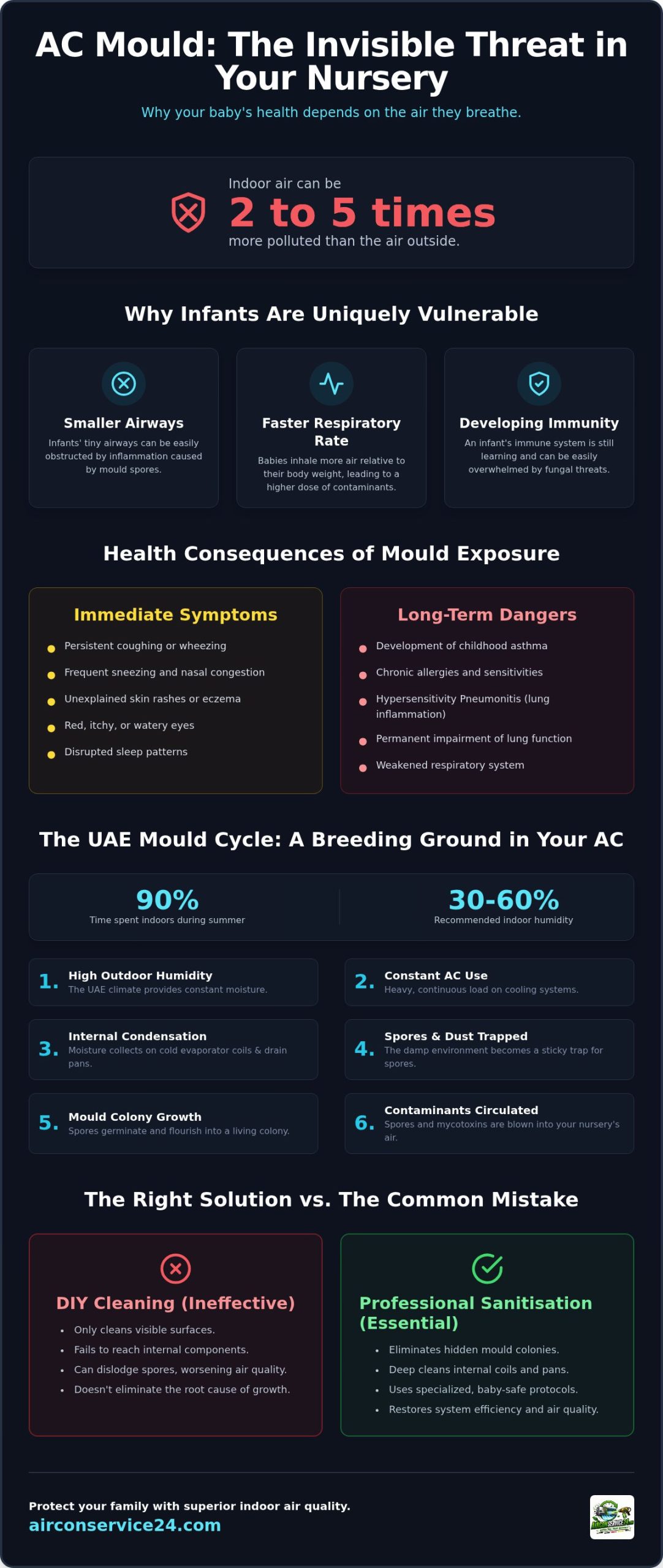
Infants are classified as “vulnerable breathers” for several physiological reasons. They possess significantly smaller airways that can be obstructed by even minor inflammation. They also have a much faster respiratory rate than adults; they inhale more air relative to their body weight. This means a baby sleeping in a contaminated nursery is receiving a higher dose of fungal spores every minute compared to an adult in the same room. This constant inhalation of Indoor mold can lead to Hypersensitivity Pneumonitis, a serious condition where the lung tissues become inflamed as an immune response to inhaled organic dust and spores.
Infant Respiratory Development and Mould Sensitivity
A baby’s immune system is essentially in a “learning” phase. It hasn’t yet developed the robust, seasoned defenses required to neutralize high concentrations of fungal spores. When spores enter a baby’s lungs, the immune system can become easily overwhelmed. There’s a documented link between early-life mould exposure and the eventual development of childhood asthma and persistent allergies. Beyond these long-term concerns, poor air quality has a direct impact on daily well-being. Spores irritate the nasal passages and throat, which often disrupts infant sleep patterns. A baby struggling with congestion or a scratchy throat cannot achieve the deep, restorative sleep necessary for healthy cognitive development.
Short-Term vs. Long-Term Health Consequences
The biological stress caused by mould exposure often manifests in two distinct stages. Immediate symptoms are frequently misdiagnosed as a common cold or seasonal allergies. You should monitor your child for these specific signs:
- Persistent, dry coughing or wheezing.
- Frequent sneezing and chronic nasal congestion.
- Unexplained skin rashes or sudden eczema flare-ups.
- Red, itchy, or watery eyes.
If the root cause inside the AC equipment isn’t addressed, these short-term irritations can lead to chronic respiratory weakness. Long-term exposure can result in permanent lung function impairment and a lifelong sensitivity to environmental triggers. It’s vital to understand that even “invisible” mould can cause significant biological stress. Just because you can’t see growth on the vents doesn’t mean the air is safe; the most dangerous contaminants are often hidden deep within the unit’s internal components.
The UAE Mould Cycle: Why Spores Flourish in National AC Systems
The climate in the UAE presents a specific challenge for indoor air quality. Residents spend approximately 90% of their time indoors during the summer months, placing a heavy, continuous load on cooling systems. This creates a “perfect storm” for fungal growth. High outdoor humidity meets the cold indoor surfaces of your unit, leading to constant condensation on internal components. When parents ask is ac mold dangerous for babies, they must recognize that the threat is often fueled by the very machine meant to keep the nursery comfortable. Moisture is the primary catalyst for these colonies, and in a national context where humidity levels fluctuate, your AC becomes a collection point for biological hazards.
Humidity and Condensation: The Engine of Growth
The evaporator coil acts as the heart of this moisture exchange. As it cools the air, it strips out humidity, which then collects in the drain pan. This damp environment is ideal for trapping airborne fungal spores. Because standard AC filters are primarily designed to catch larger dust particles, they cannot stop microscopic spores from passing through and settling on the wet coils. Over time, these spores germinate into self-sustaining colonies. They bypass basic filtration and circulate directly into the living space. The CDC confirms that the health effects of mold include persistent upper respiratory symptoms, which are particularly concerning for infants with developing lungs. To maintain a safe environment, the recommended indoor relative humidity should remain between 30% and 60%.
Dust and Biofilm: Providing the Nutrients
Fine desert dust is more than just a cleaning nuisance; it is a vital nutrient source for fungi. In the UAE, dust frequently bypasses external seals and settles deep inside the AC equipment. When this organic matter mixes with standing water in the drain lines, it forms a thick, gelatinous substance known as biofilm, often called “AC sludge.” This biofilm serves as a rich breeding ground for fungi and bacteria. If left unaddressed, it can cause blockages that lead to water backflow, further increasing humidity levels in the nursery. Basic maintenance often focuses on surface-level dust, completely missing these deep-seated colonies hidden within the cooling coils and drain pans. To ensure your home remains a safe sanctuary, you might consider a professional sanitisation assessment to identify hidden risks before they impact your family’s health.
Signs of AC Mould in Your Nursery: A Parent’s Checklist
Protecting your child begins with accurate detection. Because infants spend a significant portion of their day in a single room, the nursery’s air quality is paramount. When evaluating is ac mold dangerous for babies, parents must look beyond obvious dirt and learn to recognize the subtle sensory markers of fungal activity. Mould doesn’t always present as a large, dark stain. It often starts as a microscopic presence that reveals itself through specific odours or minor mechanical irregularities before becoming a visible threat.
One of the most reliable indicators is your baby’s physical response. If you notice that persistent coughing, nasal congestion, or skin irritation improves significantly when your child is away from the home or in a different room, the nursery’s AC unit is likely the culprit. Physical signs on the unit itself, such as excessive condensation or water dripping from the casing, suggest that the internal drainage system is compromised. As established in the previous section, standing water is the primary catalyst for biofilm and fungal growth.
Odour Identification: More Than Just a Bad Smell
That distinct musty or “rotten egg” scent isn’t just an unpleasant aroma; it’s a chemical signal. These smells are actually Microbial Volatile Organic Compounds (mVOCs) released by fungi during their metabolic process. You’ll likely find the scent is strongest when the AC first starts up after being off for several hours. This happens because the stagnant, humid air inside the unit becomes saturated with mVOCs, which are then pushed into the room in a single concentrated burst. Unlike cooking odours that dissipate, fungal smells persist and often have a sharp, damp undertone that lingers near the vents.
Visual Red Flags and Hidden Spots
A thorough visual inspection requires looking past the external grilles. Use a flashlight to peer behind the louvres and into the blower fan area. You should be searching for these specific red flags:
- Fuzzy Patches: Look for black, green, or grey spots that appear “hairy” or textured.
- Slimy Dust: If the “dust” on your vents looks damp, clumpy, or slightly translucent, it’s likely a fungal colony feeding on organic matter.
- White Mould: Often mistaken for simple lint or cotton fibres, white mould has a more crystalline or powdery structure and grows in irregular circular patterns.
- Discoloured Seals: Check the rubber gaskets and seals around the unit’s frame for dark spotting.
Mould frequently colonises the internal AC equipment where it remains shielded from view. If you spot any of these signs, the contamination is likely much more extensive inside the machine than what is visible on the surface. Identifying these markers early allows you to act before the biological load becomes a serious health risk for your newborn.
Professional Sanitisation vs. DIY Cleaning: Protecting Your Baby
When parents discover growth on their vents, the immediate instinct is to scrub it away with household cleaners. However, superficial wiping does not answer the fundamental question: is ac mold dangerous for babies even after it looks clean? The reality is that surface cleaning only removes the visible “fruiting bodies” while leaving the underlying root system intact. Attempting a DIY fix often creates a false sense of security, allowing microscopic spores to continue circulating while introducing harsh chemical fumes into the nursery environment.
The Failure of Household Bleach and Vinegar
Many online resources recommend using bleach or vinegar, but these methods are fundamentally flawed for modern AC systems. Bleach is composed primarily of water; when applied to porous surfaces, the water can actually seep in and encourage deeper fungal growth. More importantly, the strong fumes from bleach and acidic cleaners can cause acute respiratory distress in newborns. These household solutions are also physically incapable of reaching the core of the problem. They cannot penetrate the dense fins of the evaporator coil or the curved blades of the blower wheel where the most significant contamination resides. Relying on these methods leaves the biological source active and dangerous.
What Professional Deep Cleaning and Sanitisation Entails
Professional intervention is a methodical engineering process rather than a simple cleaning task. It involves the complete dismantling of the unit to expose internal components that are otherwise inaccessible. Using specialized sanitisation equipment, technicians perform a high-pressure wash that physically dislodges biofilm and fungal colonies from the coils. This is followed by the application of hospital-grade antimicrobial agents that are specifically vetted for safety in residential environments. This process ensures that every internal surface is stripped of contaminants and protected against immediate regrowth.
A critical part of this service is clearing the drain line and pan to eliminate standing water. By removing the moisture source and the biological load simultaneously, you break the growth cycle that exploits the UAE’s high humidity. We prioritize the use of eco-friendly, non-toxic sanitising agents to ensure the air remains pure for your child’s sensitive respiratory system. If you suspect your nursery air is compromised, securing a professional deep cleaning and sanitisation service is the most effective way to restore environmental hygiene and peace of mind.
Maintaining a Baby-Safe Environment in UAE Homes
Establishing a nursery as a sanctuary of health requires more than a one-time cleaning. It demands a disciplined, methodical approach to environmental hygiene. Because we have already established how is ac mold dangerous for babies due to their sensitive respiratory systems, the goal must be complete prevention rather than reactive repairs. A baby-safe home in the UAE relies on a strict quarterly maintenance schedule that accounts for the high-dust and high-humidity cycles of the national climate. Pure air isn’t a luxury; it’s a fundamental component of your child’s well-being.
Standard filters aren’t enough in an environment where fine desert dust acts as a constant nutrient source for fungi. You must commit to cleaning or replacing your AC filters every 30 days during the peak summer months. If musty odours persist even after a filter change, it indicates that the contamination has moved into the internal coils and requires specialized odour removal as part of a deeper hygiene process. Consistency is the only way to ensure the biological load in your home remains at zero.
The 2026 Standard for Nursery Air Quality
Modern nursery management involves active monitoring of the air your baby breathes. We recommend using a digital hygrometer to track moisture levels in real time. Your target should be a relative humidity between 40% and 60%. If levels climb higher, fungal spores can germinate in as little as 24 to 48 hours. One technical tip is to keep your AC fan set to “Auto” rather than “On.” This setting allows the moisture on the evaporator coils to drain away properly during the off-cycle, preventing the stagnant dampness that fuels biofilm growth. For a comprehensive look at protecting your system, refer to our guide on AC maintenance UAE to stay ahead of seasonal risks.
When to Call the Specialists
There is a clear “No-Go” zone when it comes to infant health. If your baby develops an unexplained cough, persistent congestion, or skin rashes that flare up only when the AC is running, professional intervention is mandatory. You shouldn’t wait for visible growth to appear on the vents. Our team operates with a 24/7 emergency response energy because we understand that indoor air quality is a high-stakes priority for parents. We provide the technical expertise required to strip away deep-seated contaminants and restore domestic harmony. Don’t let hidden spores compromise your nursery’s safety. Book a Professional Deep Cleaning Today and secure the pure air your family deserves.
Securing a Breathable Future for Your Nursery
Protecting your child’s health starts with acknowledging that indoor air quality is a non-negotiable priority. You’ve learned how the UAE’s humidity fuels a hidden growth cycle and why standard DIY cleaning fails to reach the biological source. Understanding that is ac mold dangerous for babies is more than just a medical concern; it’s an immediate call to secure your home’s environment. By moving from suspicion to professional action, you transition your nursery from a potential risk zone into a true sanctuary of domestic harmony and safety.
Our team provides national UAE coverage with a 24/7 emergency response energy to ensure your home remains pure. We utilize deep sanitisation protocols specifically designed for indoor air quality and professional odour removal to eliminate all traces of contamination. Don’t let hidden spores dictate your child’s well-being. You can restore your home’s environmental hygiene today. Secure your baby’s health with expert AC sanitisation and breathe easier knowing your nursery is protected by specialists who prioritize your family’s safety above all else.
Frequently Asked Questions
Can AC mould cause pneumonia in babies?
Exposure to high concentrations of fungal spores can lead to hypersensitivity pneumonitis, a serious inflammation of the lungs. While not identical to bacterial pneumonia, the symptoms of wheezing and respiratory distress are equally critical. In the UAE’s humid climate, neglected AC systems become concentrated sources of these biological irritants. If your infant shows signs of persistent breathing difficulty, you must seek medical advice and immediate professional sanitisation to remove the source.
What does AC mould smell like in a nursery?
AC mould typically produces a distinct musty, earthy, or “damp basement” odour. This scent is caused by Microbial Volatile Organic Compounds (mVOCs) released during the fungal growth cycle. You might notice a sharp “rotten egg” smell when the unit first powers on. Unlike cooking smells, these odours persist and often linger specifically near the vents. If you detect any unusual scent in the nursery, it signals a deep-seated hygiene issue within the coils.
Is it safe to sleep in a room with a musty AC?
Sleeping in a room with a musty AC is not safe for infants due to their high respiratory rates. Infants inhale more air relative to their body weight, meaning they receive a larger dose of spores during the night. Continuous exposure can lead to chronic irritation and disrupted sleep patterns. Determining whether is ac mold dangerous for babies involves recognizing that even low-level, “invisible” growth can cause significant biological stress during rest.
How often should I clean my AC if I have a newborn?
You should establish a strict quarterly deep cleaning and sanitisation schedule for any unit serving a nursery. In the high-dust environment of the UAE, standard filters must be cleaned or replaced every 30 days to prevent the accumulation of organic matter. Regular maintenance acts as a proactive shield, ensuring that biofilm does not have the opportunity to establish a foothold inside the evaporator coils or drain pans during the summer.
Will an air purifier help with AC mould?
An air purifier with a HEPA filter can capture airborne spores, but it cannot eliminate the source of the mould thriving inside your AC unit. While it provides a temporary reduction in particulates, the cooling system will continue to pump out new contaminants as long as the internal colonies remain active. Real protection requires a professional deep clean to physically remove the biofilm and fungal growth from the internal mechanical components.
Can I clean AC mould myself with vinegar?
You should avoid attempting to clean AC mould yourself with vinegar or household chemicals. Vinegar is primarily water, which can actually encourage further growth on porous internal surfaces. The strong acidic fumes can also irritate a newborn’s sensitive lungs. DIY methods are physically unable to reach the evaporator coils and blower wheels where the most dangerous growth occurs. Professional-grade sanitisation is the only methodical way to ensure complete removal.
What are the first signs of mould sickness in infants?
The first signs of mould-related distress in infants often mirror common cold symptoms. Monitor your child for persistent coughing, frequent sneezing, and chronic nasal congestion that improves when they are out of the house. You may also notice red, watery eyes or sudden skin rashes like eczema flare-ups. Because infants have underdeveloped immune systems, these early warnings should be treated with urgency to prevent long-term respiratory issues and chronic allergies.
Is black mould in AC more dangerous than other types?
While “black mould” is often highlighted, all fungal growth inside an AC unit is dangerous for infants. Different species produce various mycotoxins; even “white” or “green” fuzzy patches can cause severe respiratory irritation. The colour of the growth is less important than the presence of the colony itself. Any biological growth in a nursery AC represents a failure of environmental hygiene and requires immediate, professional-grade sanitisation to protect your baby’s health.