Troubleshooting an AC Fan Not Spinning: A Safety-First Diagnostic Guide

Article by
Jon Bonnett
Australian Air Conditioning Specialist with extensive hands-on experience in AC servicing, deep cleaning, maintenance, and troubleshooting. Focused on high-quality workmanship, reliability, and professional service to UAE standards.
Would you recognize the sound of your AC compressor struggling to survive, or would you mistake that low hum for a minor glitch while the indoor temperature climbs toward 40°C? It’s a scenario every resident across the Emirates dreads. The unit is powered on, yet there’s no air moving. You’re likely feeling the weight of uncertainty, wondering if a simple part failed or if you’re facing a total system replacement. Mastering the process of troubleshooting ac fan not spinning is your first line of defense against a sweltering home and escalating repair costs.
We understand that when the cooling stops, your priority is safety and speed. You need to know if the fix is a simple DIY task or a signal of a deeper electrical failure that requires professional intervention. This guide provides the clarity you need. We’ll detail the exact reasons your fan has stalled, from capacitor issues to mechanical blockages, and provide a methodical diagnostic path to restore your comfort. You’ll learn how to identify the problem accurately, prevent irreversible damage to your compressor, and determine the most efficient way to get your system back to peak performance.
Key Takeaways
- A stalled fan causes rapid heat buildup that can lead to permanent compressor failure if you don’t address it immediately.
- Master the safe method for troubleshooting ac fan not spinning by performing a visual inspection and a manual “stick test” to identify capacitor issues.
- Understand how the extreme UAE climate accelerates the wear on critical electrical components like start and run capacitors.
- Always prioritize safety by isolating the power at both the thermostat and the outdoor switch before you attempt any diagnostic steps.
- Recognize when a problem requires professional AC repair, specifically when it involves high-voltage testing or complex motor failures.
Understanding Why Your AC Fan Has Stopped Spinning
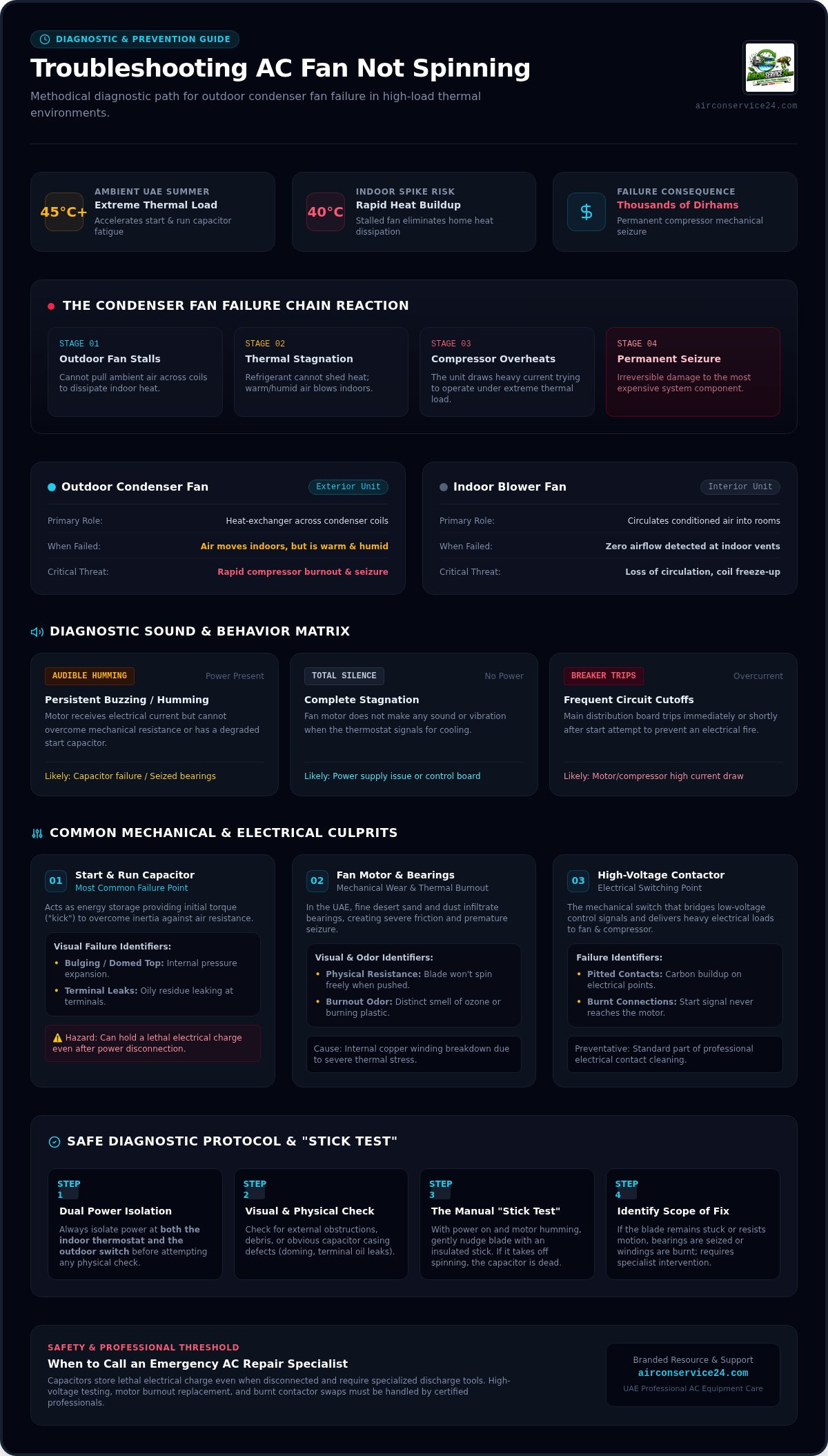
The outdoor condenser fan acts as the primary heat-exchanger for your cooling system. Its job is to pull ambient air across the condenser coils to dissipate the heat collected from inside your home. When this fan fails, the heat has nowhere to go. This creates a dangerous feedback loop where the compressor, the most expensive component in your AC equipment, begins to overheat rapidly. Without the fan’s cooling effect, the compressor’s internal temperature can soar; this lead to a permanent mechanical seizure that often costs thousands of Dirhams to replace.
It’s vital to distinguish between the indoor blower fan and the outdoor condenser fan. While a failed blower results in no airflow at your vents, a failed condenser fan allows air to move, but that air will be stiflingly warm. Identifying the “humming symptom” is a key part of troubleshooting ac fan not spinning. A persistent buzzing or humming sound usually indicates that the motor is receiving electricity but cannot overcome mechanical resistance or a faulty start capacitor. Conversely, total silence often points toward a power supply issue or a failed control board.
The Science of Heat Exchange in the UAE
Living in the UAE presents unique challenges for mechanical systems. Extreme ambient temperatures, often exceeding 45°C, place an immense thermal load on fan motors. For a deeper look at the physics involved, you can research how air conditioning systems work to understand the refrigeration cycle. In this region, fine desert sand and dust infiltrate motor bearings. This creates friction that leads to premature wear and eventual failure. When a fan stops during a UAE summer, it isn’t just a nuisance; it’s a domestic emergency that threatens the health and well-being of everyone in the home.
Symptoms That Accompany a Stuck Fan
A non-spinning fan rarely happens in isolation. You’ll often notice several red flags before the system shuts down completely. Recognizing these signs early can prevent a total compressor burnout.
- Warm Airflow: The air coming from your vents feels humid and warm because the refrigerant cannot shed heat outdoors.
- Audible Buzzing: A loud humming noise indicates the motor is struggling to start, often due to a degraded capacitor or seized bearings.
- Frequent Breaker Trips: When the fan or compressor draws excessive current while trying to start, your main distribution board will trip the circuit to prevent a fire.
Common Mechanical Culprits: Capacitors and Motors
While identifying the symptoms is the first step, understanding the internal mechanical failures allows you to make informed decisions about your system’s health. In the UAE’s high ambient environment, electrical components undergo extreme thermal stress. The constant cycling between peak afternoon heat and nighttime operation causes internal expansion and contraction that leads to component fatigue. When you begin troubleshooting ac fan not spinning, the physical cause usually lies within two specific components: the capacitor or the fan motor itself.
The contactor also plays a vital role as the mechanical switch that sends high voltage power to both the fan and the compressor. If the contactor’s electrical points are pitted or burnt, the signal to start never reaches the motor. This component bridges the gap between your home’s low voltage control signals and the heavy electrical load of the outdoor equipment. Ensuring the contactor is clean and functional is a standard part of professional maintenance that prevents sudden system failures.
The Capacitor: Your AC’s Battery
The capacitor acts as a temporary energy storage device, providing the necessary torque or “kick” to start the fan blades against air resistance. It is the most common point of failure in residential systems. A visual inspection often reveals the problem. Look for a “bulging” or domed top, where the metal casing has expanded due to internal pressure, or signs of leaking oil at the terminals. If the capacitor is weak, it cannot provide enough power to overcome the motor’s initial inertia. Be extremely cautious; these components can hold a lethal electrical charge even after the power is disconnected. Professional AC repair specialists use specialized discharge tools to handle these parts safely.
Fan Motor Burnout and Seized Bearings
If the capacitor is functioning correctly, the motor itself may have reached the end of its service life. Motor burnout often presents with a distinct smell of ozone or burning plastic, which occurs when internal copper windings melt due to overheating. Another common issue in this region is seized bearings. Fine desert sand and a lack of regular lubrication cause the fan axle to lock up. You can check for this by observing if the blades spin freely when pushed manually with a long, thin tool while the power is off. Significant resistance or a grinding sound indicates that the motor bearings have failed and the entire motor assembly likely requires replacement.
DIY Diagnostic Steps: The ‘Stick Test’ and Visual Checks
Performing a preliminary assessment is essential for narrowing down the cause of failure. However, you must prioritize your physical safety before approaching the outdoor unit. High-voltage electricity and moving mechanical parts pose a significant risk. Begin by setting your thermostat to ‘Off’ and then locate the outdoor isolator switch usually found near the condenser. Flipping this switch ensures that power is physically disconnected from the unit. This two-step power-down protocol is the only way to safely begin troubleshooting ac fan not spinning.
Once the power is isolated, you can check for obvious mechanical obstructions. In the UAE climate, wind-blown debris and fine desert sand often find their way into the unit. This can create a physical barrier that prevents the blades from rotating. Clearing these obstructions is a simple fix that can save you from a costly and unnecessary service call. If the blades are clear but the system still won’t engage, you’ll need to move on to more specific diagnostic tests to identify the electrical culprit.
How to Perform the Stick Test Safely
The “stick test” helps determine if your fan motor is functional but lacks the electrical “kick” from a failing capacitor. To do this, you’ll need to briefly restore power to the unit while observing from a safe distance. Take a long, non-conductive tool like a wooden stick or a plastic rod. Insert it through the top grille and give the fan blades a gentle push. If the fan starts spinning and continues to run on its own, your motor is likely healthy, but the capacitor has failed. If the blades feel heavy, resist movement, or make a grinding sound, the bearings are likely seized. Never use a metal screwdriver for this test. Metal conducts electricity and could cause a lethal shock if it touches a live component.
Visual Inspection of the Outdoor Unit
Environmental factors in the UAE often contribute to mechanical blockages. Open the access panel and look for physical obstructions. Sand and grit can accumulate in the motor housing, creating enough friction to stop the blades entirely. You should also check for loose wiring or terminals that may have vibrated free over time. Look closely for “arcing” marks, which appear as black, scorched spots on the wires or the contactor. Ensuring that your AC equipment is clear of external blockages like bird nests or wind-blown debris is a simple yet effective maintenance step. If you discover burnt wires or melted plastic, stop immediately. These are signs of a severe electrical short that requires professional diagnostic tools to resolve without risking a fire.
Troubleshooting Power and External Obstructions
If your manual diagnostics indicate that the fan blades are physically free to move, the failure likely resides within the electrical delivery system or the system’s internal safety logic. Electrical issues can range from a simple tripped switch to a complex short circuit within the motor windings. When you are troubleshooting ac fan not spinning, you must verify that the path of electricity from your main distribution board to the outdoor unit is uninterrupted. A break anywhere along this line will leave the fan dormant regardless of the thermostat’s demands.
Start by examining your home’s main distribution board (DB board). Look for a circuit breaker that has moved to the “off” or “neutral” position. If you find a tripped breaker, reset it once. If it trips again immediately, do not force it. This is a clear indicator of a “short to ground,” where a damaged wire or a failed motor winding is touching the metal casing. In such cases, the breaker is performing its primary job: preventing an electrical fire. You should also check the outdoor isolator switch. These switches can occasionally be flipped by accident during exterior house cleaning or by children playing nearby.
Electrical Supply and Safety Switches
Inside the outdoor disconnect box, you may find heavy-duty fuses designed to protect the condenser unit. A blown fuse will stop the fan and compressor instantly. In the UAE, fluctuations in the national power grid or extreme surges during peak summer demand can cause these fuses to fail. Maintaining stable voltage is critical for the longevity of your system. If your unit receives inconsistent power, the fan motor will run hotter than intended, which significantly accelerates the degradation of the internal insulation and leads to a premature burnout.
The Impact of Poor Maintenance
System logic can also stop the fan. If your indoor air filters are heavily clogged, the lack of airflow causes the evaporator coils to drop below freezing. This results in ice buildup on the copper pipes. When the system detects these freezing conditions, it may shut down the outdoor fan to prevent liquid refrigerant from returning to the compressor. This highlights the vital connection between consistent AC maintenance and overall fan health. Often, the fan isn’t broken; it’s simply being disabled by a system struggling with hygiene issues.
Accumulated dust and grime on the condenser coils also force the fan to work twice as hard to move air. This extra load eventually leads to motor fatigue. If your fan has stopped due to overheating, a professional deep cleaning and sanitisation are often the missing links required to restore performance. If you have checked your breakers and the fan still refuses to engage, you likely have a failed component that requires specialized tools. Contact our team for immediate emergency AC repair to restore your home’s cooling before the indoor temperature becomes dangerous.
When to Call an Emergency AC Repair Specialist
While the preliminary steps for troubleshooting ac fan not spinning help identify simple blockages, there’s a definitive line where DIY efforts become hazardous. In the UAE’s extreme climate, outdoor units reach surface temperatures that make handling metal components dangerous. More importantly, the electrical systems inside are under high tension. If you’ve reset the breaker and performed a visual check without success, continuing alone risks both your physical safety and the mechanical integrity of your compressor. Professional intervention is the only way to ensure the root cause is addressed before the heat causes permanent damage.
Capacitors are not merely simple batteries; they’re high-voltage storage devices that can deliver a lethal shock even after the power is disconnected. Protecting the compressor is your primary objective during a cooling failure. A failed fan motor is a manageable repair, but a seized compressor often necessitates a full system replacement costing thousands of د.إ. Our technicians provide professional reassurance by arriving equipped to handle these high-stakes situations with methodical precision and specialized safety gear.
Professional Diagnostic Tools and Parts
Technicians utilize advanced diagnostic equipment to measure the exact microfarad rating of your capacitors and the electrical resistance of the motor windings. This precision prevents the “guesswork” of simply swapping parts. If the motor is seized, we replace it with high-quality OEM components that meet the specific thermal requirements of the UAE market. We also verify refrigerant pressures. A fan failure often leads to a spike in internal pressure that can cause subtle leaks or oil migration, which must be corrected to restore optimal cooling efficiency and protect your AC equipment.
Securing Your Comfort with AirConService24.com
Our team operates as a disciplined guardian of your home environment, providing 24/7 emergency AC repair across the UAE. We understand that a cooling failure in this region is a genuine emergency that impacts health and domestic harmony. Every visit by AirConService24.com includes a transparent explanation of the failure and a clear path to restoration. Once the fan is operational, we recommend a comprehensive system check to identify wear before it leads to another shutdown. This proactive approach ensures your system is prepared for the next heatwave, preventing future emergencies through precision maintenance and deep cleaning.
Secure Your Comfort and Protect Your System
A stalled condenser fan isn’t just a minor mechanical glitch; it’s a critical threat to the life of your compressor. By mastering the basics of troubleshooting ac fan not spinning, you’ve gained the clarity to distinguish between a simple obstruction and a severe electrical failure. Remember that safety is your absolute priority. If your manual checks and power resets don’t restore operation, the risk of high-voltage shock or permanent hardware damage makes professional intervention the only responsible path forward.
Our team stands ready to act as the disciplined guardian of your domestic harmony. We provide 24/7 emergency availability across the UAE, ensuring you never have to face the extreme heat alone. Our expert technicians service all major AC brands, utilizing comprehensive mechanical and electrical diagnostics to pinpoint the exact failure point with total precision. Don’t let a minor component failure turn into a costly system replacement. Restore your cooling now with our 24/7 emergency AC repair experts and return your home to a state of perfect, healthy comfort today.
Frequently Asked Questions
Is it safe to run my AC if the outdoor fan isn’t spinning?
No, it’s not safe to operate your system under these conditions. Running the unit without a functional fan prevents the dissipation of heat from the refrigerant. This causes the compressor’s internal temperature to skyrocket almost instantly. If you don’t shut the system down at the thermostat immediately, you risk a total compressor seizure. This turns a simple mechanical repair into an expensive replacement of your entire outdoor unit.
Why does my AC hum but the fan won’t start?
A persistent humming sound usually indicates that electricity is reaching the unit, but the motor cannot overcome its initial inertia. This is most frequently caused by a failed start capacitor that can no longer provide the necessary electrical “kick.” In the UAE’s dusty climate, troubleshooting ac fan not spinning when humming also involves checking for seized bearings or sand buildup that has physically locked the fan axle in place.
Can a bad thermostat cause the AC fan to stop spinning?
Yes, your thermostat is the command center that triggers the cooling cycle. If the thermostat’s internal sensors or wiring fail, it won’t send the low-voltage signal to the outdoor contactor. Without this signal, the contactor won’t close the circuit to power the fan or compressor. Always check that your thermostat has fresh batteries and is set to “Cool” mode with a temperature lower than the current room ambient.
How much does it cost to replace an AC fan motor in the UAE?
The total investment for a motor replacement depends on your specific system brand and the required horsepower. Prices for these components vary across the UAE market based on whether you utilize OEM parts or high-quality compatible alternatives. While we don’t provide fixed quotes without an inspection, our technicians offer transparent, upfront estimates in د.إ after conducting a thorough diagnostic of the motor’s electrical windings and physical condition.
What happens if I don’t fix a stuck fan immediately?
Neglecting a stalled fan leads to a catastrophic chain reaction. The compressor will continue to pump refrigerant without any way to shed heat, causing internal pressures to reach dangerous levels. This thermal stress destroys the compressor’s internal insulation and eventually leads to a mechanical burnout. Addressing the fan issue now is a proactive step that protects the most expensive component in your cooling system from permanent and irreversible damage.
Can I jumpstart my AC fan with a stick every time?
You shouldn’t use this as a permanent fix. While a manual push proves the motor is still functional, it confirms that your capacitor has failed. Running a fan with a weak capacitor forces the motor to draw significantly more current than it was designed to handle. This extra electrical load generates intense heat within the motor windings. If you continue this practice, you’ll eventually burn out the motor entirely.
Why does my AC fan spin slowly or stop intermittently?
Slow or intermittent rotation is often a sign of a motor reaching the end of its service life or a failing run capacitor. Intermittent stopping can also be caused by the motor’s internal thermal overload protection. When the motor overheats due to friction or electrical resistance, it automatically shuts down to prevent a fire. Once it cools, it may restart briefly, but the cycle will continue until the underlying fault is corrected.
How do I know if my AC capacitor is blown?
Visual cues are the easiest way for a homeowner to identify a failure. Look for a bulging or “mushroomed” top on the metal cylinder or any signs of oily residue leaking from the terminals. However, many capacitors fail internally without showing physical signs. When troubleshooting ac fan not spinning, our specialists use a multimeter to measure the exact microfarad output. This ensures the component is providing the precise charge required by the manufacturer’s specifications.