Commercial HVAC Maintenance Contract: The Complete Enterprise Guide (2026)

Article by
Jon Bonnett
Australian Air Conditioning Specialist with extensive hands-on experience in AC servicing, deep cleaning, maintenance, and troubleshooting. Focused on high-quality workmanship, reliability, and professional service to UAE standards.
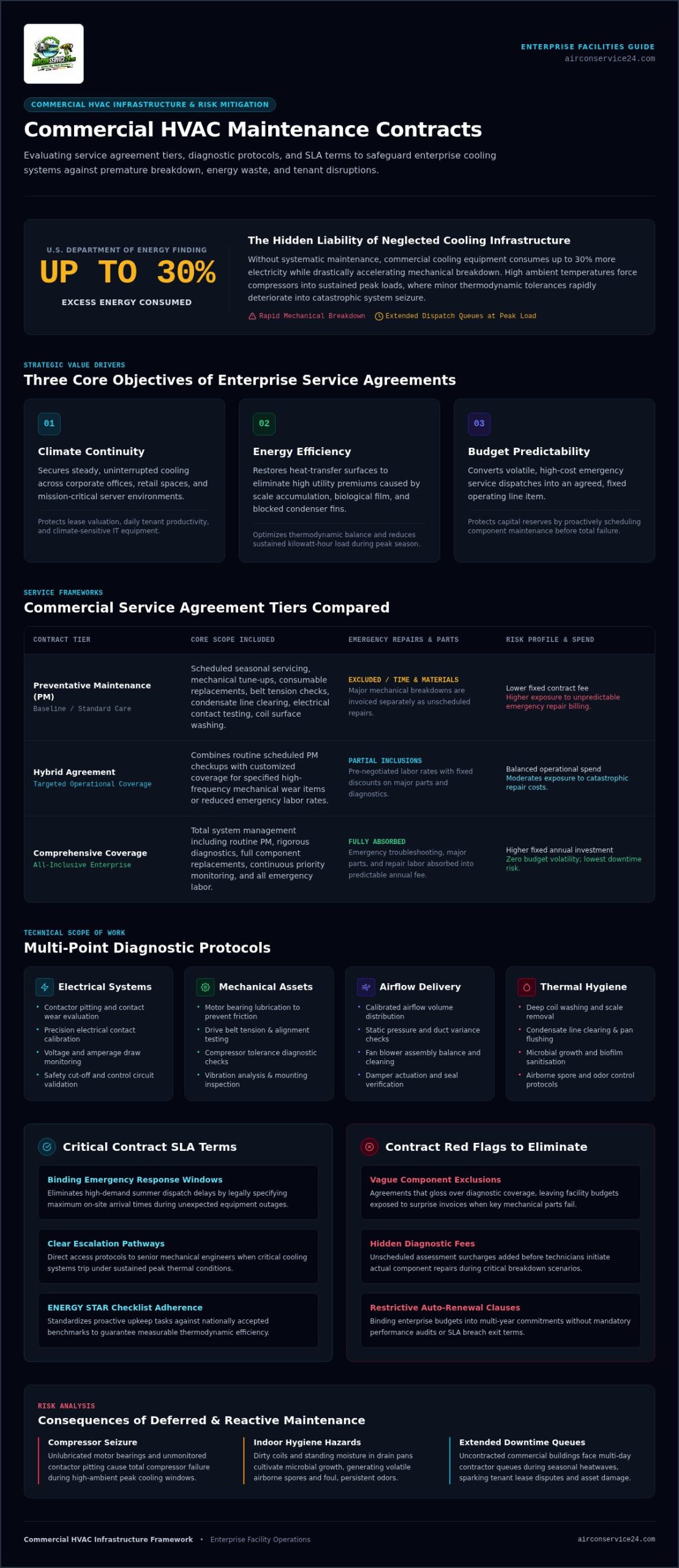
According to the U.S. Department of Energy, neglected cooling equipment consumes up to 30% more energy while rapidly accelerating mechanical breakdown. Yet many facility leaders still treat their commercial HVAC maintenance contract as a routine administrative checkbox rather than essential risk mitigation.
You already know the anxiety of vague vendor agreements that gloss over comprehensive diagnostics, only to deliver surprise invoices when a cooling system trips under peak load. A sudden equipment failure doesn’t just disrupt daily operations. It jeopardizes tenant retention, compromises indoor air hygiene, and forces your facility team into reactive crisis management.
It doesn’t have to be this way. You can take full command of your facility’s cooling infrastructure to prevent catastrophic downtime, enforce rapid emergency response times, and extend total asset lifespans. This enterprise guide examines maintenance contract tiers, critical multi-point diagnostic protocols, and strict SLA terms to keep your buildings comfortable, compliant, and cost-efficient.
Key Takeaways
- Balance Risk and Spend: Compare basic preventative, hybrid, and comprehensive service tiers to secure the right commercial hvac maintenance contract for your facility’s operational demands.
- Enforce Response SLAs: Establish binding emergency response windows and clear escalation pathways to eliminate costly operational downtime.
- Demand Multi-Point Verification: Mandate rigorous electrical, mechanical, and airflow diagnostic protocols that pinpoint minor component wear before catastrophic compressor failure occurs.
- Prioritize Thermal and Air Hygiene: Incorporate systematic coil deep cleaning, sanitisation, and odour control into your regular scope of work to maintain peak efficiency and tenant well-being.
- Spot Contract Red Flags: Identify vague exclusions, hidden diagnostic fees, and restrictive auto-renewal clauses to protect your enterprise operating budget.
What Is a Commercial HVAC Maintenance Contract and Why Does It Matter?
A commercial HVAC maintenance contract is an enforceable service-level framework designed to guarantee continuous thermal performance, indoor environmental quality, and mechanical reliability. Far beyond a casual schedule of technician check-ins, this agreement functions as an operational risk mitigation policy. In commercial environments, climate control is not a convenience; it’s a mission-critical utility. A sudden cooling failure instantly disrupts business productivity, damages climate-sensitive assets, and triggers tenant lease disputes that permanently harm asset valuation.
Operating complex commercial cooling infrastructure under extreme year-round thermal stress demands systematic care. Modern heating, ventilation, and air conditioning systems rely on balanced thermodynamic cycles, precision electrical contacts, and calibrated airflow distribution. When high ambient temperatures push compressors to sustained peak loads, small mechanical tolerances quickly degrade. A formal service agreement mandates the routine calibration and deep cleaning required to prevent small heat-exchange anomalies from becoming catastrophic component failures.
The Core Objectives of Commercial Service Agreements
An enterprise-grade maintenance contract delivers three vital operational safeguards for facilities managers and property portfolios:
- Guaranteed Climate Continuity: Securing steady, uninterrupted cooling across corporate offices, retail spaces, and mission-critical server environments.
- Optimized Energy Efficiency: Restoring heat-transfer surfaces to slash the severe utility premiums caused by scale, biological film, and blocked condenser fins.
- Budget Predictability: Converting volatile, high-cost emergency dispatches into a fixed operational line item, protecting capital reserves through scheduled servicing of commercial cooling equipment.
Risks of Operating Without a Contractual Maintenance Plan
Relying on a reactive, run-to-failure strategy introduces immense mechanical and financial liability. Minor friction in unlubricated motor bearings or unmonitored contactor pitting can cause compressors to seize during the hottest months. In high-demand periods, uncontracted facilities face extended contractor dispatch queues, leaving tenants without cooling for days.
Beyond mechanical shutdown, deferred maintenance accelerates indoor hygiene risks. Dirty coils and standing moisture in drain pans harbour microbial growth, resulting in volatile airborne spores and foul, persistent odours. Enforcing a rigorous commercial hvac maintenance contract ensures strict compliance with national commercial safety and indoor air standards, keeping your commercial facilities healthy, operational, and legally compliant.
Types of Commercial HVAC Service Agreements: Comparing Your Options
Choosing the right commercial hvac maintenance contract requires balancing your facility’s tolerance for downtime against operating capital. Commercial service agreements aren’t one-size-fits-all; they range from baseline preventative checkups to all-inclusive coverage and predictive monitoring models. Establishing the right structure upfront prevents unexpected billing disputes while keeping critical mechanical assets operating within engineered specifications.
Facilities adhering to standardized ENERGY STAR commercial HVAC maintenance checklists recognize that proactive upkeep safeguards equipment efficiency. However, the precise contract tier you select dictates whether emergency troubleshooting is billed as an expensive time-and-materials charge or absorbed into a predictable annual operating agreement.
Preventative Maintenance vs Comprehensive Coverage
Preventative maintenance (PM) agreements focus on scheduled seasonal servicing, mechanical tune-ups, and consumable replacements. Under a PM contract, technicians inspect belt tension, clear condensate lines, test electrical contactors, and wash heat-transfer surfaces. Any major mechanical component failure remains billed separately as an unscheduled repair.
Comprehensive service agreements function like complete mechanical insurance. They bundle routine servicing with priority emergency response, full diagnostic coverage, and total parts-and-labor replacement for critical assemblies like blower motors and compressors. Younger equipment under active manufacturer warranty thrives under structured PM plans. Older mechanical infrastructure nearing the end of its operational lifespan often warrants comprehensive protection to shield your enterprise budget from sudden, expensive component failures.
Customised Agreements for High-Demand Commercial Spaces
Modern enterprise contracts frequently integrate predictive maintenance, utilizing building telemetry, vibration sensors, and thermographic imaging to isolate mechanical stress before systems trip. Specialized commercial spaces require targeted contract scopes:
- Server Rooms and Data Centers: Require continuous temperature thresholds, immediate emergency dispatch, and precise humidity controls to prevent server overheating.
- Retail and High-Footfall Spaces: Demand frequent coil deep cleaning, odour removal treatments, and dynamic airflow balancing to manage heavy occupancy cycles.
- Multi-Tenant Commercial Offices: Require zoned airflow management and regular indoor hygiene audits to handle fluctuating tenant headcounts and compliance requirements.
To safeguard your portfolio against crippling cooling interruptions, explore how AirConService24 delivers disciplined, custom-tailored service agreements engineered around your property’s exact mechanical demands.
Core Scope of Work: The Commercial HVAC Maintenance Checklist
A resilient commercial hvac maintenance contract translates strategic asset protection into detailed, field-level technical execution. Standard mechanical agreements often fail because they rely on vague commitments like “inspect equipment.” To safeguard your infrastructure, your scope of work must establish clear mechanical, electrical, and hygiene verification standards. Aligning maintenance protocols with the Whole Building Design Guide’s HVAC operations and maintenance guidance ensures technicians eliminate hidden micro-faults before they cause catastrophic system shutdown.
Every planned service visit must combine thermodynamic diagnostic routines with aggressive environmental hygiene practices. When high heat loads push systems to their absolute limits, mechanical integrity and clean thermal exchange surfaces are non-negotiable.
Mechanical and Electrical Precision Diagnostics
Electrical anomalies remain the primary catalyst for sudden compressor and fan motor failures. Technicians must conduct precision testing across every critical component:
- Electrical Integrity: Measure operating amperage and voltage draws against factory nameplate tolerances to detect worn contactors, capacitor degradation, or loose connections.
- Mechanical Assembly: Inspect blower wheels, motor bearings, and drive belts for shaft play or excessive vibration anomalies.
- Refrigeration Diagnostics: Monitor operating pressures, subcooling, and superheat values to catch small leaks before system pressure crashes.
- Sensors and Actuators: Calibrate temperature sensors, static pressure transducers, and economizer dampers to preserve stable zone control.
For facility managers overseeing complex setups, review confirmed engineering standards for commercial cooling equipment maintenance to protect your investments.
Deep Cleaning, Sanitisation, and Air Hygiene Protocols
Standard service scopes frequently overlook biological contamination and heat-transfer impedance. Heavy dust, grease, and particulate buildup insulate condenser and evaporator coils, forcing compressors to run hotter and pull excessive amperage. Scheduled maintenance must mandate specialized chemical deep cleaning that degreases and descales coil fin packs without causing structural fin damage.
Simultaneously, persistent standing moisture inside condensate drain pans creates a breeding ground for bacterial biofilm and fungal colonies. A comprehensive commercial hvac maintenance contract must stipulate targeted clearing of drain channels alongside multi-stage sanitisation. Applying antimicrobial washes and targeted odour removal treatments neutralises airborne pathogens at the source, preventing foul microbial odours from circulating through occupied tenant spaces.
How to Evaluate and Negotiate an HVAC Contract: SLAs and Red Flags
A commercial HVAC maintenance contract is only as dependable as the legal framework enforcing it. When outdoor temperatures peak and cooling loads double, verbal promises of prompt attention dissolve quickly. Enterprise facility directors must negotiate unambiguous Service Level Agreements (SLAs) with binding performance baselines, clear escalation paths, and complete digital accountability.
Never accept a generic proposal that treats all service requests identically. A minor thermostat recalibration in an empty conference room cannot share the same response protocol as a chiller trip above a mission-critical server installation. Contract terms must define specific operational obligations before signatures hit the page.
Enforcing Critical Service Level Agreements (SLAs)
Your agreement must split support into distinct severity tiers with legally binding arrival windows:
- Tier 1: Critical Cooling Emergencies. Total chiller shutdowns, data centre overheating, or primary failures in occupied customer spaces demand an on-site technician response within two to four hours.
- Tier 2: Urgent Non-Critical Issues. Single-zone failures or secondary ventilation issues require guaranteed resolution pathways within 24 hours.
- OEM Component Sourcing: Contracts must guarantee rapid access to original manufacturer replacement parts rather than non-certified third-party substitutes that void equipment warranties.
- Digital Diagnostic Verification: Require detailed electronic service tickets within 24 to 48 hours of each visit, recording compressor amp draws, refrigerant pressures, and thermal delta measurements.
Identifying Contract Exclusions and Hidden Costs
Scrutinize the fine print for hidden operational surcharges. Contractors frequently offset low monthly maintenance retainers by categorizing essential procedures as non-covered extras. Watch for exclusion clauses regarding crane or specialized rigging fees for rooftop package units, which can double the bill during a major blower replacement.
Another major loophole involves refrigerant management. Clarify whether chemical recovery, nitrogen leak testing, and refrigerant top-ups are built into your tier or billed at steep retail markups. Finally, never sign multi-year evergreen clauses without a performance break: demand a 30-day cancellation clause if the vendor fails to meet defined emergency response targets.
If you’re ready to secure transparent, performance-backed mechanical protection for your enterprise portfolio, partner with AirConService24 to implement enforceable cooling agreements that keep your assets fully protected.
Partnering with AirConService24 for Commercial HVAC Maintenance
Operating commercial cooling assets in severe desert climates demands an uncompromising operational partner. AirConService24 functions as a disciplined guardian of commercial facility uptime across the UAE, engineering preventative care specifically for sustained high-ambient thermal stress. Operating under parent firm PANKOBAU Building Maintenance LLC, our licensed technical teams replace reactive patchwork with rigorous, data-driven mechanical protection.
Unplanned cooling interruptions threaten commercial operations, compromise employee productivity, and jeopardize delicate inventory. We integrate proactive multi-point mechanical inspections with specialized deep cleaning and multi-stage sanitisation protocols. This dual focus ensures your equipment delivers optimal thermodynamic heat transfer while preserving sterile, odour-free indoor air across your portfolio.
The AirConService24 Onboarding and Audit Process
Transitioning to our commercial hvac maintenance contract begins with an exhaustive mechanical and environmental onboarding audit:
- Comprehensive Asset Cataloguing: We log every chiller, package unit, split system, and air handling unit, mapping their age, duty cycle, and historical maintenance profile.
- Baseline Diagnostic Benchmarking: Our technicians record baseline refrigerant pressures, motor operating temperatures, and electrical amp draws to isolate latent component stress.
- Customised Scheduling: We build tailored maintenance calendars designed around your facility’s operational rhythms, executing intrusive servicing during off-peak hours to prevent business interruption.
Integrated Care: From Maintenance to Emergency Response
Even well-managed systems encounter acute mechanical stress during extreme weather spikes. When sudden thermal anomalies arise, our agreement provides immediate escalation into 24/7 emergency response protocols. Commercial clients gain continuous access to experienced technical dispatchers who prioritize enterprise cooling restorations without delay.
Whether your property requires precision troubleshooting, targeted odour removal, full system installation, or scheduled servicing, our technicians bring the specialized instrumentation necessary to restore peak operating conditions immediately. Property managers can review our comprehensive framework in national AC maintenance to understand how disciplined preventative standards preserve critical cooling infrastructure.
Stop risking operational downtime with vague vendor promises. Secure your business operations and safeguard your bottom line today with a dedicated enterprise maintenance plan backed by guaranteed response standards.
Take Command of Your Enterprise Cooling Reliability
A well-structured commercial hvac maintenance contract transforms unpredictable cooling crises into predictable, manageable operations. By establishing rigorous mechanical diagnostics, holding vendors to binding emergency response windows, and mandating advanced multi-stage deep cleaning with microbial air sanitisation, your facility actively safeguards high-value cooling assets while preserving tenant comfort.
Waiting for extreme thermal loads to test unverified equipment is an operational gamble your business can’t afford. Operating under licensed parent firm PANKOBAU Building Maintenance LLC, AirConService24 delivers 24/7 dedicated commercial emergency dispatch alongside rapid diagnostic troubleshooting. You don’t have to navigate between volatile repair expenses and thermal failure. Take a disciplined stance on facility uptime and health compliance. Secure Your Commercial HVAC Maintenance Contract Today to guarantee uninterrupted comfort and long-term cooling efficiency across your commercial portfolio.
Frequently Asked Questions
What is typically included in a standard commercial HVAC maintenance contract?
A standard commercial HVAC maintenance contract covers scheduled mechanical inspections, electrical diagnostics, filter replacements, and condensate drainage clearing. Certified technicians evaluate operating refrigerant pressures, test motor amperage draws, lubricate mechanical bearings, and calibrate operational zone thermostats. Reliable agreements also specify formal emergency response times, priority technician dispatch, and digital diagnostic reports delivered after every scheduled maintenance visit.
How often should commercial air conditioning systems be serviced under contract?
Commercial cooling infrastructure should undergo structured servicing at least quarterly, with high-demand facilities requiring monthly inspections. Continuous heat loads and heavy occupancy accelerate wear on compressors, contactors, and blower belts. High-traffic retail hubs, data centres, and mission-critical facilities benefit from monthly checks. Standard commercial offices typically maintain reliable cooling performance and indoor air quality through four scheduled seasonal visits each year.
Can a commercial maintenance contract help lower overall building energy costs?
Yes, a commercial maintenance contract directly curbs energy waste by restoring peak thermodynamic heat transfer and optimal airflow. Dirty coils, low refrigerant levels, and dragging blower motors force systems to work harder, consuming substantial excess electricity during peak hours. Regular coil cleaning, fan calibration, and refrigerant balancing ensure chillers and package units operate within engineered efficiency parameters, significantly reducing aggregate monthly utility expenses.
What is the difference between preventive and comprehensive HVAC maintenance agreements?
The primary difference lies in how unscheduled repairs, replacement components, and emergency labour are billed. Preventative maintenance agreements cover scheduled checkups, cleanings, and routine consumable replacements, while unexpected mechanical breakdowns are billed separately. Comprehensive agreements act like full mechanical insurance, bundling scheduled servicing with priority emergency response windows and full parts-and-labour replacement for critical components like compressors and blower assemblies.
How quickly should a commercial HVAC contractor respond to an emergency failure?
For critical emergencies like complete chiller failure or server room overheating, contractors should be on site within two to four hours. Urgent but non-critical issues, such as single-zone airflow disruptions, typically carry a contractual 24-hour resolution window. Your service agreement should formalize these response benchmarks through enforceable SLAs, backed by round-the-clock emergency dispatchers who coordinate immediate technical triage during off-peak hours and weekends.
Are deep cleaning and microbial sanitisation included in routine service contracts?
Routine contracts often only include basic filter changes and surface dusting, but enterprise agreements can mandate specialized deep cleaning and sanitisation. In high-ambient environments, stagnant condensate pans and clogged coil fin packs rapidly breed microbial biofilm, spreading unpleasant indoor odours. Progressive maintenance providers like AirConService24 integrate multi-stage sanitisation, deep coil degreasing, and specialized odour removal into routine maintenance schedules to preserve indoor air hygiene alongside mechanical health.
What happens if our commercial cooling system requires replacement parts during servicing?
Under comprehensive service agreements, approved replacement parts and installation labour are fully covered without additional invoices. Under preventative-only plans, the technician provides a digital inspection ticket outlining component degradation, part specifications, and an itemized quote before executing repairs. Reputable providers maintain direct access to original manufacturer components, ensuring contactors, belts, fan motors, and control boards are replaced swiftly without voiding existing equipment warranties.