AC Short Cycling Problem: Causes, Risks, and Expert Solutions for UAE Homes

Article by
Jon Bonnett
Australian Air Conditioning Specialist with extensive hands-on experience in AC servicing, deep cleaning, maintenance, and troubleshooting. Focused on high-quality workmanship, reliability, and professional service to UAE standards.
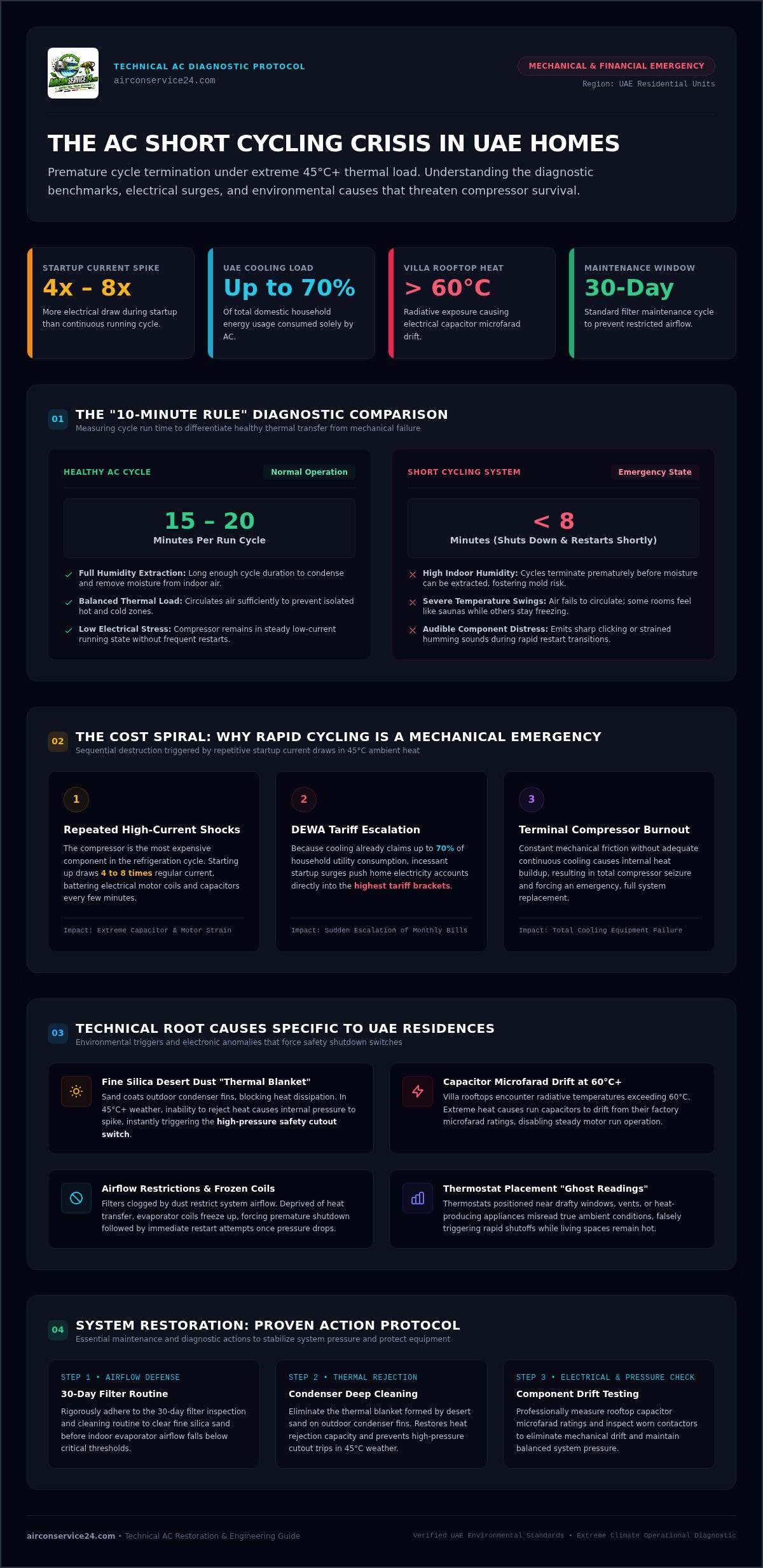
Did you know that an AC compressor draws four to eight times more electrical current during startup than during its normal running cycle? In the extreme UAE climate, where cooling accounts for up to 70% of your energy usage, a system that restarts every few minutes is more than a nuisance; it is a financial and mechanical emergency. You are likely dealing with unbearable indoor humidity and the persistent clicking of a unit that refuses to stay engaged, all while your DEWA bill threatens to climb into the highest tariff bracket.
We understand the anxiety that comes with a failing cooling system in 45°C heat. This guide provides the expert clarity you need to address the ac short cycling problem immediately. You will learn how to identify the specific triggers, from desert dust accumulation to electrical component drift, and discover the professional steps required to restore domestic harmony. We will walk you through the diagnostic process to stop rapid cycling, lower your energy consumption, and prevent a premature compressor replacement, ensuring your home remains a sanctuary of consistent, high-quality air.
Key Takeaways
- Understand that short cycling is a mechanical emergency where the system restarts frequently, driving up energy costs during the high-load startup phase.
- Identify how environmental factors like fine desert sand and restricted airflow directly contribute to the ac short cycling problem in UAE residences.
- Distinguish between mechanical failure and the common “oversizing” myth to ensure your unit provides consistent cooling without excessive wear.
- Master the 30-day filter maintenance routine and learn why professional deep cleaning is essential for maintaining system pressure and hygiene.
- Learn the precise diagnostic steps required to restore your compressor’s health, extend its lifespan, and stabilize your monthly utility bills.
Understanding the AC Short Cycling Crisis in UAE Homes
In the UAE, your air conditioning isn’t just a luxury; it’s a critical lifeline for your home. When a system begins to turn on and off every few minutes, you’re witnessing an ac short cycling problem. This behavior occurs when the cooling cycle terminates prematurely before the room reaches the desired setpoint, only to restart just seconds later. Think of this as a mechanical fever. Just as a human fever indicates an underlying infection, rapid cycling is a symptom of internal stress rather than the disease itself. Ignoring it allows the root cause to worsen until the system reaches a point of catastrophic failure.
The compressor serves as the heart of the air conditioning refrigeration cycle, and it’s also the most expensive component to replace. It consumes the most energy during the startup phase, drawing significantly more current than when it’s running steadily. In our national climate, where outdoor temperatures frequently exceed 45°C, this constant restarting places immense strain on the electrical motor and capacitors. Without intervention, this cycle of stress leads to a total breakdown of your domestic comfort.
Identifying the Signs of a Short Cycling Unit
A healthy system in the UAE should run for 15 to 20 minutes per cycle to effectively manage both heat and humidity. You can perform a baseline diagnosis using the 10-minute rule: if your unit shuts down in under 8 minutes and restarts shortly after, you have a problem. Keep an ear out for audible cues. A struggling compressor often emits a sharp clicking or a strained humming sound during these rapid transitions. You’ll also notice sharp temperature fluctuations. Because the air isn’t circulating long enough to balance the thermal load, some rooms may feel like saunas while others remain freezing.
The True Cost of Ignoring Rapid Cycling
The financial impact of an ac short cycling problem is immediate and severe. Because startup draws four to eight times more electrical current than standard operation, your utility bills will skyrocket. This often pushes households into higher residential tariff brackets. Beyond the monthly bill, you face the risk of total compressor failure. Constant mechanical friction without proper cooling leads to terminal burnout, requiring a full system replacement. There’s also a health cost. Short cycles don’t run long enough to remove moisture. This results in high indoor humidity, which encourages mold growth and compromises well-being. If you suspect your cooling equipment is failing, professional intervention is the only way to restore domestic harmony.
Technical Root Causes: Why Your System Is Rapidly Restarting
Identifying the source of an ac short cycling problem requires a methodical look at the system’s internal balance. While it might seem like a simple electronic glitch, the reality is usually a physical obstruction or a pressure imbalance. In the UAE, our systems work under extreme loads, meaning a small inefficiency quickly escalates into a cycle of rapid restarts. This mechanical instability is often triggered by the system’s own safety protocols, which shut the unit down to prevent permanent damage to the compressor.
Electrical components are equally vulnerable. On national villa rooftops, outdoor units face radiative temperatures that can exceed 60°C. This intense heat causes run capacitors to drift in their microfarad ratings, which prevents the compressor from sustaining steady motor operation. Similarly, worn-out contactors or faulty thermostat placement can lead to “ghost readings.” If a thermostat is placed near a drafty window or a heat-producing appliance, it may signal the AC to shut down prematurely, only to realize seconds later that the rest of the home is still sweltering.
The Impact of UAE Environmental Stressors
Our environment presents unique challenges that standard HVAC manuals often overlook. Fine silica desert dust is a primary culprit. It cakes the outdoor condenser fins, creating a thermal blanket that prevents heat rejection. When the unit can’t dissipate heat in 45°C+ weather, internal pressure spikes, triggering the high-pressure safety cutout switch. High humidity further complicates this by taxing the system’s ability to dehumidify, often leading to moisture buildup that chokes the cooling equipment and forces a restart.
Frozen Coils and Airflow Blockages
When airflow is restricted by clogged filters or sand-filled coils, the heat transfer process fails. The evaporator coil becomes too cold because there isn’t enough warm air passing over it to keep the refrigerant in a gaseous state. You might notice your AC “sweating” or see actual ice formation on the copper lines. Restricted airflow prevents the evaporator from absorbing heat, causing the surface temperature to drop below freezing and triggering a safety shutdown. If your unit is struggling to maintain a steady rhythm, scheduling a professional AC repair can prevent these minor blockages from turning into a total system collapse.
- Refrigerant Leaks: Low gas levels drop the internal pressure, causing the coils to freeze and the low-pressure switch to cut power.
- Clogged Filters: A month’s worth of UAE dust can block enough air to starve the blower motor, leading to immediate cycling.
- Capacitor Failure: Heat-stressed capacitors lose the ability to provide the consistent electrical “push” the compressor needs to stay running.
System Sizing vs. Mechanical Failure: A Diagnostic Comparison
Distinguishing between a design flaw and a mechanical breakdown is the first step in resolving an ac short cycling problem. In many UAE properties, the issue isn’t that the system is broken; it’s that it was never right for the space. However, identifying whether you need a simple repair or a strategic system redesign requires understanding how these two scenarios differ in behavior. One is a matter of capacity, while the other is a matter of component integrity.
Is Your AC Too Powerful for the Space?
There is a persistent myth in national construction that “bigger is always better” when it comes to cooling. This often leads to the installation of oversized units that cool the sensible air temperature in record time. While this sounds ideal, it prevents the unit from completing the necessary 15 to 20-minute runtime required to draw latent moisture over the evaporator coil. If your home feels cold yet clammy, or you notice immediate humidity spikes after the unit shuts down, your system is likely oversized. You should consult with a technician to calculate the precise BTU load for your specific floor plan to ensure your cooling equipment, such as modern Variable Refrigerant Flow (VRF) systems, is correctly matched to your needs.
Component Failure: When Parts Give Up
Mechanical failure presents differently than oversizing. While an oversized unit cycles consistently, a failing unit often cycles erratically. This is typically caused by the low-pressure switch, which acts as the system’s “panic button.” If the refrigerant levels are too low or a component is overheating, the system cuts power to protect itself from a total burnout. This erratic behavior is a clear signal that the ac short cycling problem has transitioned from a nuisance to a mechanical emergency.
An overheating compressor is particularly dangerous in our national climate. When the internal thermal overload kicks in, it’s a sign that the motor is working beyond its design limits. Distinguishing between a repairable part, like a capacitor, and a required system overhaul is a high-stakes decision. Proactive homeowners often utilize national maintenance contracts to catch these mechanical degradations before they trigger a catastrophic failure.
- Sizing Issue: Consistent, short bursts of cooling; high indoor humidity; system is relatively new or recently upgraded.
- Mechanical Failure: Erratic cycling patterns; unusual clicking or humming noises; sudden drop in cooling performance; older system age.
Step-by-Step Troubleshooting for Rapid AC Cycling
Before you attempt to diagnose an ac short cycling problem, you must prioritize safety. Air conditioning systems operate on high-voltage circuits that can be dangerous if handled incorrectly. Always switch off the power at the main circuit breaker or the local isolator switch near the outdoor unit before performing any physical inspection. This methodical approach ensures that the system won’t accidentally engage while you are checking for blockages or debris.
The Homeowner’s 5-Minute Inspection
Start with the most common culprit: the air filters. In our national environment, fine desert sand and dust can saturate a filter in as little as 30 days. Pull the filter from its housing and hold it up to a light source. If the mesh is opaque and blocks the light, it’s starving your blower motor of the air it needs to function. This restriction causes the internal pressure to drop, triggering a safety shutdown. Next, perform a visual sweep of your living space to ensure that furniture, curtains, or decorative panels aren’t obstructing the return air grilles. Finally, check your thermostat settings. Ensure the fan is set to “Auto” rather than “On,” which allows the system to regulate its cycles based on the actual cooling load rather than running the blower motor indefinitely.
Calibrating the Environment
Environmental factors often trick your system into shutting down prematurely. Inspect the area around your thermostat for heat sources. If a lamp, television, or kitchen appliance is located too close to the sensor, the thermostat will receive a false reading and signal the AC to stop cooling before the room is actually comfortable. Outside, the condenser unit requires a one-meter clearance on all sides to reject heat effectively. If you have stored items or plants crowding the unit, the heat will trap around the coils, causing the compressor to overheat and cycle off to prevent permanent damage.
When DIY Ends and Professional Repair Begins
Some warning signs indicate that the issue has moved beyond basic maintenance. If you hear a persistent hissing sound, it usually points to a refrigerant leak that requires specialized sealing and recharging. A pungent burning smell is even more urgent; it suggests electrical arcing or a failing motor winding that could lead to a fire. Handling modern refrigerants like R32 or R410A requires certified expertise to manage high-pressure lines and environmental compliance. A short cycling issue officially becomes an emergency AC repair situation when the compressor fails to sustain a run time of more than three minutes despite the filters being clean and the vents being clear. If your system is trapped in this destructive pattern, you must book a professional AC repair immediately to save the compressor from terminal burnout.
Professional Restoration: Eliminating Short Cycling for Good
When basic troubleshooting fails to stabilize your system, professional restoration becomes a mechanical necessity. Resolving an ac short cycling problem for the long term requires more than a visual inspection; it demands precision diagnostics. We utilize advanced digital gauges and thermal sensors to map your system’s internal pressures and electrical draws. This data-driven methodology allows our specialists to pinpoint the exact failure point, whether it’s a drifting capacitor or a microscopic refrigerant leak, ensuring the solution is permanent rather than a temporary patch.
Our approach at AirConService24.com combines high-stakes urgency with a methodical restoration process. We treat every rapid cycling event as a critical threat to your compressor’s lifespan. By using industry-specific terminology and advanced diagnostic tools, we provide a transparent overview of your system’s health. This eliminates customer anxiety and establishes a clear path toward restoring your home’s domestic harmony and cooling efficiency.
Deep Cleaning as a Preventative Strategy
There’s a critical, often overlooked link between hygiene and mechanical stability. Many residents don’t realize that a persistent musty odour is often a precursor to an ac short cycling problem. That smell indicates biological growth on the evaporator coils, which acts as a thermal insulator. This biofilm prevents the refrigerant from absorbing heat effectively, causing the system to work harder and eventually trigger a safety shutdown. Our professional sanitisation process removes the “sludge” that blocks drain lines and chokes airflow, restoring your unit to its factory performance standards. This level of deep cleaning doesn’t just improve indoor air quality; it stabilizes run times and significantly extends the mechanical longevity of your system in the harsh national climate.
Securing Your Cooling Future
A reactive approach to AC maintenance is a gamble that often ends in catastrophic failure during the peak of summer. Custom maintenance plans designed for our national environment provide the disciplined guardianship your home requires. These plans ensure that your system is consistently monitored for signs of wear before they escalate into an emergency. We understand that even the best-maintained systems can face unexpected issues, which is why we emphasize the value of 24/7 support for sudden system failures. This constant availability ensures that precision repairs are always just a phone call away.
Don’t let a short cycling AC burn out your compressor—Contact AirConService24.com for an expert diagnostic today. Our team is ready to act, providing the sophisticated, quality-focused service your home deserves to maintain a comfortable and sustainable lifestyle.
Securing Your Home Against Thermal Stress
Don’t treat a rapidly cycling AC as a minor inconvenience. In the extreme national heat, this behavior is a clear signal that your compressor is under terminal duress. You’ve learned that whether the cause is a sand-clogged condenser or an improperly sized unit, the financial and mechanical risks are severe. Addressing the ac short cycling problem today prevents a total system collapse and keeps your utility bills manageable.
We provide a unique blend of high-stakes urgency and professional reassurance. With our 24/7 emergency response and certified HVAC technicians, the team at AirConService24.com identifies root causes that basic maintenance often misses. We utilize specialized deep cleaning and sanitisation to restore factory-standard airflow, ensuring your home remains a sanctuary of domestic harmony. Restore Your Cooling Comfort with AirConService24.com. Take control of your indoor environment and enjoy the peace of mind that comes with elite technical reliability.
Frequently Asked Questions
How many times an hour should an AC cycle in the UAE?
A healthy system should cycle 2 to 3 times per hour, with each cooling cycle lasting roughly 15 to 20 minutes. In extreme summer heat, the unit might run longer to maintain the setpoint. If your system is cycling more than four times an hour, it suggests a mechanical imbalance or an airflow restriction that requires immediate professional attention to prevent compressor wear and excessive energy consumption.
Can a dirty air filter cause my AC to short cycle?
Yes, a clogged filter is a primary cause of the ac short cycling problem in national homes. When dust and fine sand block the filter, the blower motor can’t pull enough air over the evaporator coils. This causes the internal temperature to drop too low, which often leads to the coils freezing. The system’s safety sensors then shut the unit down prematurely to prevent permanent damage to the motor and compressor components.
Is it dangerous to run an AC that is short cycling?
While it may not be immediately life-threatening, it is dangerous for the health of your cooling equipment and your home environment. Constant restarting puts immense strain on the compressor and electrical capacitors, leading to terminal failure. Additionally, short cycles fail to dehumidify the air, which encourages mold growth and compromises indoor air quality. It’s essential to address these issues before they escalate into a full system replacement and higher utility costs.
Why does my AC turn off after only 5 minutes?
Turning off after five minutes is a classic sign of short cycling, often caused by restricted airflow or an oversized unit. If the system is too large for the room, it cools the air too quickly and shuts down before completing a full cycle. Alternatively, a high-pressure safety switch might be triggering due to a sand-filled outdoor condenser unit that can no longer reject heat effectively in the national climate.
Will low refrigerant cause my air conditioner to cycle on and off?
Low refrigerant levels frequently cause rapid cycling by triggering the low-pressure safety switch. When refrigerant is insufficient, the evaporator coils often freeze over, causing the system to shut down. Once the ice melts or the pressure equalizes, the unit attempts to restart, creating a destructive loop. Professional leak detection and a precise refrigerant recharge are necessary to restore stable operation and prevent compressor burnout in the national heat.
How much does it cost to fix an AC short cycling problem?
The cost of resolving an ac short cycling problem depends entirely on the root cause identified during a professional diagnostic. Simple fixes like deep cleaning or filter replacement are more affordable than complex repairs such as refrigerant leak sealing or capacitor replacement. While we don’t provide fixed pricing without an inspection, proactive maintenance is always more cost-effective than replacing a failed compressor or managing the high energy bills caused by inefficient cycling.
Can a faulty thermostat lead to rapid AC cycling?
A malfunctioning or poorly placed thermostat is a common culprit. If the sensor is located near a heat source, such as a lamp or a window with direct sunlight, it may receive “ghost readings” that suggest the room is warmer than it actually is. This causes the AC to turn on and off erratically as it tries to reconcile the false temperature spikes with the actual cooling load of the home.
How do I know if my AC unit is oversized?
The most telling sign of an oversized unit is a home that feels cold but extremely humid. An oversized system cools the air temperature so rapidly that it doesn’t run long enough to pull moisture out of the air. If your unit consistently reaches the setpoint in under 10 minutes and your indoor environment feels clammy, you likely have a capacity mismatch that requires a professional BTU load calculation.