AC Humidity Control (Dubai & UAE): The National Guide to Indoor Comfort

Article by
Jon Bonnett
Australian Air Conditioning Specialist with extensive hands-on experience in AC servicing, deep cleaning, maintenance, and troubleshooting. Focused on high-quality workmanship, reliability, and professional service to UAE standards.
Why does your home feel like a sauna even when the thermostat is set to a crisp 22°C? It is a common frustration for residents across the Emirates who find their AC not reducing humidity effectively, despite the system running at full capacity. You are likely dealing with the discomfort of sticky skin, damp air, and the faint, unsettling scent of musty odours that signal a system in distress. This is not merely a matter of comfort; it is a critical issue for your home’s hygiene and your family’s respiratory health.
You already know that living in this extreme climate requires more than just a cooling unit. You need a precision-tuned environment that acts as a sanctuary against the intense outdoor conditions that define the UAE summer. We promise to help you master the science of indoor moisture management. By understanding the relationship between airflow and latent heat, you can reclaim your domestic harmony and ensure your cooling system performs as a disciplined guardian of your well-being.
This guide provides a comprehensive roadmap to achieving a crisp, dry indoor environment. We will detail how professional sanitisation and expert maintenance eliminate condensation on vents, prevent mould-related risks, and lower your monthly energy bills through superior system efficiency. Discover how to transform your air conditioner into a high-performance tool for total environmental control.
Key Takeaways
- Understand the unique humidity paradox of the UAE’s coastal desert climate and how it impacts your indoor thermal comfort.
- Identify technical system failures, such as evaporator coil issues, that result in your ac not reducing humidity dubai effectively.
- Recognise the critical health risks associated with biofilm and “Dirty Sock Syndrome” when indoor moisture levels surpass 60%.
- Master practical operational strategies, including the “Auto” fan setting and optimal thermostat ranges, to maximise dehumidification.
- Discover how professional deep sanitisation and precise maintenance protocols protect your home from persistent musty odours and mould.
The Science of Humidity in the UAE Climate
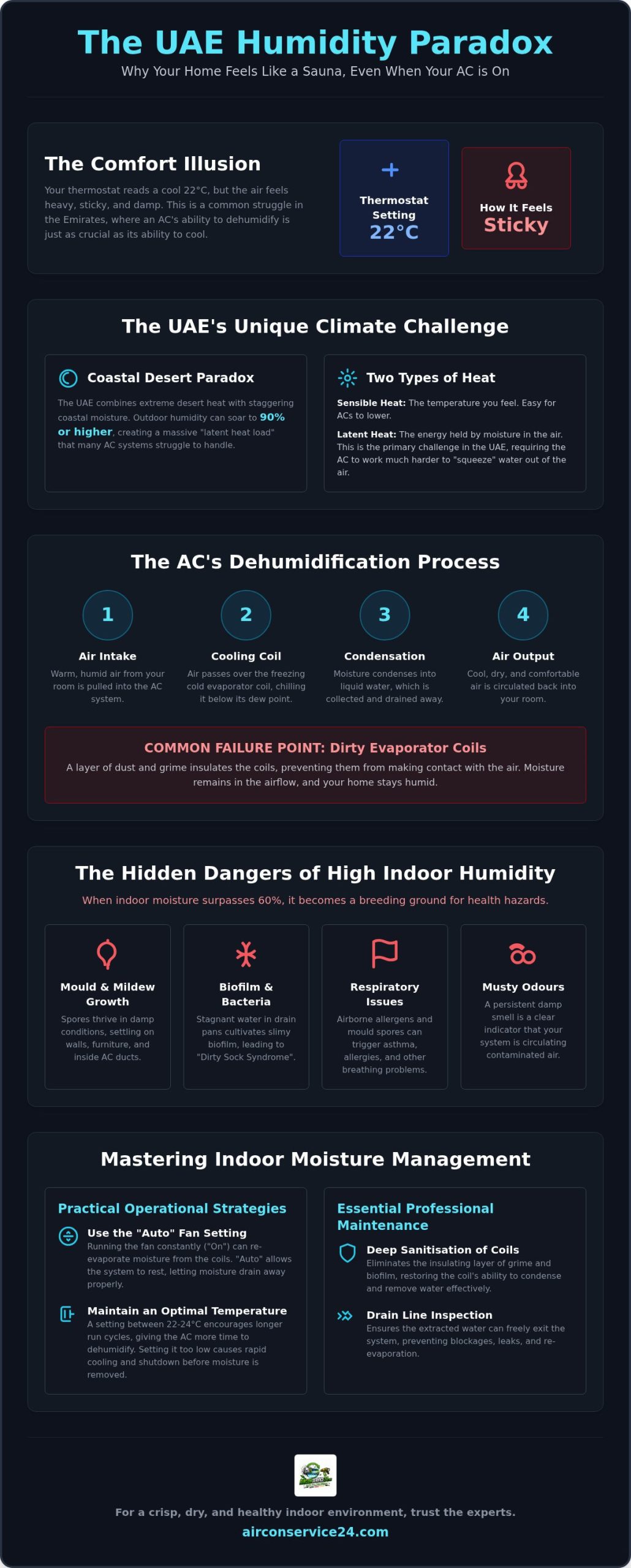
The UAE presents a unique atmospheric challenge. It is a coastal desert where extreme heat meets staggering moisture levels. During the summer months, outdoor humidity can soar to 90% or higher. This creates a “Humidity Paradox” where your home may feel cold but remains oppressively sticky. When you find your ac not reducing humidity dubai, it’s often because the system is struggling to manage the sheer volume of water vapour in the air.
Comfort is not just about the numbers on a thermostat. While a setting of 22-24°C is recommended for residents who spend 90% of their time indoors, temperature is only half the battle. The building envelope, which includes your walls, windows, and seals, acts as the primary barrier against the elements. If this envelope is compromised, or if the AC system is not calibrated for the local climate, moisture will infiltrate your living space. This leads to that “clammy” feeling that disrupts domestic harmony and ruins indoor air quality.
Latent vs. Sensible Heat Loads
Your air conditioning unit deals with two distinct types of heat. Sensible heat is what you feel as temperature, while latent heat refers to the energy held by moisture in the air. Understanding how air conditioners remove humidity is essential for every homeowner. The system must cool the air below its dew point to trigger condensation, effectively “squeezing” the water out of the air before it enters your rooms.
In the UAE, the latent load is exceptionally high. Your AC must work significantly harder to extract water than it does to lower the temperature. If the system is oversized or poorly maintained, it might cool the room too quickly and shut off before it has finished the dehumidification process. This imbalance places immense strain on mechanical components and shortens the lifespan of your specialised equipment.
National Climate Challenges for HVAC Systems
The geographical reality of the UAE dictates a more aggressive maintenance schedule than in other parts of the world. Coastal proximity means the air is constantly laden with moisture and salt, which can accelerate the degradation of evaporator coils. Unlike cooler climates, the seasonal shift here often brings humidity peaks when they are least expected, catching unmaintained systems off guard and leading to rapid mould proliferation.
Standard maintenance routines designed for temperate regions are insufficient here. Our extreme environment requires a disciplined approach to ensure the system remains a reliable responder. This includes:
- Frequent inspection of drain lines to prevent blockages from high condensation levels.
- Deep sanitisation of coils to ensure efficient heat exchange and moisture removal.
- Regular monitoring of refrigerant levels to maintain the correct dew point for water extraction.
A proactive approach is the only way to ensure your indoor environment remains a crisp, dry sanctuary against the relentless outdoor humidity.
How AC Systems Control Indoor Moisture
Your air conditioner is a dual-purpose machine. It doesn’t just lower the mercury; it acts as a mechanical sponge. If you notice your ac not reducing humidity dubai, the system is failing its secondary, and arguably more important, role. Effective dehumidification requires the system to run long enough to pull water from the air, a process that relies on precise mechanical harmony between airflow and refrigerant temperature.
The Evaporator Coil and Heat Exchange
The evaporator coil serves as the primary site where moisture condensation occurs. As warm, humid air from your home is pulled over these freezing cold metal fins, it reaches its dew point. This causes the water vapour to transform into liquid droplets, which then exit the air stream. If your coils are coated in a layer of dust or grime, they become insulated. This layer of filth prevents the air from making direct contact with the cold metal, meaning the moisture stays suspended in the air and continues to circulate through your home.
Once the water is successfully “squeezed” out, it must be removed from the property. It drips into a condensate pan and flows out through a dedicated drain line. A blockage here doesn’t just cause potential leaks; it keeps a reservoir of stagnant water inside your unit, which can re-evaporate back into the airflow. Failing to manage this process effectively increases the health risks of high indoor humidity, such as the rapid growth of allergens and mould that thrive in damp ductwork.
The Problem of Short Cycling
Bigger isn’t always better when it comes to HVAC. In the UAE, many homes are fitted with oversized AC units that cool the room to the target temperature in minutes and then shut off. This is known as short cycling. Because the unit reaches the temperature setpoint so quickly, it never runs long enough to complete a full dehumidification cycle. It takes time for the coils to stay cold enough to pull significant moisture from the air. This is a primary reason why residents find their ac not reducing humidity dubai despite the air feeling physically cold.
This “Cold but Clammy” phenomenon is a hallmark of an imbalanced HVAC setup. Modern solutions, such as variable speed compressors or inverter technology, solve this by running at lower, consistent speeds to maintain a steady dew point without constantly shutting down. If your current system is struggling to balance these loads, a professional assessment of your specialised equipment can identify if a repair or a configuration change is needed. For precision diagnostics and to restore domestic harmony, you can consult the specialists at AirConService24.com to ensure your system is perfectly calibrated for the coastal desert climate.
The Risks of High Indoor Humidity and Biofilm
Allowing indoor moisture levels to climb unchecked is a biological emergency. When your ac not reducing humidity dubai, you aren’t just dealing with personal discomfort; you’re hosting an environment that facilitates rapid microbial proliferation. Research indicates that once relative humidity exceeds 60%, the risk of mould growth and bacterial colonies increases exponentially. This threshold is critical because UAE residents spend approximately 90% of their time indoors, making the quality of that air a fundamental pillar of health and domestic harmony.
High humidity doesn’t only affect your lungs. It actively attacks the structural integrity of your home. Persistent moisture causes wallpaper to peel, timber flooring to warp, and delicate electronics to succumb to internal corrosion. These are not just aesthetic issues; they represent significant financial liabilities that can be avoided through precise environmental control and proactive maintenance.
Biofilm and Microbial Proliferation
One of the most insidious consequences of moisture mismanagement is the development of biofilm. This is a resilient, slimy layer of bacteria and fungi that adheres to your AC drain pans and evaporator coils. Biofilm is the primary culprit behind “Dirty Sock Syndrome,” a condition where your vents emit a persistent, musty odour that permeates every room. If you find your ac not reducing humidity dubai, the resulting dampness acts as a catalyst for these pathogens, creating a self-sustaining cycle of contamination.
Simple air fresheners or surface sprays are useless against this. They merely mask the scent while the underlying biological colony continues to thrive. Eliminating these odours requires a disciplined approach to deep cleaning and sanitisation. Without professional intervention to remove the biofilm at its source, the bacteria will continue to recirculate, triggering allergies and compromising the well-being of everyone in the household.
Protecting Indoor Air Quality (IAQ)
Maintaining superior Indoor Air Quality (IAQ) is a necessity for a healthy lifestyle. High indoor moisture is a known trigger for respiratory issues and can lead to Sick Building Syndrome, where occupants experience headaches and fatigue without a clear cause. By mastering humidity control, you ensure your home remains a sanctuary rather than a source of stress. Dry air leads to better sleep, fewer allergens, and a more energetic daily life. Learn about the specialised equipment we use to monitor and manage these critical environmental factors with precision.
Adhering to local standards, such as the Dubai Municipality guidelines for suspended particulates and TVOC levels, is easier when your AC system is functioning as a dehumidifier. A well-maintained system doesn’t just cool; it filters and dries, ensuring that PM2.5 and PM10 concentrations remain within safe limits. This commitment to environmental hygiene is what separates a standard living space from a high-performance home.
Strategies for Maximising AC Dehumidification
Operational precision is the first line of defence against the UAE’s relentless moisture. If you find your ac not reducing humidity dubai, the solution often lies in how you interact with your system’s controls. Small adjustments to your daily habits can prevent your home from becoming a reservoir for unwanted water vapour. It’s about working with the physics of your machine rather than against it.
Thermostat Optimization and Fan Settings
The debate between “Auto” and “On” fan settings is settled by the physics of moisture. When you set your thermostat fan to “On”, the blower runs continuously, even when the compressor is idle. This is a critical mistake. As the compressor shuts off, the evaporator coils remain drenched with recently condensed water. A continuous fan will blow air over these wet fins, re-evaporating that moisture and pushing it straight back into your rooms. Always select the “Auto” setting to ensure the fan only operates during the cooling cycle, allowing moisture to drain away properly.
Maintaining a thermostat range between 22°C and 24°C is optimal for national residences. This range balances thermal comfort with the system’s ability to run long enough for effective dehumidification. Smart thermostats provide an additional layer of protection, allowing you to monitor relative humidity in real time and adjust settings before dampness leads to musty odours. Keeping humidity between 40% and 60% is the gold standard for domestic harmony and health.
The Necessity of Deep Cleaning
Surface cleaning is merely a cosmetic fix. To truly manage humidity, you must invest in professional coil sanitisation. Over time, layers of dust and biofilm build up on the evaporator fins, creating an insulating barrier that prevents the refrigerant from absorbing heat and moisture effectively. Deep cleaning restores this heat exchange efficiency, ensuring your system removes every possible drop of water from the air. For a detailed breakdown of how to protect your system, consult our AC Maintenance UAE: The Complete 2026 Reference.
Don’t let outdoor air infiltration undermine your efforts. Ensure that windows and doors are sealed tightly and that exhaust fans in kitchens and bathrooms are used sparingly, as they can pull humid outdoor air into the building through small gaps. If your system still struggles to maintain a dry environment, it’s time for a professional intervention. You can book a comprehensive sanitisation and maintenance service with our elite technicians to restore your home’s environmental hygiene and ensure long term performance.
Professional Sanitisation and Repair Solutions
AirConService24 operates as a disciplined guardian of your indoor environment. When standard maintenance fails and you find your ac not reducing humidity dubai, the situation requires more than a simple filter change. It demands a methodical investigation into the mechanical integrity and biological hygiene of your HVAC system. We restore domestic harmony by combining technical expertise with a proactive, results-oriented methodology that addresses the root cause of moisture imbalance.
Our approach is built on transparency and precision. We don’t just guess at the problem; we use advanced diagnostics to identify why your system is failing to reach the necessary dew point. Whether the issue stems from a faulty expansion valve, a refrigerant imbalance, or a compromised evaporator coil, our technicians remain calm and methodical under pressure, ensuring your home returns to a state of equilibrium as quickly as possible.
Advanced Odour Removal Treatments
We eliminate the root cause of musty smells through a rigorous workflow that goes beyond surface cleaning. Our technicians utilise medical-grade disinfectants specifically formulated for residential AC systems to dissolve the resilient biofilm colonies mentioned in previous sections. This level of sanitisation is essential for ensuring long-term fresh air and preventing the recurrence of “Dirty Sock Syndrome.” By employing specialised equipment for deep sanitisation, we ensure that every square centimetre of your evaporator coils and drain pans is free from contaminants.
24/7 Support for Cooling Crises
Humidity spikes in the UAE are not just an inconvenience; they are an emergency that can lead to rapid mould proliferation and respiratory distress. Our rapid response methodology ensures that elite specialists are available to intervene the moment your indoor climate begins to deteriorate. We understand the high-stakes nature of a failing system in this environment, which is why we prioritise speed and precision in every repair. If your home has become a sauna due to mechanical failure, you can rely on our Emergency AC Repair Dubai: Fast Cooling Relief service to restore your comfort immediately.
Our commitment to results means we provide comprehensive mechanical repairs that recalibrate your system for the specific demands of the coastal desert. We don’t just patch problems; we solve them. From refrigerant leak detection to compressor optimisation, our goal is to ensure your air conditioner operates at peak efficiency. This protects your health, your home’s structural integrity, and ensures that your ac not reducing humidity dubai becomes a problem of the past.
Reclaim Your Indoor Environment
Mastering the UAE’s challenging climate requires more than just lowering the temperature. It demands a sophisticated understanding of latent heat loads and the biological risks of moisture. Maintaining a dry, crisp home relies on precise mechanical calibration and the elimination of resilient biofilms that thrive in damp conditions. When you find your ac not reducing humidity dubai, it’s a signal that your system’s mechanical and biological balance has been compromised, requiring immediate professional intervention to protect your health and domestic harmony.
AirConService24 stands ready as your disciplined guardian. We combine national UAE technical expertise with a methodical approach to deep sanitisation and mechanical restoration. Whether you require a 24/7 emergency professional response or specialised odour removal to eliminate persistent musty scents, our technicians are equipped to restore your system’s precision. Don’t let high humidity dictate your quality of life or compromise your home’s structural integrity.
Restore your indoor comfort with expert AC sanitisation and repair and enjoy the peace of mind that comes with a perfectly balanced environment. Your journey to a healthier, more comfortable home begins with a single proactive step. We are ready to act when you need us most.
Frequently Asked Questions
Why is my AC running but the house still feels humid?
Your system might be cooling the air without effectively removing moisture, which is a common reason for your ac not reducing humidity dubai. This happens when the evaporator coil doesn’t stay cold enough for a sufficient duration. It’s often caused by low refrigerant levels or restricted airflow. If the compressor shuts off too early, the water vapour remains suspended in the air. This creates a sticky environment that disrupts your domestic harmony and well-being.
What is the ideal indoor humidity level for UAE homes?
The optimal relative humidity range for national residences is between 40% and 60%. Maintaining this balance is essential to prevent the growth of mould and bacteria. If levels exceed 60%, biological contaminants like biofilm begin to thrive. Conversely, levels below 40% can cause dry skin and respiratory irritation. Using a smart thermostat or hygrometer helps you monitor these levels to ensure your home remains a healthy, disciplined sanctuary.
Does a dirty AC filter cause high humidity?
A clogged filter restricts the volume of air passing over the evaporator coils. This slows down the heat exchange process and prevents the system from reaching the necessary dew point for water extraction. When airflow is compromised, the AC works harder but removes less moisture. Regular maintenance and filter replacement are basic but vital steps in ensuring your system functions as a high-performance dehumidifier rather than just a simple cooling fan.
Why does my AC smell musty when it first turns on?
This odour is typically caused by biofilm and microbial growth on the evaporator coils or in the drain pan. It’s often referred to as “Dirty Sock Syndrome.” Moisture trapped in the system creates a breeding ground for bacteria that release foul scents when the fan starts. Professional sanitisation and specialised odour removal are required to eliminate these colonies. Simple sprays won’t solve the issue; you need deep cleaning to restore environmental hygiene.
Can an oversized AC unit actually make my home more humid?
Oversized units cool spaces too rapidly and then shut down. This is known as short cycling. Because the cooling cycle is so brief, the system doesn’t have enough time to pull moisture from the air and drain it away. This results in a “Cold but Clammy” feeling where the temperature is low but the humidity remains high. Correct system sizing and professional installation are critical for maintaining a crisp, dry indoor environment throughout the year.
How often should I have my AC deep cleaned for moisture control?
In the intense UAE climate, you should schedule a professional deep cleaning every six months. The high levels of airborne dust and coastal moisture lead to rapid debris buildup on internal components. Regular sanitisation ensures that evaporator coils remain efficient and drain lines stay clear. This proactive approach prevents the formation of biofilm and ensures your system continues to manage latent heat loads effectively during the peak summer months.
What is the best thermostat setting for humid weather?
Set your thermostat between 22°C and 24°C and always keep the fan on the “Auto” setting. If you use the “On” setting, the fan runs continuously. This causes moisture that has condensed on the coils to re-evaporate back into your home during the compressor’s off-cycle. The “Auto” mode ensures that the fan only blows when the system is actively cooling and dehumidifying, which is vital for maintaining domestic comfort and air quality.
Is condensation on my AC vents a sign of a serious problem?
Visible condensation on your vents suggests that warm, humid air is meeting a cold surface. This often indicates a leak in the building envelope or a restriction in airflow that is causing the vents to become excessively cold. If left unaddressed, this moisture will lead to mould growth and potential structural damage. Immediate professional inspection is necessary to identify the source of the infiltration and restore your system’s precision and performance.