Energy Efficient AC Units UAE: The 2026 Buyer’s Guide to Lower Bills

Article by
Jon Bonnett
Australian Air Conditioning Specialist with extensive hands-on experience in AC servicing, deep cleaning, maintenance, and troubleshooting. Focused on high-quality workmanship, reliability, and professional service to UAE standards.
Did you know that air conditioning accounts for a staggering 60% to 70% of your total residential electricity bill during the peak UAE summer? When the mercury hits 50°C, your cooling system isn’t just a luxury; it’s a vital lifeline that often feels like a heavy financial burden. We understand the frustration of watching your utility statements skyrocket while worrying if your unit will suddenly trip out during a July heatwave. It’s a high-stakes balancing act between domestic harmony and monthly budget management that many residents struggle to master. Selecting the most energy efficient ac units UAE offers shouldn’t be a confusing ordeal buried under technical jargon.
You deserve a home that remains a cool sanctuary without the persistent anxiety of high slab tariffs. This 2026 buyer’s guide cuts through the noise to show you exactly how to select a system that thrives in T3 tropical conditions while slashing your utility costs. We’ll break down the latest MoIAT standards, the real-world ROI of inverter technology, and why professional installation is the only way to lock in those rated savings. From understanding the shift to R32 refrigerants to the critical role of deep cleaning in maintaining peak efficiency, you’ll gain the clarity needed to make a sophisticated, high-quality investment in your long-term comfort.
Key Takeaways
- Learn how to decode the mandatory MoIAT 5-star rating system to ensure your cooling system meets the latest 2026 energy efficiency regulations.
- Discover why T3-rated compressors and inverter technology are non-negotiable for reliable cooling and significant bill reductions during extreme summer peaks.
- Identify the most energy efficient ac units UAE offers by comparing wall-mounted splits, ducted systems, and advanced VRF configurations for your specific home layout.
- Understand why professional heat load calculations and expert installation are the only ways to achieve a unit’s rated performance and avoid “slab creep” on your utility bills.
- See how proactive maintenance, including deep cleaning and sanitisation, protects your investment and prevents efficiency losses of up to 25% caused by dust and humidity.
Understanding UAE Energy Efficiency Ratings and Standards
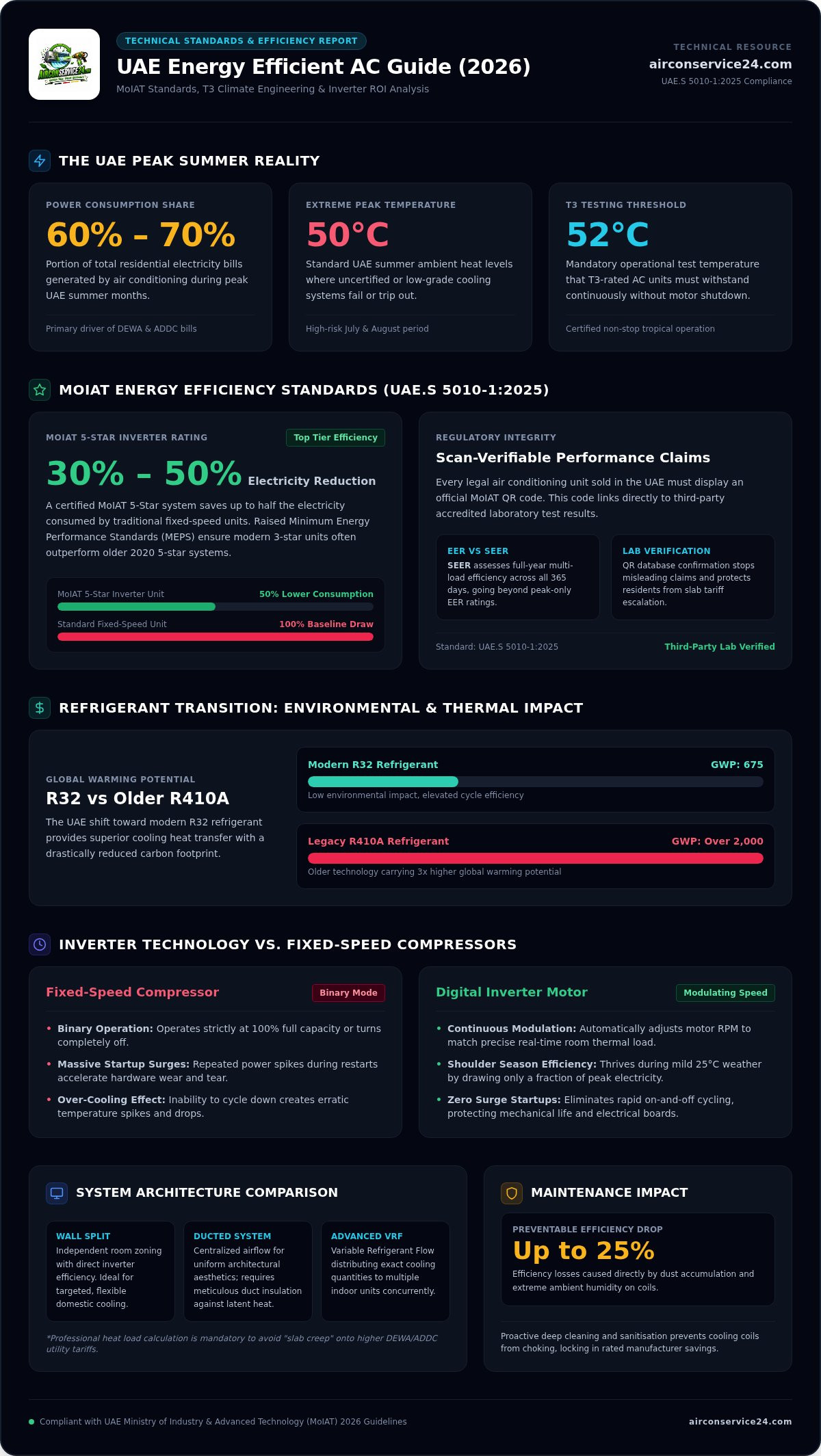
Selecting the most energy efficient ac units UAE offers requires looking beyond the cooling capacity. In 2026, the Ministry of Industry and Advanced Technology (MoIAT) enforces rigorous technical regulations under UAE.S 5010-1:2025 to ensure every system can withstand our extreme environment. These aren’t mere suggestions; they’re mandatory benchmarks designed to protect your home from the financial drain of inefficient hardware. Every unit sold must now display a scan-verifiable QR code that links directly to the MoIAT database, confirming its performance claims are backed by independent, third-party laboratory testing.
Understanding the difference between raw power and efficient performance is critical. While many look at the Energy Efficiency Ratio (EER) for peak summer performance, the Seasonal Energy Efficiency Ratio (SEER) provides a more comprehensive view of how a unit operates across varying loads throughout the year. In a climate where cooling is required almost 365 days a year, high SEER ratings translate directly to lower monthly bills. Furthermore, the transition to R32 refrigerant marks a significant shift in sustainability. With a Global Warming Potential (GWP) of just 675, it’s far more environmentally responsible than the older R410A, which carries a GWP of over 2,000.
The Star Rating System Explained
The MoIAT star rating is your most reliable tool for a quick efficiency audit. A 5-star rating typically indicates a top-tier inverter system capable of reducing electricity consumption by 30% to 50% compared to fixed-speed alternatives. It’s vital to realize that standards are constantly tightening. A 3-star unit manufactured under the 2025/2026 regulations often outperforms a 5-star unit from 2020 because the Minimum Energy Performance Standards (MEPS) have been raised. Investing in modern air conditioning equipment ensures you aren’t buying yesterday’s technology at tomorrow’s energy prices.
Why UAE Standards are Unique
UAE standards are specifically engineered for the T3 tropical climate. Unlike units designed for cooler regions, a T3-rated AC must pass operational tests at an ambient temperature of 52°C without the motor cutting off or the system tripping. This is a non-negotiable requirement for domestic harmony during July and August. High humidity also places a massive latent load on your system; UAE-certified units are built with larger condensing coils and specialized anti-corrosion coatings to handle these conditions. Without these specific T3 protections, an uncertified unit will run continuously at 100% load, failing to cycle down and causing your DEWA or ADDC bills to spiral out of control.
Inverter Technology and T3 Compressors: The Efficiency Engines
The core of any energy efficient ac units UAE residents prioritize is the compressor technology hidden within the outdoor unit. Traditional fixed-speed systems operate on a binary principle; they’re either running at 100% capacity or they’re completely off. This creates massive power surges during every startup and subjects mechanical parts to unnecessary fatigue. Modern systems have evolved. As highlighted in the International Energy Agency’s Future of Cooling report, adopting high-efficiency appliance standards is the primary defense against escalating global energy demand. Digital inverter motors solve this by modulating their output to meet the specific thermal load of your home with surgical precision.
These systems are particularly effective during the UAE’s milder shoulder seasons. When outdoor temperatures hover around 25°C, an inverter system doesn’t need to run at full throttle. It scales back its power draw to a fraction of its maximum, preventing the “over-cooling” effect and keeping your cooling equipment running in its most efficient state. This adaptability ensures your utility bills remain manageable even when the weather is unpredictable.
The Science of Inverter Cooling
Inverter technology is a method of continuous motor speed adjustment to match cooling demand. By removing the harsh start-stop cycles of older units, inverters eliminate the startup currents that often trigger the highest utility tariff slabs. It’s a matter of precision and domestic harmony. You won’t experience the annoying temperature swings or the loud clatter of a compressor kicking in at midnight. Instead, the system maintains a steady, whisper-quiet flow of air that stays within 0.5°C of your desired setting, ensuring a consistent environment for your family.
The T3 Compressor Advantage
In our national climate, the compressor’s classification is a matter of survival. T1 compressors are built for moderate zones and often fail when the ambient temperature exceeds 43°C. A T3-rated compressor is a heavy-duty machine designed specifically for extreme heat. It features physically larger condensing coils, reinforced motor windings, and synthetic lubricants that remain stable when outdoor temperatures soar. These units are legally required to pass operational tests at 52°C, ensuring they won’t trip out on the hottest summer afternoons. This durability reduces the frequency of emergency repair calls and prevents the heat-induced degradation of internal circuitry. If you suspect your current system is under-performing under the summer sun, a professional evaluation of your cooling infrastructure by AirConService24.com can determine if a T3 upgrade is your most cost-effective path forward.
Comparing System Types: Split, Ducted, and VRF Efficiency
Choosing the right cooling architecture is the most significant decision you’ll make for your home environment. While all modern energy efficient ac units UAE retailers stock must meet MoIAT standards, the delivery method drastically alters your monthly consumption. Wall-mounted split systems remain the most popular residential choice because they offer high efficiency at a lower entry point. They avoid the energy losses associated with ductwork, which can leak up to 20% of cooled air if not perfectly sealed. For larger properties, the International Energy Agency’s Future of Cooling report underscores that adopting high-performance equipment is the only way to counteract rising ambient temperatures sustainably.
Variable Refrigerant Flow (VRF) systems represent the gold standard for UAE villas. Unlike traditional ducted units that cool an entire floor at once, VRF technology allows for independent multi-zone control. It uses a single outdoor condenser to power multiple indoor units, adjusting the refrigerant flow based on the specific cooling demand of each room. This level of precision eliminates the waste of cooling unoccupied spaces. In contrast, window units have become essentially obsolete in the efficiency conversation. Their poor insulation, high noise levels, and limited EER ratings make them a liability for any resident focused on long-term utility savings.
Efficiency Comparison Table
- Wall-Mounted Split: Average EER of 11 to 13+. Best for apartments and individual rooms. Lowest initial cost with a high ROI.
- Ducted Split: Average EER of 10 to 12. Ideal for open-plan villas where aesthetics matter. Requires professional maintenance to prevent efficiency drops.
- VRF Systems: Average EER of 14 to 16+. Best for large, multi-room villas. Highest initial investment but yields the greatest long-term energy reduction.
Choosing the Right Hardware
Selecting the correct capacity is non-negotiable. An undersized unit will run at 100% capacity indefinitely, negating any inverter savings. Conversely, an oversized unit will cycle too quickly, failing to dehumidify the air properly. You must match the BTU rating to your specific square footage while accounting for ceiling height and sun exposure. Integrating smart thermostats with these systems adds another layer of disciplined control, allowing for automated setback routines when you are away. Explore our AC equipment guide for modern system options that bridge the gap between technical excellence and domestic comfort. Precision in hardware selection is your first line of defense against skyrocketing bills.
A Buyer’s Checklist for Energy Efficient AC Installation
Purchasing the most energy efficient ac units UAE retailers offer is only half the battle. If your installation is flawed, that high-performance 5-star sticker becomes a meaningless ornament. We’ve seen sophisticated systems fail to deliver their rated savings simply because the setup was rushed or unscientific. To secure your investment and ensure domestic harmony, follow this disciplined five-step checklist during the commissioning phase.
- Step 1: Conduct a professional heat load calculation. Heat load calculation is the precise measurement of thermal energy to be removed to maintain a set temperature. This ensures your unit isn’t overworking or short-cycling.
- Step 2: Verify the T3 compressor and refrigerant. Confirm the unit is rated for 52°C operation and utilizes R32 gas, as discussed in our previous sections on MoIAT compliance.
- Step 3: Inspect piping insulation. Ensure all refrigerant lines are encased in high-quality, closed-cell insulation to prevent energy loss and “sweating” that leads to ceiling damage.
- Step 4: Optimize outdoor unit placement. Your condenser must be in a shaded, well-ventilated area. If it’s trapped in a hot alcove or direct sunlight, it’ll struggle to shed heat, causing your power bill to skyrocket.
- Step 5: Calibrate the thermostat. Align your settings with UAE lifestyle patterns, using 24°C as your baseline setpoint to avoid unnecessary compressor strain.
The Hidden Impact of Installation Quality
Poor installation can reduce a 5-star unit’s efficiency by 30% almost instantly. Many “quick-fix” installers skip the critical step of vacuuming the refrigerant lines. This leaves moisture and non-condensables in the system, which causes internal corrosion and forces the compressor to work harder. Professional commissioning includes a nitrogen pressure test and precise gas charging. These methodical steps are essential for maintaining your manufacturer warranty and achieving the long-term ROI you expect from high-end cooling equipment.
Optimizing the Environment
Your AC doesn’t work in a vacuum; it’s part of a total building envelope. To preserve the cooling you’re paying for, you must seal air gaps around doors and windows. There’s a powerful synergy between efficient AC and high-quality window tinting. By reducing solar heat gain through the glass, you lower the load on your system, allowing it to run in its most efficient low-power inverter state. If you’re ready to upgrade, book a professional AC installation to ensure your new system is configured for peak performance from day one.
Preserving Efficiency: The Role of Maintenance and Hygiene
Investing in a high-performance cooling system is a sophisticated choice, but even the most energy efficient ac units UAE residents install will degrade without disciplined upkeep. In our desert environment, fine dust and high humidity create a persistent threat to mechanical performance. When filters become clogged or evaporator coils are coated in a layer of grime, your system is forced to work up to 20% harder to achieve the same cooling effect. This extra strain doesn’t just inflate your utility bill; it accelerates mechanical wear and tear, eventually leading to the premature failure of the T3 compressors that are so vital for summer survival.
Maintaining factory-rated efficiency requires more than a casual glance at the thermostat. It demands a methodical approach to hygiene that protects both your hardware investment and your home’s air quality. Proactive sanitisation and deep cleaning ensure that every component operates at its peak thermodynamic potential. Without this regular attention, the energy savings you expected from a 5-star unit will slowly evaporate, leaving you with the high costs of a poorly maintained, inefficient system.
Deep Cleaning for Peak Performance
Deep cleaning is a technical necessity that goes far beyond a simple filter rinse. This process involves the methodical removal of biofilm and mould that accumulate deep within the heat exchange fins. These contaminants act as an insulating blanket, preventing the refrigerant from absorbing heat efficiently. When these surfaces are professionally cleared, the system can reach its setpoint much faster, allowing the inverter motor to throttle down to its lowest power-saving state. Sanitisation further enhances this by eliminating microbial growth that can restrict airflow. For a comprehensive look at how to protect your system, see our AC Maintenance UAE guide for seasonal checklists.
The Conscientious Innovator’s Approach
A disciplined guardian of the home environment understands that proactive repairs are always more cost-effective than reactive emergency calls. Using professional odour removal serves as a vital diagnostic tool; foul smells are often the first indicator of bacteria-laden moisture buildup that is choking your system’s airflow. By addressing these hygiene issues early, you keep your energy efficient ac units UAE running exactly as the manufacturer intended. Annual maintenance contracts provide the professional reassurance that your system is being monitored by experts who value precision and long-term reliability. Learn about Emergency AC Repair and how to avoid it through efficiency by prioritizing the health of your cooling infrastructure today.
Secure Your Long-Term Cooling Performance
Selecting the most energy efficient ac units UAE has available is a sophisticated investment in your domestic harmony. By prioritizing MoIAT-certified T3 compressors and variable-speed inverter technology, you’ve taken the essential first step toward slashing monthly utility bills. However, technical excellence is only realized through precise installation and a commitment to rigorous hygiene standards. Without professional oversight, even the most advanced hardware will struggle to deliver its rated ROI during the peak summer heat.
AirConService24.com stands as your disciplined guardian in this process, ensuring your cooling infrastructure remains optimized for the long term. Our specialist team provides expert T3 compressor installation and advanced deep cleaning to restore your system to its original factory efficiency. With 24/7 technical support available across the UAE, we remain ready to act whenever your comfort is at stake. Don’t let amateur installation or neglected maintenance compromise your home environment. Optimize your cooling efficiency with AirConService24.com today and enjoy the lasting benefits of a high-performing, sustainable cooling strategy.
Frequently Asked Questions
What is the best energy efficient AC brand for the UAE climate?
The best energy efficient ac units UAE offers are those that carry a 5-star MoIAT rating and a T3 climatic classification. Brands like Daikin, Mitsubishi Electric, and Gree are frequently cited for their robust tropical compressors. However, the specific brand name is less important than ensuring the unit is engineered for 52°C ambient temperatures. Always verify the QR code on the energy label to confirm the system’s performance metrics meet current 2026 standards.
How much can I save on my utility bill with a 5-star AC unit?
Upgrading to a 5-star inverter AC unit can reduce your monthly electricity consumption by 30% to 50% compared to traditional fixed-speed models. These savings are most dramatic during the peak summer months when cooling accounts for nearly 70% of your total bill. By avoiding the high-consumption power spikes of older systems, you stay within lower slab tariffs, preventing the financial penalty of “slab creep” on your utility statements.
Do Inverter AC units really work when it is 50 degrees outside?
Yes, modern inverter units are specifically designed to operate efficiently even when temperatures hit 50°C, provided they have a T3-rated compressor. Unlike older units that might trip out under extreme heat, an inverter system throttles its motor speed to maintain a steady temperature without overworking. This continuous operation prevents the mechanical stress of frequent restarts, ensuring reliable cooling and domestic harmony during the most intense heatwaves of the UAE summer.
What is the difference between T1 and T3 compressors?
The primary difference lies in the maximum ambient temperature the unit can handle. T1 compressors are designed for moderate climates and are tested up to 43°C. In contrast, T3 compressors are engineered for tropical desert conditions and must pass operational tests at 52°C without thermal shutdown. Using a T1 unit in the UAE leads to frequent system failures and significantly higher energy consumption as the motor struggles to shed heat effectively.
How often should I clean my energy-efficient AC to keep it performing well?
You should schedule a professional deep cleaning and sanitisation every six months to preserve your system’s factory efficiency. Dust and sand accumulation on the condenser coils can force your unit to work 20% harder, directly increasing your power draw. Regular maintenance ensures optimal heat exchange and prevents the buildup of biofilm or mould. This proactive approach protects your hardware investment and maintains the indoor air quality essential for a healthy lifestyle.
Is it worth replacing my old AC with a new energy-efficient model?
Replacing an AC unit older than seven to ten years is typically a high-yield investment. Older fixed-speed units consume significantly more power than modern energy efficient ac units UAE residents can now access. The ROI is realized through lower monthly utility bills and a reduction in emergency repair costs. Additionally, newer models utilize R32 refrigerant, which is more environmentally sustainable and offers better cooling capacity than the phased-out R22 or R410A gases.
Can a smart thermostat help improve my AC’s energy efficiency?
A smart thermostat is a powerful tool for improving efficiency by automating your cooling schedule based on real-time occupancy. Setting your baseline to the recommended 24°C and using geolocation features to ramp up the temperature when the home is empty can save between 6% and 8% per degree adjusted. These devices eliminate the waste of cooling an unoccupied house while ensuring your living space is perfectly pre-cooled before you arrive home.
Why is my energy-efficient AC still resulting in high bills?
High bills despite an efficient unit are often caused by poor installation quality or hidden air leaks in the building envelope. If your system wasn’t professionally commissioned with a proper heat load calculation, it may be overworking. Furthermore, dirty filters or fouled coils can cause a 15% to 25% drop in efficiency. We recommend a comprehensive maintenance check to identify underlying inefficiencies or sanitisation issues that might be forcing your compressor to run longer than necessary.