AC Not Cooling in Dubai? 5 Steps Before Calling a Pro

Article by
Jon Bonnett
Australian Air Conditioning Specialist with extensive hands-on experience in AC servicing, deep cleaning, maintenance, and troubleshooting. Focused on high-quality workmanship, reliability, and professional service to UAE standards.
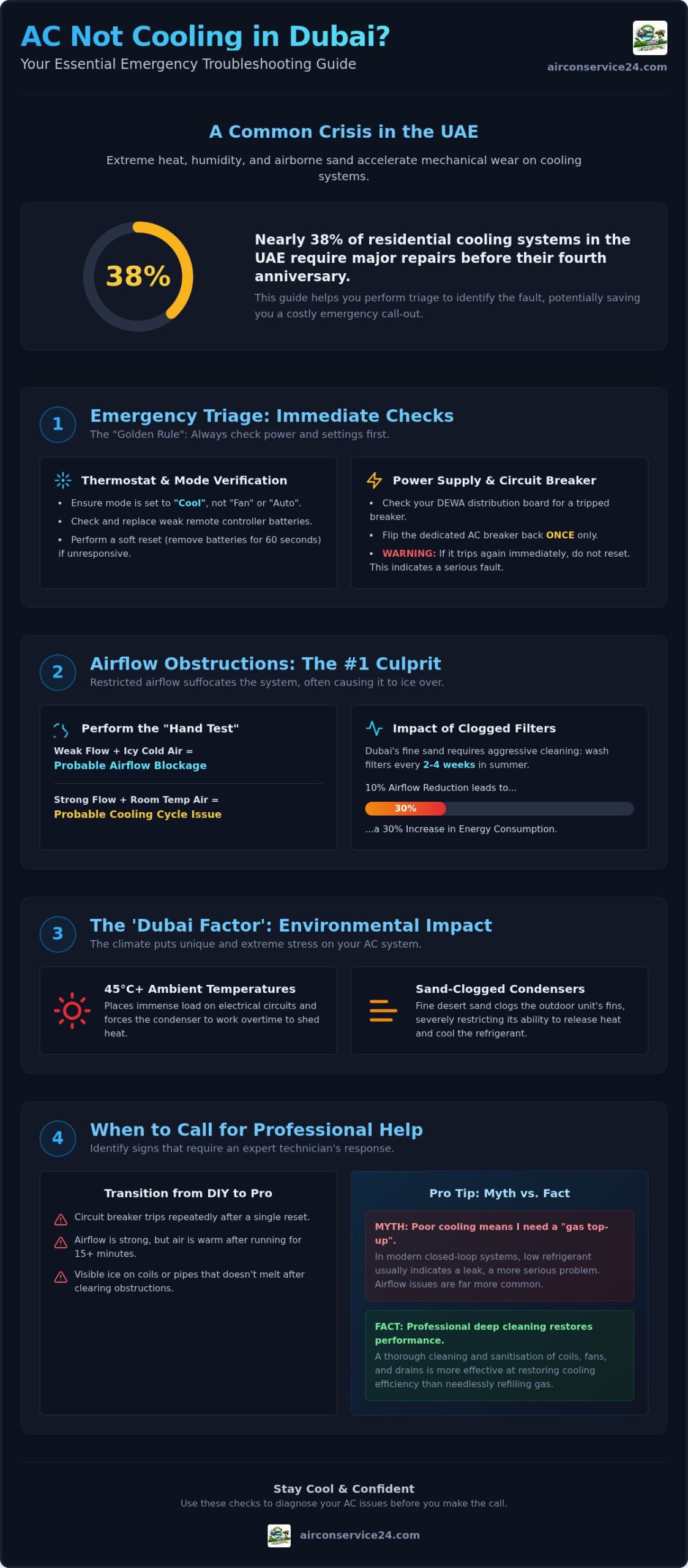
Did you know that nearly 38% of residential cooling systems in the UAE require major repairs before they even reach their fourth anniversary? In a city where the “Dubai factor” of extreme humidity and airborne sand accelerates mechanical wear, finding your air conditioner not cooling Dubai interiors is a high-stakes emergency. You’ve likely felt that sudden wave of heat as the indoor temperature spikes past 30°C, followed immediately by the fear of a massive repair bill. It’s stressful to wonder if you’re facing a simple settings issue or a total compressor failure.
We believe a functional home environment is essential for your health and domestic harmony. This guide provides the professional triage steps needed to identify the fault and potentially restore comfort immediately. We’ll walk you through five methodical checks, from thermostat calibration to airflow obstructions, ensuring you have total clarity before calling for a specialist. You’ll learn how to distinguish between a quick DIY fix and a situation that requires an elite, professional response.
Key Takeaways
- Master the “Golden Rule” of troubleshooting by identifying simple power trips and thermostat errors that often mimic mechanical failure.
- Discover how restricted airflow suffocates your evaporator coils, which is the most frequent cause of an air conditioner not cooling Dubai residences during peak summer.
- Understand the impact of Dubai’s 45°C+ temperatures and sand-clogged condensers on your system’s ability to shed heat efficiently.
- Learn why professional deep cleaning and sanitisation are more effective for restoring performance than the common myth of annual gas refills.
- Identify the specific mechanical warning signs that indicate it is time to transition from DIY triage to a professional 24/7 emergency repair.
Emergency Triage: Immediate Checks for an AC Not Cooling
When your indoor temperature begins to climb toward 35°C, the instinct is to call a technician immediately. However, the first step in resolving an air conditioner not cooling Dubai home is to remain calm and methodical. This high-stakes urgency often clouds judgment, but a structured approach can save you hundreds of dirhams in unnecessary call-out fees. The “Golden Rule” of HVAC maintenance is simple; always verify the most basic power and control settings before assuming a mechanical breakdown has occurred.
Our professional 5-step triage process is designed to eliminate common user errors and identify minor electrical trips. By following this sequence, you act as the disciplined guardian of your home’s comfort. You’ll determine if the issue is a simple software glitch or a genuine hardware failure that requires an elite, professional response. Taking ten minutes to perform these checks provides the clarity needed to handle a cooling crisis with confidence.
Thermostat Calibration and Mode Verification
Start with the control interface. Ensure the mode is set specifically to “Cool” and not “Fan” or “Dry.” Many residents in the UAE fall into the “Auto” mode trap; while it sounds efficient, it can cause the compressor to cycle off prematurely during extreme heatwaves. Understanding how air conditioning works helps clarify that the system needs a consistent signal to exchange heat and lower humidity. Check your remote controller batteries; a fading display often indicates a weak signal that fails to trigger the outdoor unit. If the screen is frozen or unresponsive, perform a soft reset by removing the batteries for 60 seconds or pressing the recessed reset button on the wall-mounted unit to clear software glitches.
Power Supply and Circuit Breaker Inspection
Dubai’s intense ambient temperatures, often exceeding 45°C, place an immense load on electrical circuits. If your system stops abruptly, check your DEWA distribution board. A tripped breaker is a safety mechanism, not necessarily a sign of a broken AC. Locate the dedicated AC breaker; if it’s in the “off” position, flip it back once to restore the connection. You should also check the isolator switch, typically located near the outdoor condenser or in the kitchen area. Be cautious of “short cycling.” If you restore power and the system trips the breaker again immediately, do not attempt to flip it a second time. Repeatedly forcing a connection can cause permanent damage to the compressor’s start capacitor or internal wiring.
Airflow Obstructions: The #1 Reason for Weak Cooling
Airflow is the lifeblood of your HVAC system. In the harsh climate of the UAE, an air conditioner not cooling Dubai interiors is frequently suffering from a simple lack of circulation rather than a mechanical failure. Cooling is essentially a process of heat exchange; your unit pulls warm air from the room, strips away the heat, and recirculates chilled air. When this volume of air is restricted, the evaporator coil becomes “suffocated,” often dropping to freezing temperatures that cause the entire system to ice over and stop functioning.
You can perform a simple “Hand Test” to diagnose this immediately. Hold your palm roughly 10 centimetres from the supply vent. If the air feels icy but the breeze is barely detectable, you are likely facing a severe blockage. Conversely, if the air volume is strong but the temperature feels like a standard fan, the issue lies within the cooling cycle itself. Many residents mistakenly assume they need a “gas top-up” when they notice poor performance, but inexperienced technicians often misdiagnose airflow issues as low refrigerant. In reality, modern AC units are closed loops, and “low gas” is rarely the culprit compared to the fine desert sand that permeates Dubai’s air.
The Impact of Clogged Air Filters
The fine, silty sand found in the Arabian Peninsula behaves differently than standard household dust. It creates a dense, carpet-like layer on your filters that standard vacuuming cannot always remove. While global manuals suggest cleaning filters every six months, Dubai’s environmental load requires a more aggressive schedule. You should remove and wash your filters every 2 to 4 weeks during the peak summer months. A mere 10% reduction in airflow can lead to a 30% increase in energy consumption as the system works overtime to compensate for the lack of heat exchange. Maintaining high efficiency is a key part of managing the environmental impact of air conditioning while keeping your DEWA bills manageable.
Blocked Vents and Obstructed Returns
It is easy to overlook the return air grilles, which are often located near the floor or hidden behind decorative elements. If you have placed a new sofa or heavy curtains near these vents, you’ve effectively cut off the system’s ability to “breathe.” You can verify the health of your return duct using the “Paper Test.” Hold a single sheet of tissue paper near the return grille; a healthy system should have enough suction to hold the paper against the slats. If the paper falls, your internal ductwork or filters are likely obstructed. If your DIY efforts don’t restore the breeze, it may be time to consider a professional Deep Cleaning to clear the internal components that are out of reach.
Technical Failures: When the Issue is Internal
Once you’ve ruled out power trips and surface-level dust, the diagnostic process shifts toward the internal mechanics of your system. Identifying a technical failure requires a transition from simple DIY checks to observing the sophisticated behavior of your unit’s internal components. In the harsh UAE environment, internal parts face extreme stress; research indicates that compressor burnout and refrigerant leaks account for over 40% of major service calls in the region. This is where professional expertise becomes a necessity to prevent a minor fault from escalating into a total system replacement.
One of the most persistent myths regarding an air conditioner not cooling Dubai homes is the idea that refrigerant, or “AC gas,” needs an annual refill. It’s vital to understand that your AC is a hermetically sealed, closed-loop system. Refrigerant isn’t “consumed” like fuel in a car; it simply circulates to move heat. If your gas levels are low, you have a physical breach in your copper lines or evaporator coils. Simply topping up the gas without fixing the leak is a temporary, environmentally irresponsible tactic that eventually leads to compressor failure. In aging Dubai villas, look for warning signs like loud grinding noises or a faint burning smell, which often signal that the compressor is struggling against internal friction or electrical wear. Before assuming the worst, it’s worth reading our guide on AC compressor repair Dubai to understand whether you’re facing a minor electrical fault or a genuine mechanical failure.
Frozen Evaporator Coils: Why Your AC is Leaking Ice
It seems counterintuitive to see ice forming when the outdoor temperature is 45°C, but frozen evaporator coils are a common sight in poorly maintained units. You might notice a layer of frost on the copper pipes or even ice crystals blowing out of the vents. This occurs when the coil temperature drops below freezing, causing atmospheric humidity to solidify on the metal. While restricted airflow is a frequent cause, a persistent ice buildup often points to a refrigerant imbalance. If you see ice, you must act immediately: turn off the cooling mode and switch the system to “Fan Only” mode. This allows the ice to thaw safely without sending liquid refrigerant back into the compressor, which could cause terminal damage.
Refrigerant (AC Gas) Leaks and Low Pressure
Humidity in Dubai can reach 90% near the coast, creating a corrosive environment that attacks the thin aluminum fins and copper tubing of your AC. This leads to “pitting” corrosion, resulting in microscopic punctures. If you hear a distinct hissing or bubbling sound coming from the indoor or outdoor unit, you’re likely listening to pressurized gas escaping. A professional AC Repair specialist will use electronic leak detectors or UV dyes to find these breaches. Once the leak is sealed and the system is vacuum-tested, only then should the refrigerant be recharged to the manufacturer’s precise specifications to restore optimal cooling pressure.
The ‘Dubai Factor’: Environmental Impacts on Cooling
Dubai’s climate is relentless. While an AC unit in a temperate city might run for a few hours a day, systems in the UAE operate under a constant, high-stakes load for nine months of the year. Your cooling system works roughly three times harder than its counterparts in Europe or North America. This environmental load means that an air conditioner not cooling Dubai home isn’t always broken; often, it has simply reached a state of thermal saturation where it can no longer shed heat faster than the building absorbs it.
In dense urban corridors like Dubai Marina or Downtown, the “heat island effect” compounds this issue. Concrete and glass towers absorb solar radiation throughout the day, radiating heat back into the atmosphere long after sunset. If your outdoor condenser is located on a narrow balcony or in a poorly ventilated service area, the ambient temperature surrounding the unit can easily exceed 55°C. When the air used to cool the condenser is already hotter than the refrigerant inside the coils, the laws of thermodynamics prevent effective heat exchange. This leads to a gradual decline in cooling capacity that many residents mistake for a mechanical failure. Residents of high-rise buildings face particularly acute versions of these challenges, and understanding the unique infrastructure of vertical living is essential — our dedicated apartment AC repair Dubai guide for high-rise living covers the specific complexities of chiller systems and confined ductwork found in towers across the city.
High humidity levels, which often fluctuate between 60% and 90% near the coast, introduce another invisible threat. Excessive moisture in the air causes condensation to linger on the internal coils, creating a breeding ground for bacteria and mold. This results in “Dirty Sock Syndrome,” a pungent, musty odour that permeates the home when the AC is running. Maintaining hygiene in this environment is a proactive necessity for both your health and the longevity of the equipment.
Sand and Dust Accumulation in Outdoor Units
The fine desert sand of the UAE is a highly effective insulator. As your outdoor unit pulls in air to cool the condenser coils, it also sucks in microscopic sand particles that coat the aluminum fins. This creates a physical barrier that traps heat inside the system. A sand-clogged condenser acts as a thermal blanket, forcing the compressor to run at dangerously high temperatures until the internal safety switch triggers a complete shutdown. While you might be tempted to hose down the unit, doing so without proper electrical precautions can short-circuit the fan motor or control board. For a safe and thorough restoration of your unit’s heat-shedding capabilities, you should book a professional Maintenance visit to chemically clean the condenser fins.
High Load and Thermal Saturation
Most AC systems are engineered with a “Design Temperature” of approximately 43°C. When Dubai’s summer peaks at 50°C, your system is operating well beyond its intended parameters. You can assist your AC by reducing the thermal load on your interiors. Using “blackout” curtains during the day can reduce solar heat gain by up to 30%, allowing the unit to reach its setpoint more easily. Additionally, ensuring the outdoor unit is shaded from direct afternoon sun can improve heat exchange efficiency significantly. Small adjustments to your environment often provide the relief your system needs to bridge the gap between “struggling” and “comfortable.”
Professional Solutions: Restoring Optimal Cooling
When the methodical triage steps of the previous sections fail to restore comfort, the situation transitions from a minor inconvenience to a mechanical emergency. Resolving a persistent air conditioner not cooling Dubai residence requires more than just a surface-level inspection; it demands a comprehensive restoration of the internal ecosystem. While basic maintenance often involves a simple filter rinse and visual check, professional intervention addresses the deep-seated accumulation of sand, biofilm, and mechanical wear that characterizes HVAC systems in the UAE.
At AirConService24.com, we operate as the disciplined guardians of your home’s climate. Our approach combines high-stakes urgency with a methodical, transparent diagnosis, ensuring you understand exactly why your cooling capacity has diminished. We prioritize long-term protection through preventive maintenance contracts, which are essential for navigating the extreme thermal loads of the region. This proactive strategy prevents the gradual degradation of components, ensuring your system remains efficient even when ambient temperatures peak during the most demanding summer months.
AC Deep Cleaning and Sanitisation
A standard service often misses the contaminants embedded deep within the evaporator coils and drain trays. Professional Deep Cleaning involves high-pressure washing of the coils to remove the “insulation” layer of fine desert dust that we discussed earlier. We follow this with specialized sanitisation and Odour Removal to eliminate the mould and bacterial colonies that thrive in dark, damp internal environments. This thorough process does more than just freshen the air; it can improve cooling efficiency by up to 25%, directly reducing the strain on your compressor and lowering your monthly DEWA expenditure. Restoring this heat exchange capacity is the most effective way to ensure your system can handle 45°C+ days without failure.
When to Call AirConService24.com for Emergency Repair
There are specific “Red Flag” indicators that signal your system has moved beyond DIY triage. If you encounter any of the following, you must shut down the unit immediately to prevent terminal damage:
- Acrid burning smells coming from the vents or the outdoor isolator.
- Loud grinding, screeching, or metallic clanging noises from the compressor.
- Zero airflow despite the fan motor being active.
- Rapid “tripping” of the circuit breaker every time the cooling cycle starts.
Delaying a professional AC Repair when these symptoms are present often leads to total compressor burnout, a catastrophic failure that is significantly more expensive to resolve than a component-level fix. Our 24/7 response team is optimized for performance and precision, providing the reliable expertise needed to restore your domestic harmony in the heat. Don’t wait for a total breakdown; Contact AirConService24.com for 24/7 Emergency AC Repair in Dubai to secure a fast-paced, professional solution today.
Restoring Your Home’s Thermal Harmony
Navigating a cooling crisis requires a balance of immediate action and technical precision. You’ve now mastered the essential triage steps, from verifying thermostat modes to identifying the airflow obstructions that frequently mimic mechanical failure. While these DIY checks solve many initial complaints, the unique environmental load of the UAE often necessitates a deeper level of intervention. When sand-clogged condensers or internal component wear result in an air conditioner not cooling Dubai residences, our elite specialists are ready to act.
We combine 24/7 emergency availability with specialized odour removal and sanitisation to ensure your indoor environment is both cool and hygienic. Don’t let unbearable temperatures compromise your health or domestic harmony. Book Your Emergency AC Repair or Deep Cleaning in Dubai Now to experience a sophisticated, quality-focused restoration. Our licensed HVAC technicians provide the transparent, methodical service needed to protect your home’s most vital system. You can face the summer with confidence knowing professional reassurance is just a click away.
Frequently Asked Questions
Why is my AC running but not cooling my room in Dubai?
This issue usually stems from restricted airflow or a thermal saturation point where the unit can’t shed heat faster than the room absorbs it. In our local climate, even a thin layer of desert dust on the coils can prevent effective heat exchange. You should first check if your filters are clogged or if the outdoor condenser is blocked by debris or sand.
How often should I clean my AC filters in the UAE?
You should clean your filters every 2 to 4 weeks during the peak summer months to maintain optimal performance. The high concentration of airborne sand in the UAE creates a dense barrier on the mesh much faster than in temperate climates. Keeping these clean is the simplest way to prevent an air conditioner not cooling Dubai interiors from becoming a recurring emergency.
Is it normal for my AC to blow warm air during a sandstorm?
It isn’t normal for a healthy system, but it’s a common sign that sand has clogged the outdoor condenser fins. This accumulation acts as a thermal blanket, trapping heat inside the system and forcing the compressor to blow warm air or shut down entirely. If performance drops during a storm, the outdoor unit needs a professional cleaning to restore its heat-shedding capabilities.
Can I fix an AC refrigerant leak myself?
No, you cannot fix a refrigerant leak without professional tools and specialized training. AC systems are hermetically sealed, closed loops that require pressure testing, vacuuming, and precise recharging. Attempting a DIY repair can introduce moisture into the lines, which often leads to permanent compressor failure and significantly higher repair costs.
Why does my AC smell musty when it stops cooling properly?
Musty odours are typically caused by mould and biofilm growth on the damp evaporator coils or in the drain tray. When cooling efficiency drops, moisture doesn’t drain away quickly enough, creating a breeding ground for bacteria. This condition, often called “Dirty Sock Syndrome,” requires professional sanitisation and deep cleaning to eliminate the source of the smell.
How much does a typical AC repair visit cost in Dubai?
Repair costs vary based on the specific fault, required parts, and the complexity of the system. While basic inspections are relatively low-cost, major mechanical failures like a burnt-out compressor or a significant leak involve more intensive labor and materials. It’s best to choose a provider that offers transparent, upfront pricing after a thorough diagnostic check.
What should I do if my AC starts leaking water inside the house?
Turn off the cooling mode immediately to prevent water damage and potential electrical shorts. Interior leaks are usually caused by a blocked condensate drain line or frozen coils that are beginning to melt. Running the system while it’s leaking can damage your walls and ceilings, so it’s vital to have the blockage cleared before restarting the unit.
How long does a professional AC deep cleaning take?
A comprehensive deep cleaning and sanitisation typically takes between 60 and 90 minutes per unit. This duration allows technicians to properly dismantle the unit, pressure wash the internal coils, and disinfect the drainage systems. It’s a methodical process that ensures your home’s air quality and cooling efficiency are fully restored to modern standards.