AC Blower Motor Repair: Expert Solutions for Restoring Airflow in the UAE

Article by
Jon Bonnett
Australian Air Conditioning Specialist with extensive hands-on experience in AC servicing, deep cleaning, maintenance, and troubleshooting. Focused on high-quality workmanship, reliability, and professional service to UAE standards.
A silent air vent in the middle of a UAE summer is more than a technical failure; it’s a domestic emergency that demands immediate, professional intervention. You’ve likely felt that spike of anxiety when the thermostat drops but the air remains stagnant. Perhaps you’ve noticed a strained, metallic scent wafting through your living room. We recognize that when airflow stops, your sense of domestic harmony disappears. Seeking an ac blower motor repair shouldn’t be a journey into the unknown or a source of financial stress.
Mastering the warning signs of a failing motor allows you to act before a total system shutdown occurs. You’ll learn to distinguish between a simple component fix and a full motor replacement, ensuring you make the most cost-effective decision for your home. We’ll examine the critical intersection of mechanical performance and environmental hygiene. This guide provides a clear roadmap to restore vital airflow and maintain a healthy, reliable cooling system for years to come.
Key Takeaways
- Understand the blower motor’s essential role as the engine of your cooling system and why its failure leaves your home’s air stagnant and unconditioned.
- Identify the critical symptoms of failure, from unusual rattling to weak airflow, so you can act with urgency before a mechanical crisis occurs.
- Master the cost-benefit analysis of an ac blower motor repair versus a full replacement to ensure you’re making the most transparent and effective choice for your budget.
- Discover the professional maintenance and troubleshooting steps that guarantee your system operates with the precision and hygiene required for the UAE climate.
Understanding the AC Blower Motor: The Heart of Your Cooling System
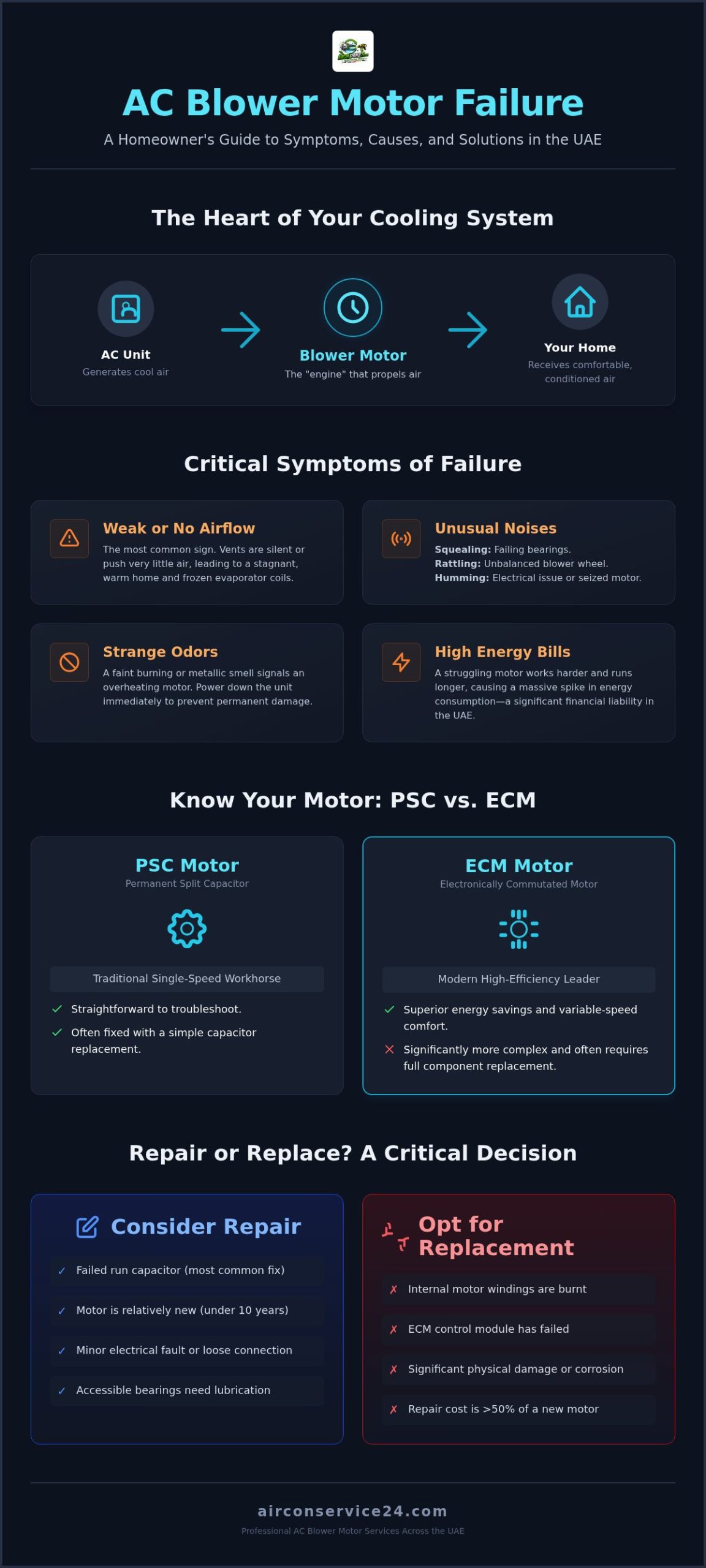
The blower motor acts as the mechanical heart of your HVAC system, serving as the primary mover of indoor climate control. It’s the engine that propels conditioned air through your ductwork and into your living space. Without this critical component, the air your system has worked so hard to chill remains trapped within the evaporator unit. This leads to ice formation on the coils and a rapid rise in indoor temperatures. Understanding the necessity of ac blower motor repair starts with recognizing its dual role in temperature regulation and moisture removal. The motor is typically housed within the Air Handling Unit (AHU), where it must operate with absolute precision to maintain domestic harmony and environmental hygiene.
The Mechanics of Airflow
Airflow is the foundation of energy efficiency in any cooling system. The blower wheel works in direct tandem with the motor to generate the necessary static pressure to move air through long duct runs. It’s vital to distinguish this indoor component from the outdoor condenser fan. While the outdoor fan’s job is to dissipate heat from the refrigerant into the environment, the indoor blower motor is responsible for your immediate comfort. If the indoor airflow is compromised, the entire system must run longer and work harder. This leads to an inevitable spike in energy consumption and premature mechanical strain. Professional maintenance of this equipment ensures that every watt of electricity translates into tangible cooling for your home.
PSC vs. ECM Motors: Which One Is in Your Unit?
Identifying your motor type is the first step in a successful ac blower motor repair strategy. Traditional units typically utilize Permanent Split Capacitor (PSC) motors. These are single-speed workhorses that are relatively straightforward to troubleshoot. Often, a simple capacitor replacement restores them to full functionality. In contrast, modern high-efficiency systems use Electronically Commutated Motors (ECM). These variable-speed leaders provide superior comfort and energy savings but are significantly more complex. Because many ECM units in the UAE market are sealed, a failure in the internal control module often necessitates a full component replacement rather than a modular repair. Understanding these nuances allows for a methodical approach that eliminates anxiety through clear technical expectations.
Common Symptoms and Causes of Blower Motor Failure
Detecting a mechanical struggle before it becomes a total cooling collapse is essential for maintaining domestic harmony. If your vents are silent but the thermostat is calling for cooling, you’re likely facing a critical bottleneck. Weak or inconsistent airflow is the most frequent precursor to an ac blower motor repair. When a motor loses its ability to reach rated RPMs, cooled air pools inside the unit, causing the evaporator coils to freeze. This inefficiency forces the compressor to run indefinitely, leading to a massive spike in energy costs. In the UAE, where cooling accounts for over 70% of building energy consumption according to the Gulf Organization for Research and Development (2024), a struggling motor is a significant financial liability.
Listen for auditory warnings that signal internal distress. A high-pitched squeal typically indicates failing bearings, while a rhythmic rattling suggests an unbalanced blower wheel. A persistent humming sound, often accompanied by a faint burning odor, points to electrical windings overheating or a seized motor. If you detect a metallic scent, it’s vital to power down the unit immediately to prevent permanent damage. Learning how to test a blower motor can help determine if the issue is a simple electrical fault or a terminal mechanical failure.
Environmental Stressors in the UAE
The local climate poses unique challenges to HVAC longevity that standard maintenance often overlooks. Fine desert dust acts as a persistent abrasive, infiltrating motor housings and creating friction that degrades internal components. This dust can also accumulate on the blower wheel, causing an imbalance that vibrates the entire indoor equipment assembly. High humidity further complicates matters by inducing corrosion on sensitive control boards and electrical connectors, which can mimic the signs of total motor failure.
The Role of the Capacitor
A failed run capacitor is the most frequent cause for an ac blower motor repair. This component delivers the electrical torque needed to initiate and sustain rotation. If your unit hums but the fan remains stationary, the capacitor has likely reached its end of life. Never attempt a DIY replacement; these components store lethal electrical charges even when the power is disconnected. You should rely on a specialist in AC maintenance who can safely discharge the system and restore your airflow with precision.
AC Blower Motor Repair vs. Replacement: A Critical Comparison
Deciding between an ac blower motor repair and a total component replacement is a pivotal moment for any property owner. This choice requires a methodical cost-benefit analysis to ensure long-term system reliability and financial integrity. We utilize the 50% Rule as a standard of transparency: if the projected cost of fixing the motor exceeds half the price of a brand-new unit, replacement is the more disciplined choice. This approach eliminates the anxiety of recurring failures and ensures your investment is focused on performance rather than temporary patches.
System age is a non-negotiable factor in this decision framework. While a well-maintained motor can last over a decade, units approaching the 10-year mark often suffer from cumulative wear that a single repair cannot resolve. In these cases, investing in a modern replacement often yields higher returns through improved energy efficiency and reduced strain on the rest of your cooling system. Identifying terminal issues early, such as burnt internal windings or failed control modules, prevents wasted expenditure on components that are fundamentally beyond restoration.
When a Simple Fix Is Sufficient
Many airflow crises are resolved through targeted, low-cost interventions that extend the life of your existing motor. Replacing a failed run capacitor is the most common repair, often restoring full functionality in a single visit. Other repairable issues include securing loose mounting brackets that cause vibration or repairing frayed wiring connectors damaged by heat. Rebalancing the blower wheel is another critical service; by removing accumulated dust and debris, we eliminate the mechanical stress that leads to bearing failure. These precise adjustments restore domestic harmony without the need for a full system overhaul.
The Case for Total Motor Replacement
Modern HVAC units often utilize sealed motors, particularly high-efficiency ECM models, which are designed for performance rather than modular repair. If the internal control board or the copper windings have suffered a catastrophic short, a full replacement is the only viable path to restoring airflow. Upgrading to a newer motor model can provide significant efficiency gains, allowing your system to move more air with less electrical consumption. When selecting a new motor, we prioritize absolute compatibility with your existing HVAC equipment to ensure seamless integration and long-term reliability. This proactive strategy safeguards your home environment against future cooling emergencies during the peak of the UAE summer.
Professional Troubleshooting and Maintenance Protocols
A disciplined approach to ac blower motor repair begins with a rigorous diagnostic protocol. Guessing at component failures leads to unnecessary costs and prolonged downtime, a luxury no one has during a UAE summer. Technicians must follow a structured workflow to eliminate variables and pinpoint the exact source of failure. This methodical sequence prevents the “parts cannon” approach, where components are replaced at random until the system starts. Instead, we focus on precision and customer clarity.
- Step 1: Power Isolation and Safety Discharge. The first priority is the total isolation of the electrical supply. Technicians must safely discharge the run capacitor to prevent accidental shocks, as these components retain high-voltage energy even after the system is off.
- Step 2: Electrical Validation. Using calibrated multimeters, we perform voltage and continuity testing. This identifies if the fault lies in the motor windings, the control board, or the external wiring harness.
- Step 3: Physical Inspection. We examine the blower assembly for physical obstructions or the presence of biofilm. This biological growth creates significant drag, forcing the motor to consume more power and generate excess heat.
These protocols ensure that every action taken is backed by technical data. By identifying the root cause, we provide a reliable solution that restores your home’s comfort without the anxiety of recurring issues.
The Hygiene-Motor Connection
Mechanical performance and environmental hygiene are inseparable. Fine dust and organic buildup on the blower wheel increase rotational resistance, which is a primary cause of motor overheating. Deep cleaning the entire assembly reduces this physical load, allowing the motor to operate within its designed thermal limits. Eliminating these contaminants also removes the source of unpleasant odours that often accompany motor strain. For a detailed breakdown of preventive care, refer to our guide on AC Maintenance UAE to understand how hygiene safeguards your mechanical investments.
Restoring Indoor Air Quality
The blower motor is the primary vehicle for air circulation in your home. If the motor and its housing are neglected, the system effectively distributes dust, allergens, and mould spores through your living spaces. Professional sanitisation serves as the essential final validation of an ac blower motor repair. We ensure the air moving through your vents is not just cool, but medically clean and fresh. This holistic approach protects the well-being of your family while ensuring the long-term reliability of the hardware. Experience the difference of a truly optimized climate by scheduling our professional AC repair and sanitisation services today.
Reliable AC Blower Services Across the UAE
AirConService24.com provides a rapid response for all blower-related emergencies across every emirate. When airflow fails in the middle of a high-heat cycle, our technicians arrive as disciplined guardians of your home’s climate. We recognize that a mechanical breakdown is a disruption to your domestic harmony and a potential risk to your family’s well-being. We don’t just offer a quick fix; we provide a comprehensive technical solution. Our approach integrates ac blower motor repair with deep cleaning and advanced sanitisation. This dual focus ensures that your system doesn’t just move air, but circulates a healthy, purified indoor environment. We prioritize transparency and integrity, eliminating customer anxiety through clear expectations and methodical execution.
Our service is deeply rooted in practical reliability and a “ready-to-act” energy. Whether you’re dealing with a seized motor in a residential villa or a failing AHU in a commercial space, we bring elite technical expertise to every site. We understand the high stakes of a cooling crisis in the UAE. That’s why our 24/7 availability is backed by a sophisticated, quality-focused demeanor. We treat your cooling system as an essential component of a comfortable lifestyle, ensuring every repair meets modern standards of excellence and sustainability.
What to Expect from Our Expert Technicians
Our experts utilize a methodical diagnostic approach powered by modern, precision equipment. You won’t receive vague guesses or “parts cannon” recommendations; you’ll get clear communication and data-driven repair strategies. We believe in the role of the “conscientious innovator,” valuing advanced methods that protect your system’s longevity. Our technicians follow a strict protocol that includes:
- Detailed voltage and mechanical load testing to verify motor health.
- Transparent reporting on the cost-benefit of repair versus replacement.
- A commitment to environmental hygiene, ensuring no dust or biofilm remains in the blower housing.
- Final system validation to confirm peak airflow and energy efficiency.
Securing Your System for the Future
Regular maintenance is the only reliable way to prevent sudden blower failure during the peak summer months. Our proactive protocols ensure your system operates at peak efficiency year-round, significantly reducing the risk of motor burnout and high energy bills. We focus on long-term system reliability rather than temporary patches. If you’ve noticed a drop in airflow or an unusual hum from your vents, act with urgency to protect your indoor climate. Contact us today for Emergency AC Repair and restore your comfort with a service that values precision, speed, and your home’s harmony above all else.
Secure Your Home’s Airflow and Comfort
Restoring your indoor climate requires more than a simple mechanical fix; it demands a comprehensive understanding of how your system interacts with the unique UAE environment. By recognizing the early warning signs of failure and applying a disciplined cost-benefit analysis, you protect both your home’s harmony and your financial interests. It’s vital to remember that a professional ac blower motor repair is most effective when paired with deep cleaning to ensure long-term reliability and medical-grade air hygiene. Our technicians act as elite guardians of your domestic well-being, standing ready to intervene with precision and speed. We provide 24/7 emergency AC repair across the UAE, ensuring that expert deep cleaning and sanitisation are included in every restoration project. Trust in our disciplined, professional technicians who prioritize results and customer clarity above all else. You don’t have to navigate a cooling crisis alone. We’re here to provide the sophisticated, high-quality support your home deserves. Your comfort is our priority.
Restore Your Airflow Today – Contact AirConService24.com
Frequently Asked Questions
Why is my AC blower humming but the fan is not spinning?
A humming sound without rotation typically indicates a failed start capacitor or a seized motor bearing. The capacitor provides the initial electrical torque required to spin the motor. If it fails, the motor attempts to start but lacks the power to overcome inertia. It’s critical to shut the system down immediately to avoid burning the motor windings. A professional ac blower motor repair often begins with testing this component to determine if a simple replacement will suffice.
Can I run my AC if the blower motor is making a grinding noise?
You shouldn’t run your system if you hear a grinding noise from the blower. This sound usually signals that the motor bearings have failed or the blower wheel has become loose and is striking the housing. Continuing to operate the unit can lead to catastrophic mechanical failure or an electrical short. Immediate isolation of the power supply is the most disciplined action to prevent expensive damage to the entire AHU assembly and ensure your home’s safety.
How much does it cost to replace an AC blower motor in the UAE?
The cost of replacing a blower motor in the UAE varies based on the unit’s specifications and technology. Modern Electronically Commutated Motors (ECM) are generally more expensive than traditional Permanent Split Capacitor (PSC) models due to their variable speed capabilities. Other factors include the difficulty of access within your specific property and the need for accompanying services like deep cleaning. We recommend a professional diagnostic visit to receive a transparent recommendation tailored to your system’s requirements and age.
How long should a standard AC blower motor last?
While a blower motor is designed to last between 10 and 15 years, the extreme UAE climate often shortens this window. High ambient temperatures require systems to operate 24/7 during peak summer months, leading to accelerated wear. Fine desert dust also increases internal friction if maintenance is neglected. Regular cleaning and sanitisation are essential to ensure your motor reaches its maximum lifespan by reducing the physical and thermal stress placed on the internal components during operation.
Will a dirty air filter really cause my blower motor to fail?
A dirty air filter is a primary cause of motor failure because it restricts the volume of air the system can pull. This restriction creates high static pressure, forcing the motor to work significantly harder to move the same amount of air. This increased workload leads to overheating and eventual burnout of the electrical windings. Maintaining clean filters is a simple but vital step in avoiding the need for an ac blower motor repair and high energy bills.
What is the difference between a blower motor and a condenser fan?
The blower motor is located in the indoor air handling unit and is responsible for circulating conditioned air through your home’s ductwork. In contrast, the condenser fan is located in the outdoor unit. Its sole purpose is to pull air across the condenser coils to dissipate heat from the refrigerant into the environment. While both are essential for cooling, they operate in different environments and face distinct mechanical stressors, particularly regarding dust and moisture exposure.
Can an AC blower motor be lubricated to stop squealing?
Most modern blower motors utilized in the UAE market are manufactured as sealed units with permanently lubricated bearings. This means they can’t be manually oiled to stop a squealing noise. If the motor is squealing, it usually indicates that the internal lubricant has dried out or the bearings have physically degraded. In these instances, a professional evaluation is necessary to decide if the unit requires a full replacement to restore silent operation and domestic harmony.
How do I know if my capacitor is bad or the motor is dead?
Distinguishing between a bad capacitor and a dead motor requires technical precision. A failed capacitor often results in a distinct humming sound as the motor tries to start without success. If the motor is completely silent and unresponsive despite receiving power, the internal windings have likely failed. Technicians use multimeters to check for electrical continuity and capacitance. This methodical testing ensures we identify the correct fault before recommending any mechanical intervention or total motor replacement.
AC Unit Making Loud Buzzing Noise? Causes, Risks, and 2026 Repair Guide
Article by
Jon Bonnett
Australian Air Conditioning Specialist with extensive hands-on experience in AC servicing, deep cleaning, maintenance, and troubleshooting. Focused on high-quality workmanship, reliability, and professional service to UAE standards.
A buzzing air conditioner is rarely just a minor mechanical quirk; it’s often a high-stakes electrical distress signal that demands your immediate attention. If you’re currently dealing with an ac unit making loud buzzing noise, the sound you hear could be the precursor to a melted compressor or a dangerous electrical arc. In the intense UAE climate, where systems run at peak capacity, ignoring this warning can transform a simple component fix into a total system failure costing thousands of AED.
We understand the anxiety that comes with sudden equipment sounds, especially when your home’s comfort and safety are on the line. You’re likely wondering if you should shut the power off immediately or if the system is still safe to run. This 2026 repair guide reveals exactly why your unit is buzzing and provides the precise steps you must take to prevent expensive damage. We will walk you through identifying faulty contactors, diagnosing failing motors, and navigating the latest regional maintenance standards to get your cooling back on track quickly and safely.
Key Takeaways
- Identify why an ac unit making loud buzzing noise is often an electrical emergency and learn when to immediately isolate power to prevent catastrophic component failure.
- Understand the critical role of contactor relays and capacitors in your system’s start-up cycle and how their degradation creates specific auditory warning signs.
- Distinguish between mechanical vibrations caused by loose hardware and internal motor friction within the condenser fan or blower assembly.
- Learn how to isolate the source of the sound between your indoor and outdoor units to facilitate a faster, more precise professional repair.
- Discover the long-term benefits of deep cleaning and sanitisation in reducing mechanical strain and maintaining quiet, high-performance cooling in the UAE.
An ac unit making loud buzzing noise is typically the audible signature of electrical arcing or excessive motor vibration. Arcing is a dangerous discharge between circuits that can melt internal components in seconds. While it’s tempting to ignore a sound if the air is still blowing cold, doing so is a high-stakes gamble with your system’s total lifespan. In the UAE’s intense summer heat, components are already under extreme thermal stress. A small buzzing sound can quickly escalate into a catastrophic failure of the compressor or control board without warning.
The ‘Turn It Off’ Rule: Protecting Your Investment
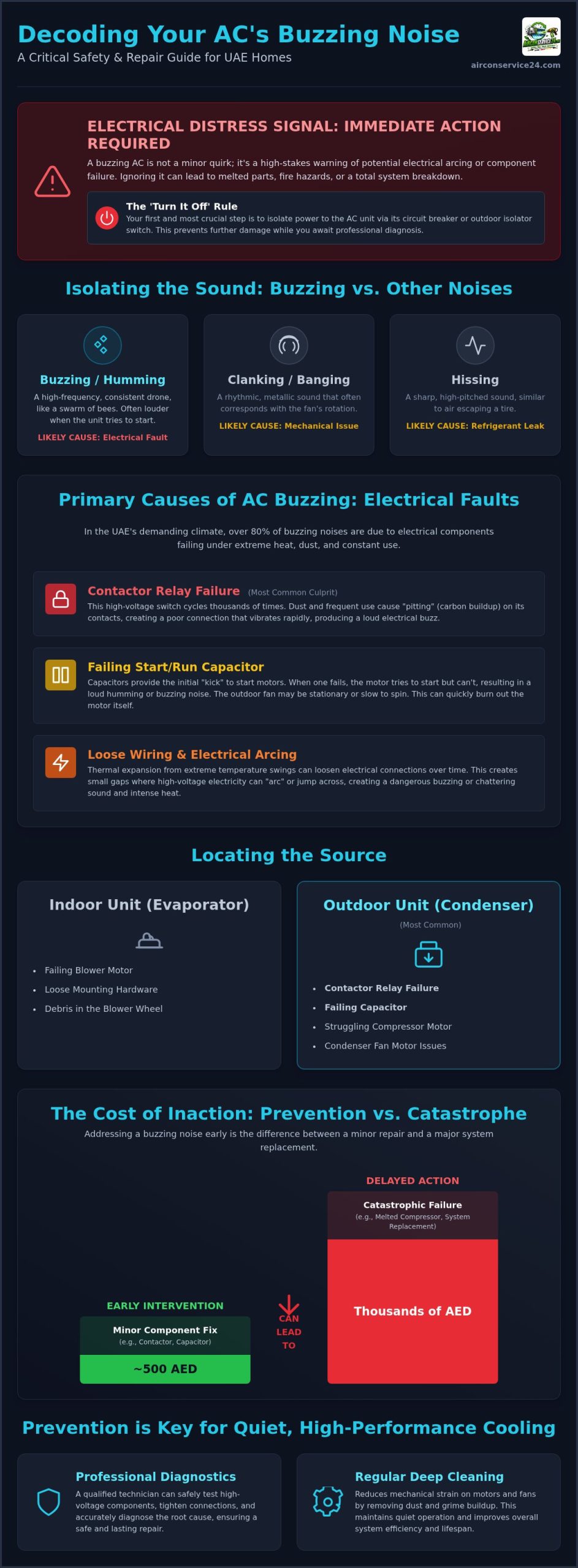
The moment you hear a persistent buzz, your first priority is to isolate the power. Electrical arcing isn’t just a noise; it creates intense heat that leads to fire hazards or permanently melted circuitry. By shutting down the unit immediately, you often prevent a minor 500-dirham component fix from turning into a total system replacement costing thousands. Locate your outdoor isolator switch or the dedicated circuit breaker in your home’s electrical panel. Flipping this switch is the most effective way to safeguard your Heating, ventilation, and air conditioning (HVAC) system from further damage while you wait for a specialist.
Identifying the Sound: Buzzing vs. Hissing vs. Clanking
Not all noises indicate the same fault. An electrical buzz is usually a high-frequency, consistent drone that sounds like a swarm of bees. This is distinct from the rhythmic, metallic clanking of a loose fan blade or the sharp hissing of a refrigerant leak. A constant hum often points to a struggling motor or a failing capacitor. If you notice an ac unit making loud buzzing noise specifically when it tries to start, you are likely dealing with a seized component or an electrical bottleneck. Electrical arcing is defined as a discharge of electricity that jumps across a gap between two electrodes or circuits. This phenomenon generates enough heat to compromise the integrity of your cooling equipment, making professional diagnostics essential to maintain domestic harmony and safety.
Electrical Faults: The Primary Causes of AC Buzzing Noises
While mechanical issues are common, the vast majority of cases involving an ac unit making loud buzzing noise stem from electrical malfunctions. In the UAE, our systems face unique challenges. Fine sand and dust infiltrate the outdoor cabinetry, coating sensitive components and increasing electrical resistance. When combined with ambient temperatures that often exceed 45 degrees Celsius, these electrical parts reach their breaking point much faster than in milder climates. Ignoring these sounds is risky because electrical faults generate localized heat that can lead to melted insulation or dangerous short circuits.
Contactor Relay Failure: The Most Common Culprit
The contactor relay acts as the gatekeeper for your system’s power. It receives a low-voltage signal from your thermostat and physically closes a set of contacts to send high-voltage electricity to the compressor. Because of the high-stakes cooling demands in the region, these switches cycle hundreds of times a day. This frequent movement, especially in dusty conditions, causes “pitting” or carbon buildup on the metal surfaces. The resulting poor connection causes the relay to vibrate at a high frequency, creating that unmistakable electrical buzz that signals a component under extreme stress.
Capacitor and Wiring Issues
Capacitors are essentially temporary energy storage devices that provide the massive torque needed to start the compressor and fan motors. A failing capacitor is often the reason you hear a loud, persistent hum while the outdoor fan remains stationary. The motor is trying to pull current but lacks the necessary “kick” to rotate. If left in this state, the motor windings will overheat and eventually burn out, turning a simple part replacement into a major mechanical overhaul that could cost thousands of dirhams.
Thermal expansion is another silent enemy of your system’s wiring. The dramatic temperature swings between the intense midday sun and night-time cooling cause copper wires to expand and contract. Over months of operation, this cycle naturally loosens terminal screws and connections. A loose wire creates a small gap where electricity can arc, producing a chattering sound that can travel through your walls. It’s vital to inspect these internal connections regularly to prevent arcing. If your system is showing these signs, scheduling a professional AC repair is the most methodical way to restore peace and safety to your home.
Mechanical Vibration: When the Noise is Physical Wear
While electrical issues are the most frequent culprits, physical wear and tear within the mechanical assembly also manifest as a persistent drone. Unlike the sharp, staccato crackle of electrical arcing, mechanical buzzing often sounds deeper and more resonant. It typically signifies that a moving part has lost its factory precision. In the UAE, the constant battle against airborne sand means your system’s mechanical components are under a literal abrasive assault every minute they operate. This environment accelerates the degradation of moving parts, turning a once-silent unit into a source of domestic disruption.
Fan Motor and Bearing Wear
The condenser fan motor is the workhorse of the outdoor unit. It must spin at high speeds to dissipate heat effectively. Over time, the lubricant inside the motor bearings can dry out or become contaminated by fine desert dust, which increases internal friction significantly. What begins as a light hum eventually transforms into an ac unit making loud buzzing noise as the motor struggles against its own resistance. If the bearings seize completely, the motor will pull excessive current, potentially leading to the electrical failures discussed in the previous section. An unbalanced fan blade, often caused by a buildup of grime or physical damage from debris, creates structural vibrations that resonate through the entire chassis.
Loose Parts and Housing Vibrations
Sometimes the buzz isn’t coming from a failing motor, but from the cabinet itself. This is known as a sympathetic vibration. Air conditioners contain hundreds of individual parts, including coil fins, mounting feet, and access panels. If a single screw loosens due to the natural movement of the compressor, the metal-on-metal contact creates an amplified buzzing sound. A loose panel can turn a quiet system into an ac unit making loud buzzing noise that can be heard from several rooms away. Refrigerant lines can also vibrate against the housing, a phenomenon sometimes exacerbated by “slugging,” which occurs when liquid refrigerant enters the compressor instead of gas.
Regular maintenance and deep cleaning are the most effective ways to prevent these mechanical issues. Professional cleaning removes the abrasive sand that destroys bearings and ensures all housing fasteners are torqued to specification. This proactive approach keeps your system balanced and prevents minor vibrations from escalating into expensive mechanical repairs that could compromise your home’s comfort during peak summer months.
Locating the Buzz: Indoor Evaporator vs. Outdoor Condenser
Pinpointing the exact source of the sound is the first step toward a methodical resolution. You must determine if the disturbance originates from the indoor air handler or the outdoor condenser unit. Each component houses different mechanical and electrical assemblies that produce distinct auditory signatures. Identifying the location helps our technicians arrive with the correct diagnostic tools, ensuring a faster return to domestic harmony. Whether your system is a split unit or a centralized package, the location of the sound dictates the level of urgency required to protect your equipment.
Outdoor Unit Noises: High-Voltage Components
The outdoor unit is the heart of the heat exchange process and contains the most power-intensive parts. If your outdoor ac unit making loud buzzing noise is vibrating the balcony or roof slab, the compressor might be experiencing a “locked rotor.” This happens when the internal mechanics seize, but the electrical motor continues to draw current, creating a deep, resonant groan. You can distinguish this from a fan motor buzz by observing the blades. If the blades are spinning but the buzz persists, the compressor is likely failing. Always maintain a safe distance when inspecting the exterior; never attempt to open the high-voltage service panel yourself, as the capacitors hold a lethal charge even after the power is cut.
Indoor Unit Noises: Blower and Control Board
Indoors, the buzzing is usually higher in pitch and often related to air distribution. The blower motor is the primary moving part here. In the UAE, fine dust can bypass filters and coat the blower wheel, causing an imbalance that sounds like a constant vibration. Another common cause is a failing transformer on the control board. These components convert high-voltage electricity into the low-voltage needed for your thermostat. When they begin to fail, they emit a steady, high-frequency hum. For homeowners looking to prevent these indoor disruptions, we recommend exploring these reliable cooling solutions for comprehensive preventive care.
The timing of the noise also provides vital clues. Intermittent buzzing that occurs only during start-up points toward a struggling capacitor or a sticking relay. If the sound is constant, it suggests a continuous electrical flow issue or a transformer that’s nearing its end of life. Regardless of the frequency, a persistent buzz is a signal that your system is working harder than it should. If your cooling performance is dropping while the noise increases, it’s time to book a professional AC Repair to diagnose the fault before it leads to a total shutdown.
Resolving an ac unit making loud buzzing noise requires more than a cursory glance; it demands a structured diagnostic process. Precision is paramount. Our technicians don’t just guess which part is failing. They follow a disciplined workflow to isolate the root cause, whether it’s a microscopic electrical arc or a mounting foot that has vibrated loose over time. By utilizing advanced multimeters and thermal imaging, we can see exactly where heat is building up before a component actually melts. This methodical approach ensures that your domestic harmony is restored with minimal disruption and maximum transparency.
What to Expect During a Professional Repair Visit
When a specialist arrives, the diagnostic begins with a comprehensive visual inspection of all high-voltage contact points. We look for the “pitting” mentioned in earlier sections, checking every capacitor for signs of bulging or leakage. Technicians then test the motor amperage. If a motor is pulling current above its factory specifications, it’s a clear indicator of internal friction or a failing winding. We also verify the integrity of all housing hardware. Tightening every screw to the correct torque specification eliminates the sympathetic vibrations that often amplify a small mechanical hum into a disruptive roar. This level of thoroughness prevents the “quick fix” that leads to another breakdown two weeks later.
Long-Term Prevention: Deep Cleaning and Maintenance
The UAE environment is unforgiving to mechanical systems. Airborne sand acts as an abrasive, grinding down bearings and coating electrical terminals with a layer of resistive grime. Implementing a AC deep cleaning regimen is the most effective way to protect your sensitive electrical parts from this environmental assault. Clean coils allow for better heat exchange, which reduces the load on your compressor and fan motors. This directly lowers the vibration levels and prevents the heat buildup that causes electrical arcing.
A professional maintenance visit offers secondary benefits that enhance your well-being. While we silence the ac unit making loud buzzing noise, we also perform sanitisation and odour removal. These steps eliminate the bacteria and mould that thrive in damp evaporator coils, ensuring your air is as healthy as it is quiet. Establishing a 2026 preventive maintenance plan transforms you from a reactive homeowner into a proactive guardian of your home’s comfort. Don’t wait for a total system failure to occur. Trust our emergency AC repair experts to silence the buzz and restore high-performance cooling to your home today.
Secure Your Home’s Comfort and System Longevity
An ac unit making loud buzzing noise is a definitive signal that your cooling system is operating under extreme duress. As we have explored, whether the cause is a pitted contactor relay or an unbalanced fan motor struggling against desert dust, ignoring these auditory warnings often leads to catastrophic component failure. Precision is our standard. By isolating the power immediately and opting for professional diagnostics, you protect your domestic harmony and avoid the high costs of total system replacement. Methodical troubleshooting remains the only way to ensure your unit remains a reliable guardian against the UAE heat.
Our expert technicians at AirConService24.com remain available around the clock to provide the precise, high-quality care your home deserves. We specialize in deep cleaning and sanitisation to eliminate the root causes of mechanical strain while ensuring your indoor air remains healthy and fresh. If you need immediate assistance, Contact AirConService24.com for 24/7 Emergency AC Repair. We are committed to restoring your peace of mind through transparency and technical expertise. Silence the buzz today and enjoy the predictable performance of a professionally maintained system.
Frequently Asked Questions
Is it safe to run my AC if it is making a loud buzzing noise?
Running an ac unit making loud buzzing noise is generally unsafe and can lead to permanent component damage. The sound often indicates electrical arcing or a seized motor that is pulling excessive current. Continuing to operate the system increases the risk of an electrical fire or a total compressor meltdown. You should isolate the power at the circuit breaker immediately to protect your home and your investment.
What does an AC contactor sound like when it is failing?
A failing contactor typically produces a rapid chattering or a loud, high-frequency hum. This occurs when the silver coating on the internal points wears down or becomes pitted with carbon deposits. In the UAE’s dusty climate, this buildup is common and prevents the relay from making a clean connection. The vibration you hear is the switch struggling to stay closed under electrical load.
Why does my AC buzz for a few seconds and then stop?
This intermittent sound usually points to a struggle during the start-up cycle. It is often caused by a failing capacitor that cannot provide the necessary torque to kick-start the compressor or fan motor. If the noise stops because the unit has successfully started, the component is likely in the early stages of failure. If the unit fails to start, the buzz is the sound of the motor windings overheating.
Can a dirty AC filter cause the unit to make a buzzing sound?
Yes, a severely clogged filter can lead to a buzzing sound by putting extreme strain on the indoor blower motor. When airflow is restricted, the motor must work harder to pull air through the system, which can lead to overheating and electrical humming. Additionally, the pressure imbalance can cause internal cabinet panels to vibrate, creating a sympathetic buzz that resonates through the unit housing.
How much does it typically cost to fix a buzzing air conditioner in the UAE?
The cost of repair depends entirely on the specific faulty component identified during the diagnostic. Minor repairs involving a contactor relay or a start capacitor are relatively affordable compared to major mechanical failures. Replacing a seized compressor or a main control board represents a much larger investment. We recommend a professional assessment to determine the exact scope of work required for your specific system type.
Why is my indoor AC unit buzzing even when the cooling is off?
If the noise persists while the system is idle, the culprit is likely the low-voltage transformer or the control board. These components remain powered to communicate with your thermostat even when the compressor isn’t running. A constant hum suggests that the transformer’s internal laminations have loosened or that the board is experiencing an electrical leak. This requires professional attention to prevent a total loss of system communication.
Can I fix a buzzing AC unit myself or should I call a professional?
You should always call a professional to handle an ac unit making loud buzzing noise. Air conditioning systems contain high-voltage capacitors that can hold a lethal charge even after the power is disconnected. Identifying the difference between a mechanical vibration and an electrical arc requires specialized diagnostic tools like multimeters and thermal cameras. Professional intervention ensures the repair is handled safely and effectively according to UAE technical standards.
AC Not Cooling in Dubai? 5 Steps Before Calling a Pro
Article by
Jon Bonnett
Australian Air Conditioning Specialist with extensive hands-on experience in AC servicing, deep cleaning, maintenance, and troubleshooting. Focused on high-quality workmanship, reliability, and professional service to UAE standards.
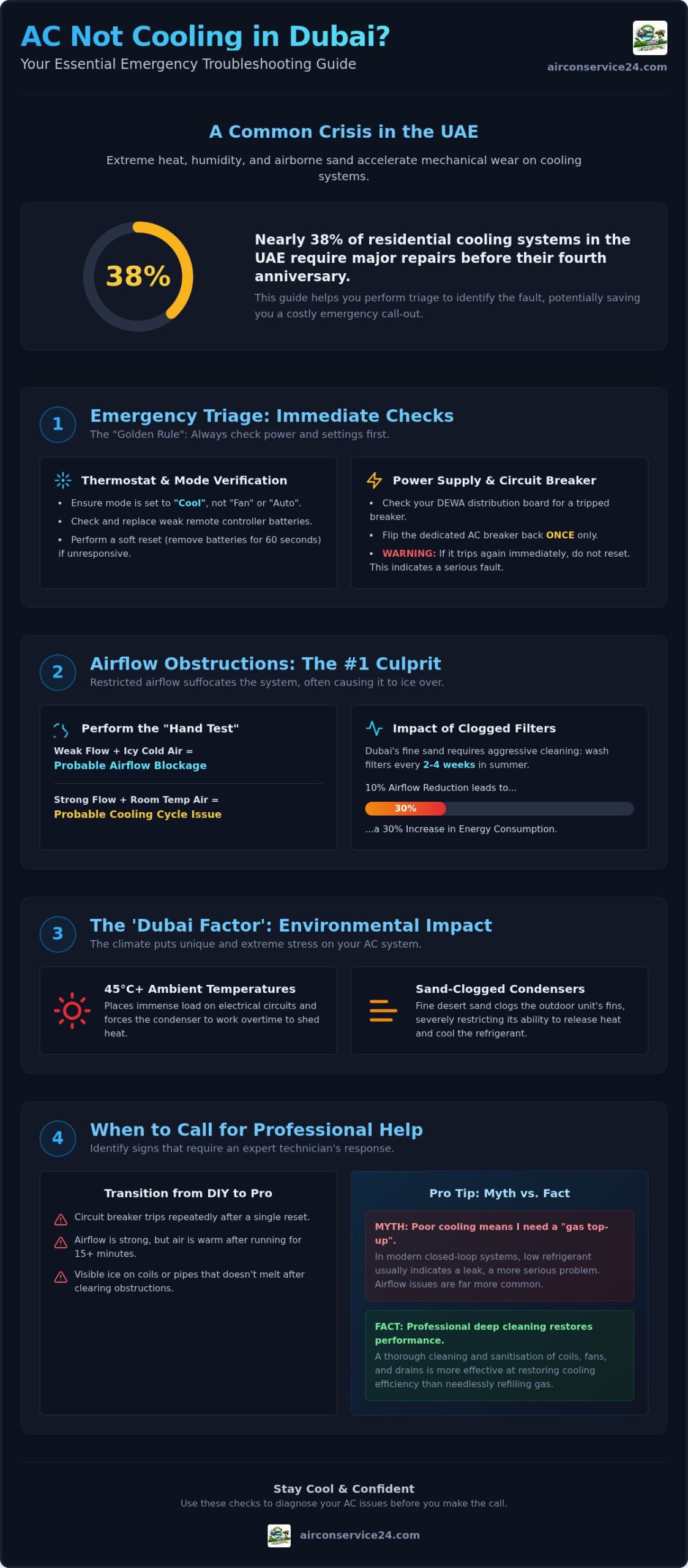
Did you know that nearly 38% of residential cooling systems in the UAE require major repairs before they even reach their fourth anniversary? In a city where the “Dubai factor” of extreme humidity and airborne sand accelerates mechanical wear, finding your air conditioner not cooling Dubai interiors is a high-stakes emergency. You’ve likely felt that sudden wave of heat as the indoor temperature spikes past 30°C, followed immediately by the fear of a massive repair bill. It’s stressful to wonder if you’re facing a simple settings issue or a total compressor failure.
We believe a functional home environment is essential for your health and domestic harmony. This guide provides the professional triage steps needed to identify the fault and potentially restore comfort immediately. We’ll walk you through five methodical checks, from thermostat calibration to airflow obstructions, ensuring you have total clarity before calling for a specialist. You’ll learn how to distinguish between a quick DIY fix and a situation that requires an elite, professional response.
Key Takeaways
- Master the “Golden Rule” of troubleshooting by identifying simple power trips and thermostat errors that often mimic mechanical failure.
- Discover how restricted airflow suffocates your evaporator coils, which is the most frequent cause of an air conditioner not cooling Dubai residences during peak summer.
- Understand the impact of Dubai’s 45°C+ temperatures and sand-clogged condensers on your system’s ability to shed heat efficiently.
- Learn why professional deep cleaning and sanitisation are more effective for restoring performance than the common myth of annual gas refills.
- Identify the specific mechanical warning signs that indicate it is time to transition from DIY triage to a professional 24/7 emergency repair.
When your indoor temperature begins to climb toward 35°C, the instinct is to call a technician immediately. However, the first step in resolving an air conditioner not cooling Dubai home is to remain calm and methodical. This high-stakes urgency often clouds judgment, but a structured approach can save you hundreds of dirhams in unnecessary call-out fees. The “Golden Rule” of HVAC maintenance is simple; always verify the most basic power and control settings before assuming a mechanical breakdown has occurred.
Our professional 5-step triage process is designed to eliminate common user errors and identify minor electrical trips. By following this sequence, you act as the disciplined guardian of your home’s comfort. You’ll determine if the issue is a simple software glitch or a genuine hardware failure that requires an elite, professional response. Taking ten minutes to perform these checks provides the clarity needed to handle a cooling crisis with confidence.
Thermostat Calibration and Mode Verification
Start with the control interface. Ensure the mode is set specifically to “Cool” and not “Fan” or “Dry.” Many residents in the UAE fall into the “Auto” mode trap; while it sounds efficient, it can cause the compressor to cycle off prematurely during extreme heatwaves. Understanding how air conditioning works helps clarify that the system needs a consistent signal to exchange heat and lower humidity. Check your remote controller batteries; a fading display often indicates a weak signal that fails to trigger the outdoor unit. If the screen is frozen or unresponsive, perform a soft reset by removing the batteries for 60 seconds or pressing the recessed reset button on the wall-mounted unit to clear software glitches.
Power Supply and Circuit Breaker Inspection
Dubai’s intense ambient temperatures, often exceeding 45°C, place an immense load on electrical circuits. If your system stops abruptly, check your DEWA distribution board. A tripped breaker is a safety mechanism, not necessarily a sign of a broken AC. Locate the dedicated AC breaker; if it’s in the “off” position, flip it back once to restore the connection. You should also check the isolator switch, typically located near the outdoor condenser or in the kitchen area. Be cautious of “short cycling.” If you restore power and the system trips the breaker again immediately, do not attempt to flip it a second time. Repeatedly forcing a connection can cause permanent damage to the compressor’s start capacitor or internal wiring.
Airflow Obstructions: The #1 Reason for Weak Cooling
Airflow is the lifeblood of your HVAC system. In the harsh climate of the UAE, an air conditioner not cooling Dubai interiors is frequently suffering from a simple lack of circulation rather than a mechanical failure. Cooling is essentially a process of heat exchange; your unit pulls warm air from the room, strips away the heat, and recirculates chilled air. When this volume of air is restricted, the evaporator coil becomes “suffocated,” often dropping to freezing temperatures that cause the entire system to ice over and stop functioning.
You can perform a simple “Hand Test” to diagnose this immediately. Hold your palm roughly 10 centimetres from the supply vent. If the air feels icy but the breeze is barely detectable, you are likely facing a severe blockage. Conversely, if the air volume is strong but the temperature feels like a standard fan, the issue lies within the cooling cycle itself. Many residents mistakenly assume they need a “gas top-up” when they notice poor performance, but inexperienced technicians often misdiagnose airflow issues as low refrigerant. In reality, modern AC units are closed loops, and “low gas” is rarely the culprit compared to the fine desert sand that permeates Dubai’s air.
The Impact of Clogged Air Filters
The fine, silty sand found in the Arabian Peninsula behaves differently than standard household dust. It creates a dense, carpet-like layer on your filters that standard vacuuming cannot always remove. While global manuals suggest cleaning filters every six months, Dubai’s environmental load requires a more aggressive schedule. You should remove and wash your filters every 2 to 4 weeks during the peak summer months. A mere 10% reduction in airflow can lead to a 30% increase in energy consumption as the system works overtime to compensate for the lack of heat exchange. Maintaining high efficiency is a key part of managing the environmental impact of air conditioning while keeping your DEWA bills manageable.
Blocked Vents and Obstructed Returns
It is easy to overlook the return air grilles, which are often located near the floor or hidden behind decorative elements. If you have placed a new sofa or heavy curtains near these vents, you’ve effectively cut off the system’s ability to “breathe.” You can verify the health of your return duct using the “Paper Test.” Hold a single sheet of tissue paper near the return grille; a healthy system should have enough suction to hold the paper against the slats. If the paper falls, your internal ductwork or filters are likely obstructed. If your DIY efforts don’t restore the breeze, it may be time to consider a professional Deep Cleaning to clear the internal components that are out of reach.
Technical Failures: When the Issue is Internal
Once you’ve ruled out power trips and surface-level dust, the diagnostic process shifts toward the internal mechanics of your system. Identifying a technical failure requires a transition from simple DIY checks to observing the sophisticated behavior of your unit’s internal components. In the harsh UAE environment, internal parts face extreme stress; research indicates that compressor burnout and refrigerant leaks account for over 40% of major service calls in the region. This is where professional expertise becomes a necessity to prevent a minor fault from escalating into a total system replacement.
One of the most persistent myths regarding an air conditioner not cooling Dubai homes is the idea that refrigerant, or “AC gas,” needs an annual refill. It’s vital to understand that your AC is a hermetically sealed, closed-loop system. Refrigerant isn’t “consumed” like fuel in a car; it simply circulates to move heat. If your gas levels are low, you have a physical breach in your copper lines or evaporator coils. Simply topping up the gas without fixing the leak is a temporary, environmentally irresponsible tactic that eventually leads to compressor failure. In aging Dubai villas, look for warning signs like loud grinding noises or a faint burning smell, which often signal that the compressor is struggling against internal friction or electrical wear. Before assuming the worst, it’s worth reading our guide on AC compressor repair Dubai to understand whether you’re facing a minor electrical fault or a genuine mechanical failure.
Frozen Evaporator Coils: Why Your AC is Leaking Ice
It seems counterintuitive to see ice forming when the outdoor temperature is 45°C, but frozen evaporator coils are a common sight in poorly maintained units. You might notice a layer of frost on the copper pipes or even ice crystals blowing out of the vents. This occurs when the coil temperature drops below freezing, causing atmospheric humidity to solidify on the metal. While restricted airflow is a frequent cause, a persistent ice buildup often points to a refrigerant imbalance. If you see ice, you must act immediately: turn off the cooling mode and switch the system to “Fan Only” mode. This allows the ice to thaw safely without sending liquid refrigerant back into the compressor, which could cause terminal damage.
Refrigerant (AC Gas) Leaks and Low Pressure
Humidity in Dubai can reach 90% near the coast, creating a corrosive environment that attacks the thin aluminum fins and copper tubing of your AC. This leads to “pitting” corrosion, resulting in microscopic punctures. If you hear a distinct hissing or bubbling sound coming from the indoor or outdoor unit, you’re likely listening to pressurized gas escaping. A professional AC Repair specialist will use electronic leak detectors or UV dyes to find these breaches. Once the leak is sealed and the system is vacuum-tested, only then should the refrigerant be recharged to the manufacturer’s precise specifications to restore optimal cooling pressure.
The ‘Dubai Factor’: Environmental Impacts on Cooling
Dubai’s climate is relentless. While an AC unit in a temperate city might run for a few hours a day, systems in the UAE operate under a constant, high-stakes load for nine months of the year. Your cooling system works roughly three times harder than its counterparts in Europe or North America. This environmental load means that an air conditioner not cooling Dubai home isn’t always broken; often, it has simply reached a state of thermal saturation where it can no longer shed heat faster than the building absorbs it.
In dense urban corridors like Dubai Marina or Downtown, the “heat island effect” compounds this issue. Concrete and glass towers absorb solar radiation throughout the day, radiating heat back into the atmosphere long after sunset. If your outdoor condenser is located on a narrow balcony or in a poorly ventilated service area, the ambient temperature surrounding the unit can easily exceed 55°C. When the air used to cool the condenser is already hotter than the refrigerant inside the coils, the laws of thermodynamics prevent effective heat exchange. This leads to a gradual decline in cooling capacity that many residents mistake for a mechanical failure. Residents of high-rise buildings face particularly acute versions of these challenges, and understanding the unique infrastructure of vertical living is essential — our dedicated apartment AC repair Dubai guide for high-rise living covers the specific complexities of chiller systems and confined ductwork found in towers across the city.
High humidity levels, which often fluctuate between 60% and 90% near the coast, introduce another invisible threat. Excessive moisture in the air causes condensation to linger on the internal coils, creating a breeding ground for bacteria and mold. This results in “Dirty Sock Syndrome,” a pungent, musty odour that permeates the home when the AC is running. Maintaining hygiene in this environment is a proactive necessity for both your health and the longevity of the equipment.
Sand and Dust Accumulation in Outdoor Units
The fine desert sand of the UAE is a highly effective insulator. As your outdoor unit pulls in air to cool the condenser coils, it also sucks in microscopic sand particles that coat the aluminum fins. This creates a physical barrier that traps heat inside the system. A sand-clogged condenser acts as a thermal blanket, forcing the compressor to run at dangerously high temperatures until the internal safety switch triggers a complete shutdown. While you might be tempted to hose down the unit, doing so without proper electrical precautions can short-circuit the fan motor or control board. For a safe and thorough restoration of your unit’s heat-shedding capabilities, you should book a professional Maintenance visit to chemically clean the condenser fins.
High Load and Thermal Saturation
Most AC systems are engineered with a “Design Temperature” of approximately 43°C. When Dubai’s summer peaks at 50°C, your system is operating well beyond its intended parameters. You can assist your AC by reducing the thermal load on your interiors. Using “blackout” curtains during the day can reduce solar heat gain by up to 30%, allowing the unit to reach its setpoint more easily. Additionally, ensuring the outdoor unit is shaded from direct afternoon sun can improve heat exchange efficiency significantly. Small adjustments to your environment often provide the relief your system needs to bridge the gap between “struggling” and “comfortable.”
Professional Solutions: Restoring Optimal Cooling
When the methodical triage steps of the previous sections fail to restore comfort, the situation transitions from a minor inconvenience to a mechanical emergency. Resolving a persistent air conditioner not cooling Dubai residence requires more than just a surface-level inspection; it demands a comprehensive restoration of the internal ecosystem. While basic maintenance often involves a simple filter rinse and visual check, professional intervention addresses the deep-seated accumulation of sand, biofilm, and mechanical wear that characterizes HVAC systems in the UAE.
At AirConService24.com, we operate as the disciplined guardians of your home’s climate. Our approach combines high-stakes urgency with a methodical, transparent diagnosis, ensuring you understand exactly why your cooling capacity has diminished. We prioritize long-term protection through preventive maintenance contracts, which are essential for navigating the extreme thermal loads of the region. This proactive strategy prevents the gradual degradation of components, ensuring your system remains efficient even when ambient temperatures peak during the most demanding summer months.
AC Deep Cleaning and Sanitisation
A standard service often misses the contaminants embedded deep within the evaporator coils and drain trays. Professional Deep Cleaning involves high-pressure washing of the coils to remove the “insulation” layer of fine desert dust that we discussed earlier. We follow this with specialized sanitisation and Odour Removal to eliminate the mould and bacterial colonies that thrive in dark, damp internal environments. This thorough process does more than just freshen the air; it can improve cooling efficiency by up to 25%, directly reducing the strain on your compressor and lowering your monthly DEWA expenditure. Restoring this heat exchange capacity is the most effective way to ensure your system can handle 45°C+ days without failure.
When to Call AirConService24.com for Emergency Repair
There are specific “Red Flag” indicators that signal your system has moved beyond DIY triage. If you encounter any of the following, you must shut down the unit immediately to prevent terminal damage:
- Acrid burning smells coming from the vents or the outdoor isolator.
- Loud grinding, screeching, or metallic clanging noises from the compressor.
- Zero airflow despite the fan motor being active.
- Rapid “tripping” of the circuit breaker every time the cooling cycle starts.
Delaying a professional AC Repair when these symptoms are present often leads to total compressor burnout, a catastrophic failure that is significantly more expensive to resolve than a component-level fix. Our 24/7 response team is optimized for performance and precision, providing the reliable expertise needed to restore your domestic harmony in the heat. Don’t wait for a total breakdown; Contact AirConService24.com for 24/7 Emergency AC Repair in Dubai to secure a fast-paced, professional solution today.
Restoring Your Home’s Thermal Harmony
Navigating a cooling crisis requires a balance of immediate action and technical precision. You’ve now mastered the essential triage steps, from verifying thermostat modes to identifying the airflow obstructions that frequently mimic mechanical failure. While these DIY checks solve many initial complaints, the unique environmental load of the UAE often necessitates a deeper level of intervention. When sand-clogged condensers or internal component wear result in an air conditioner not cooling Dubai residences, our elite specialists are ready to act.
We combine 24/7 emergency availability with specialized odour removal and sanitisation to ensure your indoor environment is both cool and hygienic. Don’t let unbearable temperatures compromise your health or domestic harmony. Book Your Emergency AC Repair or Deep Cleaning in Dubai Now to experience a sophisticated, quality-focused restoration. Our licensed HVAC technicians provide the transparent, methodical service needed to protect your home’s most vital system. You can face the summer with confidence knowing professional reassurance is just a click away.
Frequently Asked Questions
Why is my AC running but not cooling my room in Dubai?
This issue usually stems from restricted airflow or a thermal saturation point where the unit can’t shed heat faster than the room absorbs it. In our local climate, even a thin layer of desert dust on the coils can prevent effective heat exchange. You should first check if your filters are clogged or if the outdoor condenser is blocked by debris or sand.
How often should I clean my AC filters in the UAE?
You should clean your filters every 2 to 4 weeks during the peak summer months to maintain optimal performance. The high concentration of airborne sand in the UAE creates a dense barrier on the mesh much faster than in temperate climates. Keeping these clean is the simplest way to prevent an air conditioner not cooling Dubai interiors from becoming a recurring emergency.
Is it normal for my AC to blow warm air during a sandstorm?
It isn’t normal for a healthy system, but it’s a common sign that sand has clogged the outdoor condenser fins. This accumulation acts as a thermal blanket, trapping heat inside the system and forcing the compressor to blow warm air or shut down entirely. If performance drops during a storm, the outdoor unit needs a professional cleaning to restore its heat-shedding capabilities.
Can I fix an AC refrigerant leak myself?
No, you cannot fix a refrigerant leak without professional tools and specialized training. AC systems are hermetically sealed, closed loops that require pressure testing, vacuuming, and precise recharging. Attempting a DIY repair can introduce moisture into the lines, which often leads to permanent compressor failure and significantly higher repair costs.
Why does my AC smell musty when it stops cooling properly?
Musty odours are typically caused by mould and biofilm growth on the damp evaporator coils or in the drain tray. When cooling efficiency drops, moisture doesn’t drain away quickly enough, creating a breeding ground for bacteria. This condition, often called “Dirty Sock Syndrome,” requires professional sanitisation and deep cleaning to eliminate the source of the smell.
How much does a typical AC repair visit cost in Dubai?
Repair costs vary based on the specific fault, required parts, and the complexity of the system. While basic inspections are relatively low-cost, major mechanical failures like a burnt-out compressor or a significant leak involve more intensive labor and materials. It’s best to choose a provider that offers transparent, upfront pricing after a thorough diagnostic check.
What should I do if my AC starts leaking water inside the house?
Turn off the cooling mode immediately to prevent water damage and potential electrical shorts. Interior leaks are usually caused by a blocked condensate drain line or frozen coils that are beginning to melt. Running the system while it’s leaking can damage your walls and ceilings, so it’s vital to have the blockage cleared before restarting the unit.
How long does a professional AC deep cleaning take?
A comprehensive deep cleaning and sanitisation typically takes between 60 and 90 minutes per unit. This duration allows technicians to properly dismantle the unit, pressure wash the internal coils, and disinfect the drainage systems. It’s a methodical process that ensures your home’s air quality and cooling efficiency are fully restored to modern standards.