AC Not Responding to Remote Control? Professional Troubleshooting Guide 2026

Article by
Jon Bonnett
Australian Air Conditioning Specialist with extensive hands-on experience in AC servicing, deep cleaning, maintenance, and troubleshooting. Focused on high-quality workmanship, reliability, and professional service to UAE standards.
Imagine it’s a mid-August afternoon with the UAE sun pushing temperatures past 45°C, and your primary source of relief suddenly ignores your every command. You’re clicking the power button with increasing intensity, yet the unit remains stubbornly silent. This specific moment of helplessness is more than just a minor inconvenience; it’s a direct threat to your home’s comfort and your family’s well-being. When you find your ac not responding to remote control, the immediate anxiety regarding expensive PCB repairs or the cost of a full system replacement can be overwhelming.
We understand that you need fast, transparent answers to restore order to your living environment. You’re likely wondering if a simple battery change will suffice or if the internal infrared sensor has finally succumbed to the intense regional humidity. This professional guide eliminates the guesswork by providing a methodical breakdown of the most common failure points. We’ll walk you through a series of diagnostic steps to identify whether the fault lies within the handheld device, the receiver module, or the main control board. By the end of this article, you’ll have a clear roadmap to restore cooling efficiency and avoid unnecessary service fees in 2026.
Key Takeaways
- Perform a rapid smartphone camera test to visualize the infrared signal and immediately determine if the fault lies within the handheld device or the AC unit.
- Identify how accumulated dust and biofilm on the internal receiver panel can lead to your ac not responding to remote control, requiring professional deep cleaning to restore signal clarity.
- Understand the impact of UAE voltage fluctuations and high humidity on internal PCB components to prevent permanent electronic degradation.
- Evaluate the critical technical differences between universal remotes and OEM replacements to ensure full compatibility with modern, high-performance inverter systems.
- Establish a proactive maintenance and sanitisation schedule to protect sensitive electronic sensors and ensure 24/7 system responsiveness throughout the summer.
Immediate Diagnostics: Why Your AC Remote Isn’t Working
The cooling stops. The heat rises. You’re left pointing a plastic brick at a silent machine while the UAE sun intensifies outside. When you find your ac not responding to remote control, the first priority is isolating the failure point with clinical precision. You’re likely feeling the immediate pressure of a rising indoor temperature, but before assuming the internal circuit board has failed, we must determine if the signal is actually leaving your hand. This methodical approach prevents unnecessary replacement costs and identifies the root cause within minutes.
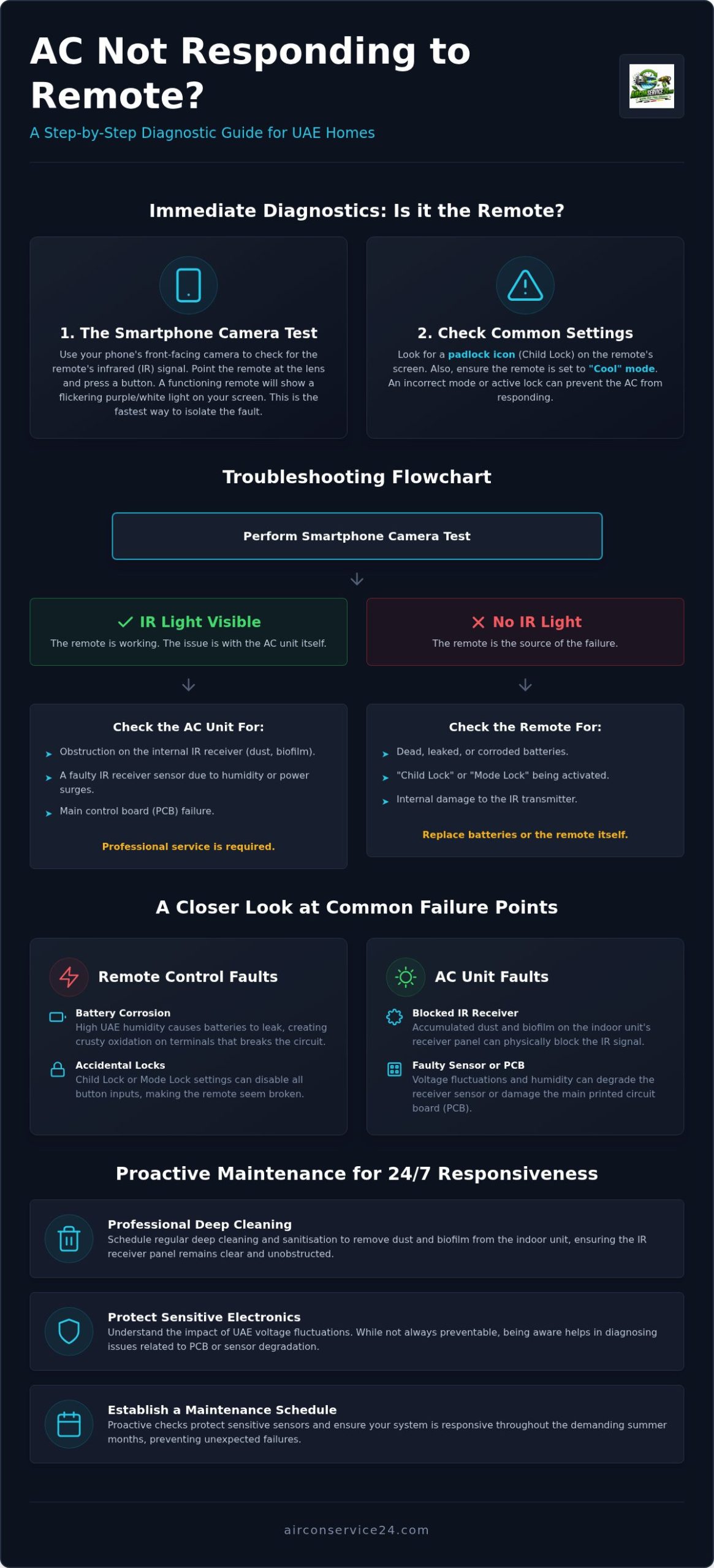
The Smartphone Camera IR Test
Most modern remotes use infrared light to communicate with the indoor unit. Since this light is invisible to the human eye, you can use a digital sensor to visualize the transmission. Open the camera app on your smartphone; the front-facing camera usually works best in 2026 because it often lacks the heavy IR filters found on primary lenses. Point the remote directly at the lens and press the power button. If the remote is functioning, you’ll see a flickering purple or white light on your phone screen. This simple diagnostic reveals the fundamental physics of how remote controls work by converting light pulses into data. If no light appears on your screen, the remote itself is the source of the failure.
Common Remote Setting Errors
Sometimes the hardware is perfect, but the logic is locked. Look closely at your remote’s LCD screen for a small padlock icon. This indicates the “Child Lock” is active, which prevents any button from triggering a response. You can usually deactivate this by holding the “+” and “-” temperature buttons simultaneously for three seconds. Additionally, verify that the remote is set to “Cool” mode. In some instances, a “Mode Lock” may prevent the unit from responding to cooling commands if it was previously restricted by a facility manager.
If the screen is blank or the digits are fading, inspect the battery compartment immediately. In the UAE’s high humidity, batteries frequently leak or develop white, crusty oxidation on the terminals. This corrosion breaks the electrical circuit and prevents the remote from powering its transmitter. Clean the contacts with a dry cotton swab and insert fresh alkaline batteries. If the unit still ignores your commands, perform a hard reset. Remove the batteries from the remote and unplug the AC unit from its power source for 60 seconds. This clears the temporary memory and often resolves communication glitches. For issues involving the internal AC equipment or the receiver panel, professional technical support is the next logical step.
Technical Failures: When the AC Unit Stops Listening
If your remote passes the camera test described in the previous section, the diagnostic focus must shift to the internal electronics of the indoor unit. When you face an ac not responding to remote control, the failure often stems from the ‘eye’ of the system: the infrared receiver sensor. This small component is responsible for capturing and decoding the binary light pulses used in infrared remote technology. In the UAE’s demanding climate, these sensors are frequently exposed to high humidity and electrical noise, which can cause the delicate semiconductor material to degrade or short-circuit entirely.
To confirm a sensor failure, locate the ‘Emergency Run’ or ‘Manual’ button, usually hidden behind the front panel of your indoor unit. If the system starts and cools normally when this button is pressed, you’ve successfully isolated the fault to the receiver module or the communication path to the main board. This is a critical distinction; it proves the compressor and fan are functional, meaning you’re likely looking at a component repair rather than a total system replacement. If the system remains dead even after a manual override, the issue is significantly deeper.
Faulty IR Receiver Sensors
The receiver sensor is the primary gateway for all user commands. In 2026, many high-efficiency inverter models utilize sophisticated sensors that are sensitive to voltage fluctuations. A sudden surge in the local power grid can easily overwhelm the sensor’s protection circuit, rendering it blind to your remote’s signals. Because these modules are integrated into the internal wiring of the AC equipment, they require professional handling to avoid damaging the surrounding plastic housing or the main logic board. Attempting a DIY repair on these sensitive components often leads to accidental shorts that can escalate repair costs.
PCB and Control Board Degradation
The Printed Circuit Board (PCB) acts as the central nervous system of your air conditioner. In the UAE, heat stress is a primary driver of electronic failure. During peak summer months, internal temperatures within the unit’s casing can lead to thermal fatigue in solder joints. Over time, these joints may crack, creating intermittent connections that make the unit appear ‘frozen’ or unresponsive to any input. If your system ignores both the remote and the manual override button, the PCB has likely suffered a logic failure or a blown capacitor. If you suspect your electronics have been compromised by the heat, a professional diagnostic check can determine if the board can be repaired or if a full replacement is the most cost-effective path forward.
The Hygiene Connection: Dust, Biofilm, and Signal Interference
While most troubleshooting begins with batteries or circuit boards, the root cause of your ac not responding to remote control is frequently a matter of basic hygiene. In the UAE’s unique environment, fine desert dust and airborne particulate matter don’t just settle on your furniture; they infiltrate the microscopic gaps in your air conditioner’s housing. Over time, these particles form a dense, opaque layer over the infrared receiver window. Because infrared signals are essentially pulses of light, any physical obstruction acts as a filter that weakens or completely blocks the command before it reaches the internal sensor.
The relationship between indoor air quality and electronic performance is direct and measurable. When a system operates in a high-dust environment without regular maintenance, the receiver panel becomes coated in a sticky biofilm. This residue, a byproduct of high humidity mixing with organic dust, creates a “ghosting” effect where the signal reflects off the grime instead of penetrating the sensor. To ensure your system remains responsive, you can learn about our deep cleaning and sanitisation services which are designed to clear these critical signal pathways and protect sensitive electronics from environmental degradation.
Obstructed Receiver Windows
The display panel on your indoor unit serves as the gateway for every remote command. If you notice a visible film or a dull appearance on the plastic “eye” of the AC, your signal is likely being strangled by surface grime. Professional sanitisation goes beyond a simple wipe-down; it involves removing the accumulated bio-growth that thrives in the cool, damp areas near the receiver. By restoring the clarity of the receiver window, you allow the IR sensor to detect low-strength signals from across the room, effectively eliminating the need to stand directly under the unit to change the temperature.
Environmental Interference
External factors can also drown out your remote’s signal, creating the illusion of a hardware failure. In 2026, the prevalence of high-output LED lighting and the intense UAE sunlight can introduce significant “optical noise” into a room. Infrared light from the sun is powerful enough to saturate the AC’s receiver, making it unable to distinguish the remote’s specific binary code from the background light. If your unit works perfectly at night but fails during the day, consider the following strategies:
- Close heavy curtains or blinds during peak sunlight hours to reduce IR saturation.
- Check if new electronic appliances or smart home hubs are positioned directly opposite the AC receiver.
- Ensure the remote’s transmitter lens is free of fingerprints or oils that scatter the light beam.
Maintaining a sterile, dust-free environment is the most effective way to prevent these communication breakdowns. When signal interference persists despite a clean exterior, it typically indicates that dust has bypassed the outer casing and settled directly on the internal PCB components, necessitating a professional technical intervention.
Professional Resolution: Universal vs. OEM Replacement
When your ac not responding to remote control persists after cleaning and battery checks, the final stage of troubleshooting involves selecting a replacement device. This decision isn’t merely about finding a button that turns the power on; it’s about maintaining the sophisticated logic of your cooling system. In 2026, air conditioning units have evolved into complex climate control systems that require precise communication between the handheld transmitter and the internal PCB. Choosing between a universal remote and an Original Equipment Manufacturer (OEM) model can determine whether your unit operates at peak efficiency or becomes a source of daily frustration. A mismatched device might even cause logic errors within the main board over time.
Universal Remote Limitations
Universal remotes are often marketed as a catch-all solution, but they frequently fall short when paired with high-performance inverter models. While they can typically manage basic temperature adjustments, they often lack support for specialized features such as ‘I-Feel’ sensors, ‘Eco-Navi’ energy-saving modes, or advanced vertical and horizontal swing controls. This ‘partial pairing’ means you might restore basic cooling but lose the very features you paid for when purchasing a premium unit. A universal remote serves as a valid emergency stop-gap, but it’s rarely a permanent solution for maintaining Expert AC maintenance for UAE homeowners. Relying on an incompatible device can lead to erratic system behavior, which complicates future diagnostics.
Sourcing Genuine Replacement Parts
OEM remotes are engineered specifically for the frequency and binary code of your unit’s receiver module. They offer superior durability in the high-use environments of the UAE, where remotes are handled multiple times a day throughout the long summer. To ensure you source the correct part, look for the specific model number usually printed inside the battery compartment or on the rear casing. Professional technicians play a vital role here; they don’t just guess which remote might work. They use diagnostic tools to verify the frequency match before finalizing the replacement, ensuring that the new device communicates perfectly with the internal electronics. This precision is essential when your ac not responding to remote control because of a specific signal mismatch rather than a hardware failure. If you’re struggling to find the exact match for your system, our team provides 24/7 support for expert AC repair and parts sourcing.
Preventive Care: Ensuring 24/7 Responsiveness
Restoring a system after it fails is a necessity, but preventing the failure entirely is the hallmark of sophisticated home management. In intense summer conditions, your air conditioner operates under extreme thermal loads that can accelerate the degradation of sensitive electronics. When you encounter your ac not responding to remote control, it’s often the final symptom of a long-term accumulation of dust or electrical stress. Shifting your strategy from reactive repairs to proactive preventive care ensures that your indoor environment remains a sanctuary of health and comfort throughout 2026.
A disciplined maintenance schedule acts as a protective shield for your system’s “nervous system.” By addressing minor electronic drifts and environmental obstructions before they manifest as total unresponsiveness, you extend the operational lifespan of your equipment. This methodical approach doesn’t just save you from the immediate frustration of a broken remote; it protects the high-value internal components like the main logic board from premature burnout. If you find yourself in a situation where the system has already stopped responding during extreme temperatures, Emergency AC repair for cooling relief is available to restore your home’s climate immediately.
The Maintenance Advantage
Professional maintenance visits in 2026 involve much more than just washing filters. Our technicians perform a comprehensive audit of the communication pathways between your remote and the indoor unit. This includes a precise cleaning of the IR receiver window to ensure 100% signal transparency and a detailed inspection of the wiring harnesses. Loose or oxidized connections are a common cause of intermittent signal loss and can lead to dangerous PCB surges if left unaddressed. By tightening these electrical points and verifying the sensor’s calibration, we eliminate the primary triggers that lead to an unresponsive system.
Ready-to-Act Support
DIY troubleshooting has its limits. While changing batteries is a logical first step, digging into the internal receiver modules or attempting to bypass safety switches can lead to irreversible damage. We position ourselves as the elite guardians of your domestic harmony, offering a “ready-to-act” energy that mirrors the urgency of your situation. Our commitment to transparency means you’ll always receive a clear explanation of whether a component needs a simple cleaning, a technical repair, or a full OEM replacement. We value modern, environmentally responsible methods that prioritize system longevity and indoor air quality above all else.
Don’t let a minor communication glitch escalate into a total cooling failure. Whether you need a deep sanitisation of your AC equipment or a technical diagnostic of your control board, our specialists are available around the clock to provide precision solutions. Contact our experts for immediate AC repair and ensure your home remains perfectly cooled regardless of the external temperatures.
Restoring Precision Control to Your Indoor Climate
Facing an ac not responding to remote control during the peak of a UAE summer requires a methodical response rather than guesswork. We’ve established that while a simple battery change is the first step, the root cause often involves signal-blocking biofilm or heat-induced electronic degradation. By utilizing the smartphone camera test and prioritizing professional sanitisation, you can effectively distinguish between a minor hardware glitch and a more serious logic board failure that requires technical intervention.
Our elite technicians are trained in all major HVAC brands and specialize in the deep cleaning and sanitisation required to protect sensitive IR sensors from environmental interference. We understand the high stakes of a failed cooling system, which is why we provide 24/7 emergency AC response across the nation. Don’t let a communication breakdown compromise your comfort or well-being in 2026. Precision diagnostics and proactive maintenance are the most reliable ways to ensure your system remains responsive to every command.
Restore your cooling now with AirConService24.com expert repairs
Take command of your home environment today and ensure your cooling system remains as responsive and efficient as it was on day one. Your comfort is our priority, and we’re ready to act whenever you need us.
Frequently Asked Questions
Can I use my smartphone as an AC remote if the original is lost?
You can use your smartphone as a replacement if your device features an integrated infrared (IR) blaster or if your air conditioner is a smart model with Wi-Fi connectivity. Most flagship phones in 2026 rely on Wi-Fi apps rather than IR. While convenient, these apps often lack the granular control of an OEM device. If you’re struggling with an ac not responding to remote control, professional repair of the internal receiver is often more reliable than app-based workarounds.
Why does my AC remote screen show numbers but the unit doesn’t beep?
This symptom indicates that the remote’s logic board and LCD are powered, but the infrared signal isn’t reaching the indoor unit. The fault typically lies in a failed IR transmitter LED or a malfunctioning receiver sensor inside the AC. In the UAE’s humid climate, internal corrosion often prevents the unit from “hearing” the remote. Our technicians specialize in diagnosing these silent failures to determine if a component repair or a deep cleaning is required to restore communication.
How do I know if my AC sensor is broken or just dirty?
A dirty sensor often results in intermittent responsiveness or requires you to stand directly under the unit to trigger a response. If the system fails to respond entirely from any angle after you’ve wiped the receiver window, the internal sensor has likely shorted due to voltage fluctuations. We recommend professional sanitisation first; if the biofilm is removed and the unit remains silent, a technical replacement of the internal IR module is the next logical step for restoration.
Is it worth repairing an old AC remote or should I buy a new one?
Repairing a handheld remote is rarely cost-effective compared to sourcing a genuine OEM replacement in 2026. The delicate plastic housings and microscopic solder joints make manual repairs labor-intensive and prone to future failure. However, if the issue is actually within the AC unit’s receiver board, buying a new remote won’t solve the problem. We provide precision diagnostics to ensure you don’t waste money on a new remote when the actual fault lies within the internal electronics.
Will a universal remote work with all AC brands in the UAE?
Universal remotes work with approximately 90% of standard split systems in the UAE, but they often fail to support advanced inverter features. You might lose access to specialized energy-saving modes or precise vertical swing controls. For high-performance systems, we always recommend OEM parts to ensure full compatibility. If your ac not responding to remote control is due to a frequency mismatch, a universal device might only provide a partial, frustrating solution that limits your system’s efficiency.
Does the heat in the UAE affect how long AC remote batteries last?
The extreme UAE heat and high humidity significantly impact battery longevity and safety. High ambient temperatures increase the rate of internal chemical discharge, while humidity promotes terminal corrosion and electrolyte leakage. This leakage can permanently damage the remote’s internal circuitry. We advise residents to use high-quality alkaline batteries and inspect the compartment every three months to prevent acidic damage from compromising your remote’s transmitter during the peak summer months when cooling is most critical.
What should I do if the emergency button on the AC works but the remote doesn’t?
If the manual emergency button triggers the cooling cycle, your compressor and main PCB are likely functional. This narrows the fault down to either the handheld remote or the infrared receiver module. Since the unit can still operate, the high-voltage components are safe, but you’ve lost the ability to modulate temperature or fan speeds. You should contact a specialist to test the receiver’s voltage and signal reception to restore full wireless control and avoid rising indoor temperatures.
Can bright sunlight prevent my AC remote from working?
Intense UAE sunlight contains high levels of infrared radiation that can saturate the AC unit’s receiver. This “optical noise” prevents the sensor from distinguishing the remote’s specific binary code from the background light. If your unit only fails during daylight hours, try closing the curtains or repositioning the unit’s receiver window. If the problem persists even in the shade, it indicates a weakened sensor that requires professional inspection to ensure 24/7 responsiveness throughout the cooling season.